mirror of
https://github.com/gosticks/DefinitelyTyped.git
synced 2025-10-16 12:05:41 +00:00

10812 lines
512 KiB
TypeScript
10812 lines
512 KiB
TypeScript
// Type definitions for Samchon Framework 2.0
|
||
// Project: https://github.com/samchon/framework
|
||
// Definitions by: Jeongho Nam <http://samchon.org>
|
||
// Definitions: https://github.com/DefinitelyTyped/DefinitelyTyped
|
||
|
||
/// <reference types="typescript-stl" />
|
||
|
||
declare module "samchon-framework"
|
||
{
|
||
export = samchon;
|
||
}
|
||
|
||
/**
|
||
* # Samchon-Framework
|
||
*
|
||
* <a href="https://nodei.co/npm/samchon-framework">
|
||
* <img src="https://nodei.co/npm/samchon-framework.png?downloads=true&downloadRank=true&stars=true"> </a>
|
||
*
|
||
* Samchon, a OON (Object-Oriented Network) framework.
|
||
*
|
||
* With Samchon Framework, you can implement distributed processing system within framework of OOD like handling S/W
|
||
* objects (classes). You can realize cloud and distributed system very easily with provided system templates and even
|
||
* integration with C++ is possible.
|
||
*
|
||
* The goal, ultimate utilization model of Samchon Framework is, building cloud system with NodeJS and taking heavy works
|
||
* to C++ distributed systems with provided modules (those are system templates).
|
||
*
|
||
* @git https://github.com/samchon/framework
|
||
* @author Jeongho Nam <http://samchon.org>
|
||
*/
|
||
declare namespace samchon {
|
||
/**
|
||
* Running on Node.
|
||
*
|
||
* Test whether the JavaScript is running on Node.
|
||
*
|
||
* @references http://stackoverflow.com/questions/17575790/environment-detection-node-js-or-browser
|
||
*/
|
||
function is_node(): boolean;
|
||
}
|
||
declare namespace samchon.collections {
|
||
/**
|
||
* A {@link Vector} who can detect element I/O events.
|
||
*
|
||
* Below is the list of methods who are dispatching {@link CollectionEvent}:
|
||
* - *insert* typed events:
|
||
* - {@link assign}
|
||
* - {@link insert}
|
||
* - {@link push}
|
||
* - {@link push_back}
|
||
* - {@link unshift}
|
||
* - *erase* typed events:
|
||
* - {@link assign}
|
||
* - {@link clear}
|
||
* - {@link erase}
|
||
* - {@link pop_back}
|
||
* - {@link shift}
|
||
* - {@link pop}
|
||
* - {@link splice}
|
||
* - *refresh* typed events:
|
||
* - {@link refresh}
|
||
*
|
||
* #### [Inherited] {@link Vector}
|
||
* {@link Vector Vectors}s are sequence containers representing arrays that can change in size.
|
||
*
|
||
* Just like arrays, {@link Vector}s use contiguous storage locations for their elements, which means that their
|
||
* elements can also be accessed using offsets on regular pointers to its elements, and just as efficiently as in
|
||
* arrays. But unlike arrays, their size can change dynamically, with their storage being handled automatically
|
||
* by the container.
|
||
*
|
||
* Internally, {@link Vector}s use a dynamically allocated array to store their elements. This array may need to
|
||
* be reallocated in order to grow in size when new elements are inserted, which implies allocating a new array
|
||
* and moving all elements to it. This is a relatively expensive task in terms of processing time, and thus,
|
||
* {@link Vector}s do not reallocate each time an element is added to the container.
|
||
*
|
||
* Instead, {@link Vector} containers may allocate some extra storage to accommodate for possible growth, and
|
||
* thus the container may have an actual {@link capacity} greater than the storage strictly needed to contain its
|
||
* elements (i.e., its {@link size}). Libraries can implement different strategies for growth to balance between
|
||
* memory usage and reallocations, but in any case, reallocations should only happen at logarithmically growing
|
||
* intervals of {@link size} so that the insertion of individual elements at the end of the {@link Vector} can be
|
||
* provided with amortized constant time complexity (see {@link push_back push_back()}).
|
||
*
|
||
* Therefore, compared to arrays, {@link Vector}s consume more memory in exchange for the ability to manage
|
||
* storage and grow dynamically in an efficient way.
|
||
*
|
||
* Compared to the other dynamic sequence containers ({@link Deque}s, {@link List}s), {@link Vector Vectors} are
|
||
* very efficient accessing its elements (just like arrays) and relatively efficient adding or removing elements
|
||
* from its end. For operations that involve inserting or removing elements at positions other than the end, they
|
||
* perform worse than the others, and have less consistent iterators and references than {@link List}s.
|
||
*
|
||
* <a href="http://samchon.github.io/typescript-stl/images/design/class_diagram/linear_containers.png" target="_blank">
|
||
* <img src="http://samchon.github.io/typescript-stl/images/design/class_diagram/linear_containers.png" style="max-width: 100%" />
|
||
* </a>
|
||
*
|
||
* <h3> Container properties </h3>
|
||
* <dl>
|
||
* <dt> Sequence </dt>
|
||
* <dd>
|
||
* Elements in sequence containers are ordered in a strict linear sequence. Individual elements are
|
||
* accessed by their position in this sequence.
|
||
* </dd>
|
||
*
|
||
* <dt> Dynamic array </dt>
|
||
* <dd>
|
||
* Allows direct access to any element in the sequence, even through pointer arithmetics, and provides
|
||
* relatively fast addition/removal of elements at the end of the sequence.
|
||
* </dd>
|
||
* </dl>
|
||
*
|
||
* @param <T> Type of the elements.
|
||
*
|
||
* @reference http://www.cplusplus.com/reference/vector/vector
|
||
* @handbook [Collections](https://github.com/samchon/framework/wiki/TypeScript-STL#collections)
|
||
* @author Jeongho Nam <http://samchon.org>
|
||
*/
|
||
class ArrayCollection<T> extends std.Vector<T> implements ICollection<T> {
|
||
/**
|
||
* A chain object taking responsibility of dispatching events.
|
||
*/
|
||
private event_dispatcher_;
|
||
/**
|
||
* @inheritdoc
|
||
*/
|
||
push(...items: T[]): number;
|
||
/**
|
||
* @inheritdoc
|
||
*/
|
||
push_back(val: T): void;
|
||
/**
|
||
* @hidden
|
||
*/
|
||
protected _Insert_by_repeating_val(position: std.VectorIterator<T>, n: number, val: T): std.VectorIterator<T>;
|
||
/**
|
||
* @hidden
|
||
*/
|
||
protected _Insert_by_range<U extends T, InputIterator extends std.Iterator<U>>(position: std.VectorIterator<T>, begin: InputIterator, end: InputIterator): std.VectorIterator<T>;
|
||
/**
|
||
* @hidden
|
||
*/
|
||
protected _Erase_by_range(first: std.VectorIterator<T>, last: std.VectorIterator<T>): std.VectorIterator<T>;
|
||
/**
|
||
* @hidden
|
||
*/
|
||
private notify_insert(first, last);
|
||
/**
|
||
* @hidden
|
||
*/
|
||
private notify_erase(first, last);
|
||
/**
|
||
* @inheritdoc
|
||
*/
|
||
hasEventListener(type: string): boolean;
|
||
/**
|
||
* @inheritdoc
|
||
*/
|
||
dispatchEvent(event: library.BasicEvent): boolean;
|
||
/**
|
||
* @inheritdoc
|
||
*/
|
||
refresh(): void;
|
||
/**
|
||
* @inheritdoc
|
||
*/
|
||
refresh(it: std.VectorIterator<T>): void;
|
||
/**
|
||
* @inheritdoc
|
||
*/
|
||
refresh(first: std.VectorIterator<T>, last: std.VectorIterator<T>): void;
|
||
/**
|
||
* @inheritdoc
|
||
*/
|
||
addEventListener(type: string, listener: library.BasicEventListener): void;
|
||
addEventListener(type: "insert", listener: CollectionEventListener<T>): void;
|
||
addEventListener(type: "erase", listener: CollectionEventListener<T>): void;
|
||
addEventListener(type: "refresh", listener: CollectionEventListener<T>): void;
|
||
/**
|
||
* @inheritdoc
|
||
*/
|
||
addEventListener(type: string, listener: library.BasicEventListener, thisArg: Object): void;
|
||
addEventListener(type: "insert", listener: CollectionEventListener<T>, thisArg: Object): void;
|
||
addEventListener(type: "erase", listener: CollectionEventListener<T>, thisArg: Object): void;
|
||
addEventListener(type: "refresh", listener: CollectionEventListener<T>, thisArg: Object): void;
|
||
/**
|
||
* @inheritdoc
|
||
*/
|
||
removeEventListener(type: string, listener: library.BasicEventListener): void;
|
||
removeEventListener(type: "insert", listener: CollectionEventListener<T>): void;
|
||
removeEventListener(type: "erase", listener: CollectionEventListener<T>): void;
|
||
removeEventListener(type: "refresh", listener: CollectionEventListener<T>): void;
|
||
/**
|
||
* @inheritdoc
|
||
*/
|
||
removeEventListener(type: string, listener: library.BasicEventListener, thisArg: Object): void;
|
||
removeEventListener(type: "insert", listener: CollectionEventListener<T>, thisArg: Object): void;
|
||
removeEventListener(type: "erase", listener: CollectionEventListener<T>, thisArg: Object): void;
|
||
removeEventListener(type: "refresh", listener: CollectionEventListener<T>, thisArg: Object): void;
|
||
/**
|
||
* @inheritdoc
|
||
*/
|
||
unshift<U extends T>(...items: U[]): number;
|
||
/**
|
||
* @inheritdoc
|
||
*/
|
||
pop(): T;
|
||
/**
|
||
* @inheritdoc
|
||
*/
|
||
splice(start: number): T[];
|
||
/**
|
||
* @inheritdoc
|
||
*/
|
||
splice(start: number, deleteCount: number, ...items: T[]): T[];
|
||
}
|
||
}
|
||
declare namespace samchon.library {
|
||
/**
|
||
* A basic event class of Samchon Framework.
|
||
*
|
||
* @reference https://developer.mozilla.org/en-US/docs/Web/API/Event
|
||
* @handbook https://github.com/samchon/framework/wiki/TypeScript-Library-EventDispatcher
|
||
* @author Jeongho Nam <http://samchon.org>
|
||
*/
|
||
class BasicEvent {
|
||
protected type_: string;
|
||
protected target_: IEventDispatcher;
|
||
private currentTarget_;
|
||
protected trusted_: boolean;
|
||
protected bubbles_: boolean;
|
||
protected cancelable_: boolean;
|
||
protected defaultPrevented_: boolean;
|
||
protected cancelBubble_: boolean;
|
||
private timeStamp_;
|
||
constructor(type: string, bubbles?: boolean, cancelable?: boolean);
|
||
/**
|
||
* @inheritdoc
|
||
*/
|
||
initEvent(type: string, bubbles: boolean, cancelable: boolean): void;
|
||
/**
|
||
* @inheritdoc
|
||
*/
|
||
/**
|
||
* @inheritdoc
|
||
*/
|
||
stopImmediatePropagation(): void;
|
||
/**
|
||
* @inheritdoc
|
||
*/
|
||
stopPropagation(): void;
|
||
/**
|
||
* @inheritdoc
|
||
*/
|
||
readonly type: string;
|
||
/**
|
||
* @inheritdoc
|
||
*/
|
||
target: IEventDispatcher;
|
||
/**
|
||
* @inheritdoc
|
||
*/
|
||
readonly currentTarget: IEventDispatcher;
|
||
/**
|
||
* @inheritdoc
|
||
*/
|
||
readonly isTrusted: boolean;
|
||
/**
|
||
* @inheritdoc
|
||
*/
|
||
readonly bubbles: boolean;
|
||
/**
|
||
* @inheritdoc
|
||
*/
|
||
readonly cancelable: boolean;
|
||
/**
|
||
* @inheritdoc
|
||
*/
|
||
readonly eventPhase: number;
|
||
/**
|
||
* @inheritdoc
|
||
*/
|
||
readonly defaultPrevented: boolean;
|
||
/**
|
||
* @inheritdoc
|
||
*/
|
||
readonly srcElement: Element;
|
||
/**
|
||
* @inheritdoc
|
||
*/
|
||
readonly cancelBubble: boolean;
|
||
/**
|
||
* @inheritdoc
|
||
*/
|
||
readonly timeStamp: number;
|
||
/**
|
||
* Don't know what it is.
|
||
*/
|
||
readonly returnValue: boolean;
|
||
}
|
||
}
|
||
declare namespace samchon.collections {
|
||
/**
|
||
* Type of function pointer for listener of {@link CollectionEvent CollectionEvents}.
|
||
*/
|
||
type CollectionEventListener<T> = (event: CollectionEvent<T>) => void;
|
||
}
|
||
declare namespace samchon.collections {
|
||
/**
|
||
* An event occured in a {@link ICollection collection} object.
|
||
*
|
||
* @handbook [Collections](https://github.com/samchon/framework/wiki/TypeScript-STL#collections)
|
||
* @author Jeongho Nam <http://samchon.org>
|
||
*/
|
||
class CollectionEvent<T> extends library.BasicEvent {
|
||
/**
|
||
* @hidden
|
||
*/
|
||
private first_;
|
||
/**
|
||
* @hidden
|
||
*/
|
||
private last_;
|
||
/**
|
||
* @hidden
|
||
*/
|
||
private temporary_container_;
|
||
/**
|
||
* @hidden
|
||
*/
|
||
private origin_first_;
|
||
/**
|
||
* Initialization Constructor.
|
||
*
|
||
* @param type Type of collection event.
|
||
* @param first An {@link Iterator} to the initial position in this {@link CollectionEvent}.
|
||
* @param last An {@link Iterator} to the final position in this {@link CollectionEvent}.
|
||
*/
|
||
constructor(type: string, first: std.Iterator<T>, last: std.Iterator<T>);
|
||
constructor(type: "insert", first: std.Iterator<T>, last: std.Iterator<T>);
|
||
constructor(type: "erase", first: std.Iterator<T>, last: std.Iterator<T>);
|
||
constructor(type: "refresh", first: std.Iterator<T>, last: std.Iterator<T>);
|
||
/**
|
||
* Associative target, the {@link ICollection collection}.
|
||
*/
|
||
readonly target: ICollection<T>;
|
||
/**
|
||
* An {@link Iterator} to the initial position in this {@link CollectionEvent}.
|
||
*/
|
||
readonly first: std.Iterator<T>;
|
||
/**
|
||
* An {@link Iterator} to the final position in this {@link CollectionEvent}.
|
||
*/
|
||
readonly last: std.Iterator<T>;
|
||
/**
|
||
* @inheritdoc
|
||
*/
|
||
preventDefault(): void;
|
||
}
|
||
}
|
||
declare namespace samchon.collections.CollectionEvent {
|
||
const INSERT: "insert";
|
||
const ERASE: "erase";
|
||
const REFRESH: "refresh";
|
||
}
|
||
declare namespace samchon.collections {
|
||
/**
|
||
* A {@link Deque} who can detect element I/O events.
|
||
*
|
||
* Below is the list of methods who are dispatching {@link CollectionEvent}:
|
||
* - *insert* typed events:
|
||
* - {@link assign}
|
||
* - {@link insert}
|
||
* - {@link push}
|
||
* - {@link push_front}
|
||
* - {@link push_back}
|
||
* - *erase* typed events:
|
||
* - {@link assign}
|
||
* - {@link clear}
|
||
* - {@link erase}
|
||
* - {@link pop_front}
|
||
* - {@link pop_back}
|
||
* - *refresh* typed events:
|
||
* - {@link refresh}
|
||
*
|
||
* #### [Inherited] {@link Deque}
|
||
* {@link Deque} (usually pronounced like "*deck*") is an irregular acronym of **d**ouble-**e**nded **q**ueue.
|
||
* Double-ended queues are sequence containers with dynamic sizes that can be expanded or contracted on both ends
|
||
* (either its front or its back).
|
||
*
|
||
* Specific libraries may implement deques in different ways, generally as some form of dynamic array. But in any
|
||
* case, they allow for the individual elements to be accessed directly through random access iterators, with
|
||
* storage handled automatically by expanding and contracting the container as needed.
|
||
*
|
||
* Therefore, they provide a functionality similar to vectors, but with efficient insertion and deletion of
|
||
* elements also at the beginning of the sequence, and not only at its end. But, unlike {@link Vector Vectors},
|
||
* {@link Deque Deques} are not guaranteed to store all its elements in contiguous storage locations: accessing
|
||
* elements in a <u>deque</u> by offsetting a pointer to another element causes undefined behavior.
|
||
*
|
||
* Both {@link Vector}s and {@link Deque}s provide a very similar interface and can be used for similar purposes,
|
||
* but internally both work in quite different ways: While {@link Vector}s use a single array that needs to be
|
||
* occasionally reallocated for growth, the elements of a {@link Deque} can be scattered in different chunks of
|
||
* storage, with the container keeping the necessary information internally to provide direct access to any of its
|
||
* elements in constant time and with a uniform sequential interface (through iterators). Therefore,
|
||
* {@link Deque Deques} are a little more complex internally than {@link Vector}s, but this allows them to grow
|
||
* more efficiently under certain circumstances, especially with very long sequences, where reallocations become
|
||
* more expensive.
|
||
*
|
||
* For operations that involve frequent insertion or removals of elements at positions other than the beginning or
|
||
* the end, {@link Deque Deques} perform worse and have less consistent iterators and references than
|
||
* {@link List Lists}.
|
||
*
|
||
* <a href="http://samchon.github.io/typescript-stl/images/design/class_diagram/linear_containers.png" target="_blank">
|
||
* <img src="http://samchon.github.io/typescript-stl/images/design/class_diagram/linear_containers.png" style="max-width: 100%" />
|
||
* </a>
|
||
*
|
||
* <h3> Container properties </h3>
|
||
* <dl>
|
||
* <dt> Sequence </dt>
|
||
* <dd> Elements in sequence containers are ordered in a strict linear sequence. Individual elements
|
||
* are accessed by their position in this sequence. </dd>
|
||
*
|
||
* <dt> Dynamic array </dt>
|
||
* <dd> Generally implemented as a dynamic array, it allows direct access to any element in the
|
||
* sequence and provides relatively fast addition/removal of elements at the beginning or the end
|
||
* of the sequence. </dd>
|
||
* </dl>
|
||
*
|
||
* @param <T> Type of the elements.
|
||
*
|
||
* @reference http://www.cplusplus.com/reference/deque/deque/
|
||
* @handbook [Collections](https://github.com/samchon/framework/wiki/TypeScript-STL#collections)
|
||
* @author Jeongho Nam <http://samchon.org>
|
||
*/
|
||
class DequeCollection<T> extends std.Deque<T> implements ICollection<T> {
|
||
/**
|
||
* A chain object taking responsibility of dispatching events.
|
||
*/
|
||
private event_dispatcher_;
|
||
/**
|
||
* @inheritdoc
|
||
*/
|
||
push(...items: T[]): number;
|
||
/**
|
||
* @inheritdoc
|
||
*/
|
||
push_back(val: T): void;
|
||
/**
|
||
* @hidden
|
||
*/
|
||
protected _Insert_by_repeating_val(position: std.DequeIterator<T>, n: number, val: T): std.DequeIterator<T>;
|
||
/**
|
||
* @hidden
|
||
*/
|
||
protected _Insert_by_range<U extends T, InputIterator extends std.Iterator<U>>(position: std.DequeIterator<T>, begin: InputIterator, end: InputIterator): std.DequeIterator<T>;
|
||
/**
|
||
* @inheritdoc
|
||
*/
|
||
pop_back(): void;
|
||
/**
|
||
* @hidden
|
||
*/
|
||
protected _Erase_by_range(first: std.DequeIterator<T>, last: std.DequeIterator<T>): std.DequeIterator<T>;
|
||
/**
|
||
* @hidden
|
||
*/
|
||
private notify_insert(first, last);
|
||
/**
|
||
* @hidden
|
||
*/
|
||
private notify_erase(first, last);
|
||
/**
|
||
* @inheritdoc
|
||
*/
|
||
hasEventListener(type: string): boolean;
|
||
/**
|
||
* @inheritdoc
|
||
*/
|
||
dispatchEvent(event: library.BasicEvent): boolean;
|
||
/**
|
||
* @inheritdoc
|
||
*/
|
||
refresh(): void;
|
||
/**
|
||
* @inheritdoc
|
||
*/
|
||
refresh(it: std.DequeIterator<T>): void;
|
||
/**
|
||
* @inheritdoc
|
||
*/
|
||
refresh(first: std.DequeIterator<T>, last: std.DequeIterator<T>): void;
|
||
/**
|
||
* @inheritdoc
|
||
*/
|
||
addEventListener(type: string, listener: library.BasicEventListener): void;
|
||
addEventListener(type: "insert", listener: CollectionEventListener<T>): void;
|
||
addEventListener(type: "erase", listener: CollectionEventListener<T>): void;
|
||
addEventListener(type: "refresh", listener: CollectionEventListener<T>): void;
|
||
/**
|
||
* @inheritdoc
|
||
*/
|
||
addEventListener(type: string, listener: library.BasicEventListener, thisArg: Object): void;
|
||
addEventListener(type: "insert", listener: CollectionEventListener<T>, thisArg: Object): void;
|
||
addEventListener(type: "erase", listener: CollectionEventListener<T>, thisArg: Object): void;
|
||
addEventListener(type: "refresh", listener: CollectionEventListener<T>, thisArg: Object): void;
|
||
/**
|
||
* @inheritdoc
|
||
*/
|
||
removeEventListener(type: string, listener: library.BasicEventListener): void;
|
||
removeEventListener(type: "insert", listener: CollectionEventListener<T>): void;
|
||
removeEventListener(type: "erase", listener: CollectionEventListener<T>): void;
|
||
removeEventListener(type: "refresh", listener: CollectionEventListener<T>): void;
|
||
/**
|
||
* @inheritdoc
|
||
*/
|
||
removeEventListener(type: string, listener: library.BasicEventListener, thisArg: Object): void;
|
||
removeEventListener(type: "insert", listener: CollectionEventListener<T>, thisArg: Object): void;
|
||
removeEventListener(type: "erase", listener: CollectionEventListener<T>, thisArg: Object): void;
|
||
removeEventListener(type: "refresh", listener: CollectionEventListener<T>, thisArg: Object): void;
|
||
}
|
||
}
|
||
declare namespace samchon.collections {
|
||
/**
|
||
* A {@link HashMap} who can detect element I/O events.
|
||
*
|
||
* Below is the list of methods who are dispatching {@link MapCollectionEvent}:
|
||
* - *insert* typed events:
|
||
* - {@link assign}
|
||
* - {@link insert}
|
||
* - {@link insert_or_assign}
|
||
* - {@link emplace}
|
||
* - {@link set}
|
||
* - {@link push}
|
||
* - *erase* typed events:
|
||
* - {@link assign}
|
||
* - {@link clear}
|
||
* - {@link erase}
|
||
* - {@link extract}
|
||
* - *refresh* typed events:
|
||
* - {@link refresh}
|
||
*
|
||
* #### [Inherited] {@link HashMap}
|
||
* {@link HashMap HashMaps} are associative containers that store elements formed by the combination of a
|
||
* *key value* and a *mapped value*, and which allows for fast retrieval of individual elements based on their
|
||
* *keys*.
|
||
*
|
||
* In an {@link HashMap}, the *key value* is generally used to uniquely identify the element, while the
|
||
* *mapped value* is an object with the content associated to this *key*. Types of *key* and *mapped value* may
|
||
* differ.
|
||
*
|
||
* Internally, the elements in the {@link HashMap} are not sorted in any particular order with respect to either
|
||
* their *key* or *mapped values*, but organized into *buckets* depending on their hash values to allow for fast
|
||
* access to individual elements directly by their *key values* (with a constant average time complexity on
|
||
* average).
|
||
*
|
||
* {@link HashMap} containers are faster than {@link TreeMap} containers to access individual elements by their
|
||
* *key*, although they are generally less efficient for range iteration through a subset of their elements.
|
||
*
|
||
* <a href="http://samchon.github.io/typescript-stl/images/design/class_diagram/map_containers.png" target="_blank">
|
||
* <img src="http://samchon.github.io/typescript-stl/images/design/class_diagram/map_containers.png" style="max-width: 100%" />
|
||
* </a>
|
||
*
|
||
* <h3> Container properties </h3>
|
||
* <dl>
|
||
* <dt> Associative </dt>
|
||
* <dd> Elements in associative containers are referenced by their *key* and not by their absolute
|
||
* position in the container. </dd>
|
||
*
|
||
* <dt> Hashed </dt>
|
||
* <dd> Hashed containers organize their elements using hash tables that allow for fast access to elements
|
||
* by their *key*. </dd>
|
||
*
|
||
* <dt> Map </dt>
|
||
* <dd> Each element associates a *key* to a *mapped value*:
|
||
* *Keys* are meant to identify the elements whose main content is the *mapped value*. </dd>
|
||
*
|
||
* <dt> Unique keys </dt>
|
||
* <dd> No two elements in the container can have equivalent keys. </dd>
|
||
* </dl>
|
||
*
|
||
* @param <Key> Type of the key values.
|
||
* Each element in an {@link HashMap} is uniquely identified by its key value.
|
||
* @param <T> Type of the mapped value.
|
||
* Each element in an {@link HashMap} is used to store some data as its mapped value.
|
||
*
|
||
* @reference http://www.cplusplus.com/reference/unordered_map/unordered_map
|
||
* @handbook [Collections](https://github.com/samchon/framework/wiki/TypeScript-STL#collections)
|
||
* @author Jeongho Nam <http://samchon.org>
|
||
*/
|
||
class HashMapCollection<Key, T> extends std.HashMap<Key, T> implements ICollection<std.Pair<Key, T>> {
|
||
/**
|
||
* A chain object taking responsibility of dispatching events.
|
||
*/
|
||
private event_dispatcher_;
|
||
/**
|
||
* @inheritdoc
|
||
*/
|
||
protected _Handle_insert(first: std.MapIterator<Key, T>, last: std.MapIterator<Key, T>): void;
|
||
/**
|
||
* @inheritdoc
|
||
*/
|
||
protected _Handle_erase(first: std.MapIterator<Key, T>, last: std.MapIterator<Key, T>): void;
|
||
/**
|
||
* @inheritdoc
|
||
*/
|
||
hasEventListener(type: string): boolean;
|
||
/**
|
||
* @inheritdoc
|
||
*/
|
||
dispatchEvent(event: library.BasicEvent): boolean;
|
||
/**
|
||
* @inheritdoc
|
||
*/
|
||
refresh(): void;
|
||
/**
|
||
* @inheritdoc
|
||
*/
|
||
refresh(it: std.MapIterator<Key, T>): void;
|
||
/**
|
||
* @inheritdoc
|
||
*/
|
||
refresh(first: std.MapIterator<Key, T>, last: std.MapIterator<Key, T>): void;
|
||
/**
|
||
* @inheritdoc
|
||
*/
|
||
addEventListener(type: string, listener: library.BasicEventListener): void;
|
||
addEventListener(type: "insert", listener: MapCollectionEventListener<Key, T>): void;
|
||
addEventListener(type: "erase", listener: MapCollectionEventListener<Key, T>): void;
|
||
addEventListener(type: "refresh", listener: MapCollectionEventListener<Key, T>): void;
|
||
/**
|
||
* @inheritdoc
|
||
*/
|
||
addEventListener(type: string, listener: library.BasicEventListener, thisArg: Object): void;
|
||
addEventListener(type: "insert", listener: MapCollectionEventListener<Key, T>, thisArg: Object): void;
|
||
addEventListener(type: "erase", listener: MapCollectionEventListener<Key, T>, thisArg: Object): void;
|
||
addEventListener(type: "refresh", listener: MapCollectionEventListener<Key, T>, thisArg: Object): void;
|
||
/**
|
||
* @inheritdoc
|
||
*/
|
||
removeEventListener(type: string, listener: library.BasicEventListener): void;
|
||
removeEventListener(type: "insert", listener: MapCollectionEventListener<Key, T>): void;
|
||
removeEventListener(type: "erase", listener: MapCollectionEventListener<Key, T>): void;
|
||
removeEventListener(type: "refresh", listener: MapCollectionEventListener<Key, T>): void;
|
||
/**
|
||
* @inheritdoc
|
||
*/
|
||
removeEventListener(type: string, listener: library.BasicEventListener, thisArg: Object): void;
|
||
removeEventListener(type: "insert", listener: MapCollectionEventListener<Key, T>, thisArg: Object): void;
|
||
removeEventListener(type: "erase", listener: MapCollectionEventListener<Key, T>, thisArg: Object): void;
|
||
removeEventListener(type: "refresh", listener: MapCollectionEventListener<Key, T>, thisArg: Object): void;
|
||
}
|
||
}
|
||
declare namespace samchon.collections {
|
||
/**
|
||
* A {@link HashMultiMap} who can detect element I/O events.
|
||
*
|
||
* Below is the list of methods who are dispatching {@link MapCollectionEvent}:
|
||
* - *insert* typed events:
|
||
* - {@link assign}
|
||
* - {@link insert}
|
||
* - {@link emplace}
|
||
* - {@link push}
|
||
* - *erase* typed events:
|
||
* - {@link assign}
|
||
* - {@link clear}
|
||
* - {@link erase}
|
||
* - *refresh* typed events:
|
||
* - {@link refresh}
|
||
*
|
||
* #### [Inherited] {@link HashMultiMap}
|
||
* {@link HashMultiMap HashMultiMap}s are associative containers that store elements formed by the combination of
|
||
* a *key value* and a *mapped value*, much like {@link HashMultiMap} containers, but allowing different elements
|
||
* to have equivalent *keys*.
|
||
*
|
||
* In an {@link HashMultiMap}, the *key value* is generally used to uniquely identify the element, while the
|
||
* *mapped value* is an object with the content associated to this *key*. Types of *key* and *mapped value* may
|
||
* differ.
|
||
*
|
||
* Internally, the elements in the {@link HashMultiMap} are not sorted in any particular order with respect to
|
||
* either their *key* or *mapped values*, but organized into *buckets* depending on their hash values to allow for
|
||
* fast access to individual elements directly by their *key values* (with a constant average time complexity on
|
||
* average).
|
||
*
|
||
* Elements with equivalent *keys* are grouped together in the same bucket and in such a way that an iterator can
|
||
* iterate through all of them. Iterators in the container are doubly linked iterators.
|
||
*
|
||
* <a href="http://samchon.github.io/typescript-stl/images/design/class_diagram/map_containers.png" target="_blank">
|
||
* <img src="http://samchon.github.io/typescript-stl/images/design/class_diagram/map_containers.png" style="max-width: 100%" />
|
||
* </a>
|
||
*
|
||
* <h3> Container properties </h3>
|
||
* <dl>
|
||
* <dt> Associative </dt>
|
||
* <dd> Elements in associative containers are referenced by their *key* and not by their absolute
|
||
* position in the container. </dd>
|
||
*
|
||
* <dt> Hashed </dt>
|
||
* <dd> Hashed containers organize their elements using hash tables that allow for fast access to elements
|
||
* by their *key*. </dd>
|
||
*
|
||
* <dt> Map </dt>
|
||
* <dd> Each element associates a *key* to a *mapped value*:
|
||
* *Keys* are meant to identify the elements whose main content is the *mapped value*. </dd>
|
||
*
|
||
* <dt> Multiple equivalent keys </dt>
|
||
* <dd> The container can hold multiple elements with equivalent *keys*. </dd>
|
||
* </dl>
|
||
*
|
||
* @param <Key> Type of the key values.
|
||
* Each element in an {@link HashMultiMap} is identified by a key value.
|
||
* @param <T> Type of the mapped value.
|
||
* Each element in an {@link HashMultiMap} is used to store some data as its mapped value.
|
||
*
|
||
* @reference http://www.cplusplus.com/reference/unordered_map/unordered_multimap
|
||
* @handbook [Collections](https://github.com/samchon/framework/wiki/TypeScript-STL#collections)
|
||
* @author Jeongho Nam <http://samchon.org>
|
||
*/
|
||
class HashMultiMapCollection<Key, T> extends std.HashMap<Key, T> implements ICollection<std.Pair<Key, T>> {
|
||
/**
|
||
* A chain object taking responsibility of dispatching events.
|
||
*/
|
||
private event_dispatcher_;
|
||
/**
|
||
* @inheritdoc
|
||
*/
|
||
protected _Handle_insert(first: std.MapIterator<Key, T>, last: std.MapIterator<Key, T>): void;
|
||
/**
|
||
* @inheritdoc
|
||
*/
|
||
protected _Handle_erase(first: std.MapIterator<Key, T>, last: std.MapIterator<Key, T>): void;
|
||
/**
|
||
* @inheritdoc
|
||
*/
|
||
hasEventListener(type: string): boolean;
|
||
/**
|
||
* @inheritdoc
|
||
*/
|
||
dispatchEvent(event: library.BasicEvent): boolean;
|
||
/**
|
||
* @inheritdoc
|
||
*/
|
||
refresh(): void;
|
||
/**
|
||
* @inheritdoc
|
||
*/
|
||
refresh(it: std.MapIterator<Key, T>): void;
|
||
/**
|
||
* @inheritdoc
|
||
*/
|
||
refresh(first: std.MapIterator<Key, T>, last: std.MapIterator<Key, T>): void;
|
||
/**
|
||
* @inheritdoc
|
||
*/
|
||
addEventListener(type: string, listener: library.BasicEventListener): void;
|
||
addEventListener(type: "insert", listener: MapCollectionEventListener<Key, T>): void;
|
||
addEventListener(type: "erase", listener: MapCollectionEventListener<Key, T>): void;
|
||
addEventListener(type: "refresh", listener: MapCollectionEventListener<Key, T>): void;
|
||
/**
|
||
* @inheritdoc
|
||
*/
|
||
addEventListener(type: string, listener: library.BasicEventListener, thisArg: Object): void;
|
||
addEventListener(type: "insert", listener: MapCollectionEventListener<Key, T>, thisArg: Object): void;
|
||
addEventListener(type: "erase", listener: MapCollectionEventListener<Key, T>, thisArg: Object): void;
|
||
addEventListener(type: "refresh", listener: MapCollectionEventListener<Key, T>, thisArg: Object): void;
|
||
/**
|
||
* @inheritdoc
|
||
*/
|
||
removeEventListener(type: string, listener: library.BasicEventListener): void;
|
||
removeEventListener(type: "insert", listener: MapCollectionEventListener<Key, T>): void;
|
||
removeEventListener(type: "erase", listener: MapCollectionEventListener<Key, T>): void;
|
||
removeEventListener(type: "refresh", listener: MapCollectionEventListener<Key, T>): void;
|
||
/**
|
||
* @inheritdoc
|
||
*/
|
||
removeEventListener(type: string, listener: library.BasicEventListener, thisArg: Object): void;
|
||
removeEventListener(type: "insert", listener: MapCollectionEventListener<Key, T>, thisArg: Object): void;
|
||
removeEventListener(type: "erase", listener: MapCollectionEventListener<Key, T>, thisArg: Object): void;
|
||
removeEventListener(type: "refresh", listener: MapCollectionEventListener<Key, T>, thisArg: Object): void;
|
||
}
|
||
}
|
||
declare namespace samchon.collections {
|
||
/**
|
||
* A {@link HashMultiSet} who can detect element I/O events.
|
||
*
|
||
* Below is the list of methods who are dispatching {@link CollectionEvent}:
|
||
* - *insert* typed events:
|
||
* - {@link assign}
|
||
* - {@link insert}
|
||
* - {@link push}
|
||
* - *erase* typed events:
|
||
* - {@link assign}
|
||
* - {@link clear}
|
||
* - {@link erase}
|
||
* - *refresh* typed events:
|
||
* - {@link refresh}
|
||
*
|
||
* #### [Inherited] {@link HashMultiSet}
|
||
* {@link HashMultiSet HashMultiSets} are containers that store elements in no particular order, allowing fast
|
||
* retrieval of individual elements based on their value, much like {@link HashMultiSet} containers, but allowing
|
||
* different elements to have equivalent values.
|
||
*
|
||
* In an {@link HashMultiSet}, the value of an element is at the same time its *key*, used to identify it. *Keys*
|
||
* are immutable, therefore, the elements in an {@link HashMultiSet} cannot be modified once in the container -
|
||
* they can be inserted and removed, though.
|
||
*
|
||
* Internally, the elements in the {@link HashMultiSet} are not sorted in any particular, but organized into
|
||
* *buckets* depending on their hash values to allow for fast access to individual elements directly by their
|
||
* *values* (with a constant average time complexity on average).
|
||
*
|
||
* Elements with equivalent values are grouped together in the same bucket and in such a way that an iterator can
|
||
* iterate through all of them. Iterators in the container are doubly linked iterators.
|
||
*
|
||
* <a href="http://samchon.github.io/typescript-stl/images/design/class_diagram/set_containers.png" target="_blank">
|
||
* <img src="http://samchon.github.io/typescript-stl/images/design/class_diagram/set_containers.png" style="max-width: 100%" />
|
||
* </a>
|
||
*
|
||
* <h3> Container properties </h3>
|
||
* <dl>
|
||
* <dt> Associative </dt>
|
||
* <dd> Elements in associative containers are referenced by their *key* and not by their absolute
|
||
* position in the container. </dd>
|
||
*
|
||
* <dt> Hashed </dt>
|
||
* <dd> Hashed containers organize their elements using hash tables that allow for fast access to elements
|
||
* by their *key*. </dd>
|
||
*
|
||
* <dt> Set </dt>
|
||
* <dd> The value of an element is also the *key* used to identify it. </dd>
|
||
*
|
||
* <dt> Multiple equivalent keys </dt>
|
||
* <dd> The container can hold multiple elements with equivalent *keys*. </dd>
|
||
* </dl>
|
||
*
|
||
* @param <T> Type of the elements.
|
||
* Each element in an {@link UnorderedMultiSet} is also identified by this value..
|
||
*
|
||
* @reference http://www.cplusplus.com/reference/unordered_set/unordered_multiset
|
||
* @handbook [Collections](https://github.com/samchon/framework/wiki/TypeScript-STL#collections)
|
||
* @author Jeongho Nam <http://samchon.org>
|
||
*/
|
||
class HashMultiSetCollection<T> extends std.HashMultiSet<T> implements ICollection<T> {
|
||
/**
|
||
* A chain object taking responsibility of dispatching events.
|
||
*/
|
||
private event_dispatcher_;
|
||
/**
|
||
* @inheritdoc
|
||
*/
|
||
protected _Handle_insert(first: std.SetIterator<T>, last: std.SetIterator<T>): void;
|
||
/**
|
||
* @inheritdoc
|
||
*/
|
||
protected _Handle_erase(first: std.SetIterator<T>, last: std.SetIterator<T>): void;
|
||
/**
|
||
* @inheritdoc
|
||
*/
|
||
hasEventListener(type: string): boolean;
|
||
/**
|
||
* @inheritdoc
|
||
*/
|
||
dispatchEvent(event: library.BasicEvent): boolean;
|
||
/**
|
||
* @inheritdoc
|
||
*/
|
||
refresh(): void;
|
||
/**
|
||
* @inheritdoc
|
||
*/
|
||
refresh(it: std.SetIterator<T>): void;
|
||
/**
|
||
* @inheritdoc
|
||
*/
|
||
refresh(first: std.SetIterator<T>, last: std.SetIterator<T>): void;
|
||
/**
|
||
* @inheritdoc
|
||
*/
|
||
addEventListener(type: string, listener: library.BasicEventListener): void;
|
||
addEventListener(type: "insert", listener: CollectionEventListener<T>): void;
|
||
addEventListener(type: "erase", listener: CollectionEventListener<T>): void;
|
||
addEventListener(type: "refresh", listener: CollectionEventListener<T>): void;
|
||
/**
|
||
* @inheritdoc
|
||
*/
|
||
addEventListener(type: string, listener: library.BasicEventListener, thisArg: Object): void;
|
||
addEventListener(type: "insert", listener: CollectionEventListener<T>, thisArg: Object): void;
|
||
addEventListener(type: "erase", listener: CollectionEventListener<T>, thisArg: Object): void;
|
||
addEventListener(type: "refresh", listener: CollectionEventListener<T>, thisArg: Object): void;
|
||
/**
|
||
* @inheritdoc
|
||
*/
|
||
removeEventListener(type: string, listener: library.BasicEventListener): void;
|
||
removeEventListener(type: "insert", listener: CollectionEventListener<T>): void;
|
||
removeEventListener(type: "erase", listener: CollectionEventListener<T>): void;
|
||
removeEventListener(type: "refresh", listener: CollectionEventListener<T>): void;
|
||
/**
|
||
* @inheritdoc
|
||
*/
|
||
removeEventListener(type: string, listener: library.BasicEventListener, thisArg: Object): void;
|
||
removeEventListener(type: "insert", listener: CollectionEventListener<T>, thisArg: Object): void;
|
||
removeEventListener(type: "erase", listener: CollectionEventListener<T>, thisArg: Object): void;
|
||
removeEventListener(type: "refresh", listener: CollectionEventListener<T>, thisArg: Object): void;
|
||
}
|
||
}
|
||
declare namespace samchon.collections {
|
||
/**
|
||
* A {@link HashSet} who can detect element I/O events.
|
||
*
|
||
* Below is the list of methods who are dispatching {@link CollectionEvent}:
|
||
* - *insert* typed events:
|
||
* - {@link assign}
|
||
* - {@link insert}
|
||
* - {@link push}
|
||
* - {@link insert_or_assign}
|
||
* - *erase* typed events:
|
||
* - {@link assign}
|
||
* - {@link clear}
|
||
* - {@link erase}
|
||
* - {@link extract}
|
||
* - *refresh* typed events:
|
||
* - {@link refresh}
|
||
*
|
||
* #### [Inherited] {@link HashSet}
|
||
* {@link HashSet HashSets} are containers that store unique elements in no particular order, and which allow for
|
||
* fast retrieval of individual elements based on their value.
|
||
*
|
||
* In an {@link HashSet}, the value of an element is at the same time its *key*, that identifies it uniquely.
|
||
* Keys are immutable, therefore, the elements in an {@link HashSet} cannot be modified once in the container -
|
||
* they can be inserted and removed, though.
|
||
*
|
||
* Internally, the elements in the {@link HashSet} are not sorted in any particular order, but organized into
|
||
* buckets depending on their hash values to allow for fast access to individual elements directly by their
|
||
* *values* (with a constant average time complexity on average).
|
||
*
|
||
* {@link HashSet} containers are faster than {@link TreeSet} containers to access individual elements by their
|
||
* *key*, although they are generally less efficient for range iteration through a subset of their elements.
|
||
*
|
||
* <a href="http://samchon.github.io/typescript-stl/images/design/class_diagram/set_containers.png" target="_blank">
|
||
* <img src="http://samchon.github.io/typescript-stl/images/design/class_diagram/set_containers.png" style="max-width: 100%" />
|
||
* </a>
|
||
*
|
||
* <h3> Container properties </h3>
|
||
* <dl>
|
||
* <dt> Associative </dt>
|
||
* <dd> Elements in associative containers are referenced by their *key* and not by their absolute
|
||
* position in the container. </dd>
|
||
*
|
||
* <dt> Hashed </dt>
|
||
* <dd> Hashed containers organize their elements using hash tables that allow for fast access to elements
|
||
* by their *key*. </dd>
|
||
*
|
||
* <dt> Set </dt>
|
||
* <dd> The value of an element is also the *key* used to identify it. </dd>
|
||
*
|
||
* <dt> Unique keys </dt>
|
||
* <dd> No two elements in the container can have equivalent *keys*. </dd>
|
||
* </dl>
|
||
*
|
||
* @param <T> Type of the elements.
|
||
* Each element in an {@link HashSet} is also uniquely identified by this value.
|
||
*
|
||
* @reference http://www.cplusplus.com/reference/unordered_set/unordered_set
|
||
* @handbook [Collections](https://github.com/samchon/framework/wiki/TypeScript-STL#collections)
|
||
* @author Jeongho Nam <http://samchon.org>
|
||
*/
|
||
class HashSetCollection<T> extends std.HashSet<T> implements ICollection<T> {
|
||
/**
|
||
* A chain object taking responsibility of dispatching events.
|
||
*/
|
||
private event_dispatcher_;
|
||
/**
|
||
* @inheritdoc
|
||
*/
|
||
protected _Handle_insert(first: std.SetIterator<T>, last: std.SetIterator<T>): void;
|
||
/**
|
||
* @inheritdoc
|
||
*/
|
||
protected _Handle_erase(first: std.SetIterator<T>, last: std.SetIterator<T>): void;
|
||
/**
|
||
* @inheritdoc
|
||
*/
|
||
hasEventListener(type: string): boolean;
|
||
/**
|
||
* @inheritdoc
|
||
*/
|
||
dispatchEvent(event: library.BasicEvent): boolean;
|
||
/**
|
||
* @inheritdoc
|
||
*/
|
||
refresh(): void;
|
||
/**
|
||
* @inheritdoc
|
||
*/
|
||
refresh(it: std.SetIterator<T>): void;
|
||
/**
|
||
* @inheritdoc
|
||
*/
|
||
refresh(first: std.SetIterator<T>, last: std.SetIterator<T>): void;
|
||
/**
|
||
* @inheritdoc
|
||
*/
|
||
addEventListener(type: string, listener: library.BasicEventListener): void;
|
||
addEventListener(type: "insert", listener: CollectionEventListener<T>): void;
|
||
addEventListener(type: "erase", listener: CollectionEventListener<T>): void;
|
||
addEventListener(type: "refresh", listener: CollectionEventListener<T>): void;
|
||
/**
|
||
* @inheritdoc
|
||
*/
|
||
addEventListener(type: string, listener: library.BasicEventListener, thisArg: Object): void;
|
||
addEventListener(type: "insert", listener: CollectionEventListener<T>, thisArg: Object): void;
|
||
addEventListener(type: "erase", listener: CollectionEventListener<T>, thisArg: Object): void;
|
||
addEventListener(type: "refresh", listener: CollectionEventListener<T>, thisArg: Object): void;
|
||
/**
|
||
* @inheritdoc
|
||
*/
|
||
removeEventListener(type: string, listener: library.BasicEventListener): void;
|
||
removeEventListener(type: "insert", listener: CollectionEventListener<T>): void;
|
||
removeEventListener(type: "erase", listener: CollectionEventListener<T>): void;
|
||
removeEventListener(type: "refresh", listener: CollectionEventListener<T>): void;
|
||
/**
|
||
* @inheritdoc
|
||
*/
|
||
removeEventListener(type: string, listener: library.BasicEventListener, thisArg: Object): void;
|
||
removeEventListener(type: "insert", listener: CollectionEventListener<T>, thisArg: Object): void;
|
||
removeEventListener(type: "erase", listener: CollectionEventListener<T>, thisArg: Object): void;
|
||
removeEventListener(type: "refresh", listener: CollectionEventListener<T>, thisArg: Object): void;
|
||
}
|
||
}
|
||
/**
|
||
* Collections, elements I/O detectable STL containers.
|
||
*
|
||
* STL Containers | Collections
|
||
* ---------------------|-------------------
|
||
* {@link Vector} | {@link ArrayCollection}
|
||
* {@link List} | {@link ListCollection}
|
||
* {@link Deque} | {@link DequeCollection}
|
||
* |
|
||
* {@link TreeSet} | {@link TreeSetCollection}
|
||
* {@link HashSet} | {@link HashSetCollection}
|
||
* {@link TreeMultiSet} | {@link TreeMultiSetCollection}
|
||
* {@link HashMultiSet} | {@link HashMultiSetCollection}
|
||
* |
|
||
* {@link TreeMap} | {@link TreeMapCollection}
|
||
* {@link HashMap} | {@link HashMapCollection}
|
||
* {@link TreeMultiMap} | {@link TreeMultiMapCollection}
|
||
* {@link HashMultiMap} | {@link HashMultiMapCollection}
|
||
*
|
||
* @author Jeongho Nam <http://samchon.org>
|
||
*/
|
||
declare namespace samchon.collections {
|
||
/**
|
||
* An interface for {@link IContainer containers} who can detect element I/O events.
|
||
*
|
||
* Below are list of methods who are dispatching {@link CollectionEvent}:
|
||
* - *insert* typed events:
|
||
* - {@link assign}
|
||
* - {@link insert}
|
||
* - {@link push}
|
||
* - *erase* typed events:
|
||
* - {@link assign}
|
||
* - {@link clear}
|
||
* - {@link erase}
|
||
* - *refresh* typed events:
|
||
* - {@link refresh}
|
||
*
|
||
* @author Jeongho Nam <http://samchon.org>
|
||
*/
|
||
interface ICollection<T> extends std.base.IContainer<T>, library.IEventDispatcher {
|
||
/**
|
||
* Dispatch a {@link CollectionEvent} with *refresh* typed.
|
||
*
|
||
* {@link ICollection} dispatches {@link CollectionEvent} typed *insert* or *erase* whenever elements I/O has
|
||
* occured. However, unlike those elements I/O events, content change in element level can't be detected.
|
||
* There's no way to detect those events automatically by {@link IContainer}.
|
||
*
|
||
* If you want to dispatch those typed events (notifying change on contents in element level), you've to
|
||
* dispatch *refresh* typed event manually, by yourself. Call {@link refresh refresh()} with specified
|
||
* iterators who're pointing the elements whose content have changed. Then a {@link CollectionEvent} with
|
||
* *refresh* typed will be dispatched.
|
||
*
|
||
* If you don't specify any iterator, then the range of the *refresh* event will be all elements in this
|
||
* {@link ICollection collection}; {@link begin begin()} to {@link end end()}.
|
||
*/
|
||
refresh(): void;
|
||
/**
|
||
* Dispatch a {@link CollectionEvent} with *refresh* typed.
|
||
*
|
||
* {@link ICollection} dispatches {@link CollectionEvent} typed *insert* or *erase* whenever elements I/O has
|
||
* occured. However, unlike those elements I/O events, content change in element level can't be detected.
|
||
* There's no way to detect those events automatically by {@link IContainer}.
|
||
*
|
||
* If you want to dispatch those typed events (notifying change on contents in element level), you've to
|
||
* dispatch *refresh* typed event manually, by yourself. Call {@link refresh refresh()} with specified
|
||
* iterators who're pointing the elements whose content have changed. Then a {@link CollectionEvent} with
|
||
* *refresh* typed will be dispatched.
|
||
*
|
||
* @param it An iterator targeting the content changed element.
|
||
*/
|
||
refresh(it: std.Iterator<T>): void;
|
||
/**
|
||
* Dispatch a {@link CollectionEvent} with *refresh* typed.
|
||
*
|
||
* {@link ICollection} dispatches {@link CollectionEvent} typed *insert* or *erase* whenever elements I/O has
|
||
* occured. However, unlike those elements I/O events, content change in element level can't be detected.
|
||
* There's no way to detect those events automatically by {@link IContainer}.
|
||
*
|
||
* If you want to dispatch those typed events (notifying change on contents in element level), you've to
|
||
* dispatch *refresh* typed event manually, by yourself. Call {@link refresh refresh()} with specified
|
||
* iterators who're pointing the elements whose content have changed. Then a {@link CollectionEvent} with
|
||
* *refresh* typed will be dispatched.
|
||
*
|
||
* @param first An Iterator to the initial position in a sequence of the content changed elmeents.
|
||
* @param last An {@link Iterator} to the final position in a sequence of the content changed elements. The range
|
||
* used is [*first*, *last*), which contains all the elements between *first* and
|
||
* *last*, including the element pointed by *first* but not the element pointed by
|
||
* *last*.
|
||
*/
|
||
refresh(first: std.Iterator<T>, last: std.Iterator<T>): void;
|
||
/**
|
||
* @inheritdoc
|
||
*/
|
||
addEventListener(type: string, listener: library.BasicEventListener): void;
|
||
addEventListener(type: "insert", listener: CollectionEventListener<T>): void;
|
||
addEventListener(type: "erase", listener: CollectionEventListener<T>): void;
|
||
addEventListener(type: "refresh", listener: CollectionEventListener<T>): void;
|
||
/**
|
||
* @inheritdoc
|
||
*/
|
||
addEventListener(type: string, listener: library.BasicEventListener, thisArg: Object): void;
|
||
addEventListener(type: "insert", listener: CollectionEventListener<T>, thisArg: Object): void;
|
||
addEventListener(type: "erase", listener: CollectionEventListener<T>, thisArg: Object): void;
|
||
addEventListener(type: "refresh", listener: CollectionEventListener<T>, thisArg: Object): void;
|
||
/**
|
||
* @inheritdoc
|
||
*/
|
||
removeEventListener(type: string, listener: library.BasicEventListener): void;
|
||
removeEventListener(type: "insert", listener: CollectionEventListener<T>): void;
|
||
removeEventListener(type: "erase", listener: CollectionEventListener<T>): void;
|
||
removeEventListener(type: "refresh", listener: CollectionEventListener<T>): void;
|
||
/**
|
||
* @inheritdoc
|
||
*/
|
||
removeEventListener(type: string, listener: library.BasicEventListener, thisArg: Object): void;
|
||
removeEventListener(type: "insert", listener: CollectionEventListener<T>, thisArg: Object): void;
|
||
removeEventListener(type: "erase", listener: CollectionEventListener<T>, thisArg: Object): void;
|
||
removeEventListener(type: "refresh", listener: CollectionEventListener<T>, thisArg: Object): void;
|
||
}
|
||
/**
|
||
* @hidden
|
||
*/
|
||
namespace ICollection {
|
||
/**
|
||
* @hidden
|
||
*/
|
||
function _Dispatch_CollectionEvent<T>(collection: ICollection<T>, type: string, first: std.Iterator<T>, last: std.Iterator<T>): void;
|
||
/**
|
||
* @hidden
|
||
*/
|
||
function _Dispatch_MapCollectionEvent<Key, T>(collection: ICollection<std.Pair<Key, T>>, type: string, first: std.MapIterator<Key, T>, last: std.MapIterator<Key, T>): void;
|
||
}
|
||
}
|
||
declare namespace samchon.collections {
|
||
/**
|
||
* A {@link List} who can detect element I/O events.
|
||
*
|
||
* Below is the list of methods who are dispatching {@link CollectionEvent}:
|
||
* - *insert* typed events:
|
||
* - {@link assign}
|
||
* - {@link insert}
|
||
* - {@link push}
|
||
* - {@link push_front}
|
||
* - {@link push_back}
|
||
* - {@link merge}
|
||
* - *erase* typed events:
|
||
* - {@link assign}
|
||
* - {@link clear}
|
||
* - {@link erase}
|
||
* - {@link pop_front}
|
||
* - {@link pop_back}
|
||
* - {@link unique}
|
||
* - {@link remove}
|
||
* - {@link remove_if}
|
||
* - {@link splice}
|
||
* - *refresh* typed events:
|
||
* - {@link refresh}
|
||
* - {@link sort}
|
||
*
|
||
* #### [Inherited] {@link List}
|
||
* {@link List Lists} are sequence containers that allow constant time insert and erase operations anywhere within
|
||
* the sequence, and iteration in both directions.
|
||
*
|
||
* List containers are implemented as doubly-linked lists; Doubly linked lists can store each of the elements they
|
||
* contain in different and unrelated storage locations. The ordering is kept internally by the association to
|
||
* each element of a link to the element preceding it and a link to the element following it.
|
||
*
|
||
* They are very similar to forward_list: The main difference being that forward_list objects are single-linked
|
||
* lists, and thus they can only be iterated forwards, in exchange for being somewhat smaller and more efficient.
|
||
*
|
||
* Compared to other base standard sequence containers (array, vector and deque), lists perform generally better
|
||
* in inserting, extracting and moving elements in any position within the container for which an iterator has
|
||
* already been obtained, and therefore also in algorithms that make intensive use of these, like sorting
|
||
* algorithms.
|
||
*
|
||
* The main drawback of lists and forward_lists compared to these other sequence containers is that they lack
|
||
* direct access to the elements by their position; For example, to access the sixth element in a list, one has to
|
||
* iterate from a known position (like the beginning or the end) to that position, which takes linear time in the
|
||
* distance between these. They also consume some extra memory to keep the linking information associated to each
|
||
* element (which may be an important factor for large lists of small-sized elements).
|
||
*
|
||
* <a href="http://samchon.github.io/typescript-stl/images/design/class_diagram/linear_containers.png" target="_blank">
|
||
* <img src="http://samchon.github.io/typescript-stl/images/design/class_diagram/linear_containers.png" style="max-width: 100%" />
|
||
* </a>
|
||
*
|
||
* <h3> Container properties </h3>
|
||
* <dl>
|
||
* <dt> Sequence </dt>
|
||
* <dd> Elements in sequence containers are ordered in a strict linear sequence. Individual elements are accessed by
|
||
* their position in this sequence. </dd>
|
||
*
|
||
* <dt> Doubly-linked list </dt>
|
||
* <dd> Each element keeps information on how to locate the next and the previous elements, allowing constant time
|
||
* insert and erase operations before or after a specific element (even of entire ranges), but no direct random
|
||
* access. </dd>
|
||
* </dl>
|
||
*
|
||
* @param <T> Type of the elements.
|
||
*
|
||
* @reference http://www.cplusplus.com/reference/list/list/
|
||
* @handbook [Collections](https://github.com/samchon/framework/wiki/TypeScript-STL#collections)
|
||
* @author Jeongho Nam <http://samchon.org>
|
||
*/
|
||
class ListCollection<T> extends std.List<T> implements ICollection<T> {
|
||
/**
|
||
* A chain object taking responsibility of dispatching events.
|
||
*/
|
||
private event_dispatcher_;
|
||
/**
|
||
* @inheritdoc
|
||
*/
|
||
push(...items: T[]): number;
|
||
/**
|
||
* @inheritdoc
|
||
*/
|
||
push_front(val: T): void;
|
||
/**
|
||
* @inheritdoc
|
||
*/
|
||
push_back(val: T): void;
|
||
/**
|
||
* @hidden
|
||
*/
|
||
protected _Insert_by_repeating_val(position: std.ListIterator<T>, n: number, val: T): std.ListIterator<T>;
|
||
/**
|
||
* @hidden
|
||
*/
|
||
protected _Insert_by_range<U extends T, InputIterator extends std.Iterator<U>>(position: std.ListIterator<T>, begin: InputIterator, end: InputIterator): std.ListIterator<T>;
|
||
/**
|
||
* @inheritdoc
|
||
*/
|
||
pop_front(): void;
|
||
/**
|
||
* @inheritdoc
|
||
*/
|
||
pop_back(): void;
|
||
/**
|
||
* @hidden
|
||
*/
|
||
protected _Erase_by_range(first: std.ListIterator<T>, last: std.ListIterator<T>): std.ListIterator<T>;
|
||
/**
|
||
* @hidden
|
||
*/
|
||
private notify_insert(first, last);
|
||
/**
|
||
* @hidden
|
||
*/
|
||
private notify_erase(first, last);
|
||
/**
|
||
* @inheritdoc
|
||
*/
|
||
hasEventListener(type: string): boolean;
|
||
/**
|
||
* @inheritdoc
|
||
*/
|
||
dispatchEvent(event: library.BasicEvent): boolean;
|
||
/**
|
||
* @inheritdoc
|
||
*/
|
||
refresh(): void;
|
||
/**
|
||
* @inheritdoc
|
||
*/
|
||
refresh(it: std.ListIterator<T>): void;
|
||
/**
|
||
* @inheritdoc
|
||
*/
|
||
refresh(first: std.ListIterator<T>, last: std.ListIterator<T>): void;
|
||
/**
|
||
* @inheritdoc
|
||
*/
|
||
addEventListener(type: string, listener: library.BasicEventListener): void;
|
||
addEventListener(type: "insert", listener: CollectionEventListener<T>): void;
|
||
addEventListener(type: "erase", listener: CollectionEventListener<T>): void;
|
||
addEventListener(type: "refresh", listener: CollectionEventListener<T>): void;
|
||
/**
|
||
* @inheritdoc
|
||
*/
|
||
addEventListener(type: string, listener: library.BasicEventListener, thisArg: Object): void;
|
||
addEventListener(type: "insert", listener: CollectionEventListener<T>, thisArg: Object): void;
|
||
addEventListener(type: "erase", listener: CollectionEventListener<T>, thisArg: Object): void;
|
||
addEventListener(type: "refresh", listener: CollectionEventListener<T>, thisArg: Object): void;
|
||
/**
|
||
* @inheritdoc
|
||
*/
|
||
removeEventListener(type: string, listener: library.BasicEventListener): void;
|
||
removeEventListener(type: "insert", listener: CollectionEventListener<T>): void;
|
||
removeEventListener(type: "erase", listener: CollectionEventListener<T>): void;
|
||
removeEventListener(type: "refresh", listener: CollectionEventListener<T>): void;
|
||
/**
|
||
* @inheritdoc
|
||
*/
|
||
removeEventListener(type: string, listener: library.BasicEventListener, thisArg: Object): void;
|
||
removeEventListener(type: "insert", listener: CollectionEventListener<T>, thisArg: Object): void;
|
||
removeEventListener(type: "erase", listener: CollectionEventListener<T>, thisArg: Object): void;
|
||
removeEventListener(type: "refresh", listener: CollectionEventListener<T>, thisArg: Object): void;
|
||
}
|
||
}
|
||
declare namespace samchon.collections {
|
||
type MapCollectionEventListener<Key, T> = (event: MapCollectionEvent<Key, T>) => void;
|
||
/**
|
||
* An event occured in a {@link MapContainer map container} object.
|
||
*
|
||
* @handbook [Collections](https://github.com/samchon/framework/wiki/TypeScript-STL#collections)
|
||
* @author Jeongho Nam <http://samchon.org>
|
||
*/
|
||
class MapCollectionEvent<Key, T> extends CollectionEvent<std.Pair<Key, T>> {
|
||
/**
|
||
* @inheritdoc
|
||
*/
|
||
readonly first: std.MapIterator<Key, T>;
|
||
/**
|
||
* @inheritdoc
|
||
*/
|
||
readonly last: std.MapIterator<Key, T>;
|
||
}
|
||
}
|
||
declare namespace samchon.collections {
|
||
/**
|
||
* A {@link TreeMap} who can detect element I/O events.
|
||
*
|
||
* Below is the list of methods who are dispatching {@link MapCollectionEvent}:
|
||
* - *insert* typed events:
|
||
* - {@link assign}
|
||
* - {@link insert}
|
||
* - {@link insert_or_assign}
|
||
* - {@link emplace}
|
||
* - {@link set}
|
||
* - {@link push}
|
||
* - *erase* typed events:
|
||
* - {@link assign}
|
||
* - {@link clear}
|
||
* - {@link erase}
|
||
* - {@link extract}
|
||
* - *refresh* typed events:
|
||
* - {@link refresh}
|
||
*
|
||
* #### [Inherited] {@link TreeMap}
|
||
* {@link TreeMap TreeMaps} are associative containers that store elements formed by a combination of a
|
||
* *key value* (*Key*) and a *mapped value* (*T*), following order.
|
||
*
|
||
* In a {@link TreeMap}, the *key values* are generally used to sort and uniquely identify the elements, while the
|
||
* *mapped values* store the content associated to this key. The types of *key* and *mapped value* may differ, and
|
||
* are grouped together in member type *value_type*, which is a {@link Pair} type combining both:
|
||
*
|
||
* ```typedef Pair<Key, T> value_type;```
|
||
*
|
||
* Internally, the elements in a {@link TreeMap} are always sorted by its *key* following a *strict weak ordering*
|
||
* criterion indicated by its internal comparison method {@link less}.
|
||
*
|
||
* {@link TreeMap} containers are generally slower than {@link HashMap HashMap} containers to access individual
|
||
* elements by their *key*, but they allow the direct iteration on subsets based on their order.
|
||
*
|
||
* {@link TreeMap}s are typically implemented as binary search trees.
|
||
*
|
||
* <a href="http://samchon.github.io/typescript-stl/images/design/class_diagram/map_containers.png" target="_blank">
|
||
* <img src="http://samchon.github.io/typescript-stl/images/design/class_diagram/map_containers.png" style="max-width: 100%" />
|
||
* </a>
|
||
*
|
||
* <h3> Container properties </h3>
|
||
* <dl>
|
||
* <dt> Associative </dt>
|
||
* <dd> Elements in associative containers are referenced by their *key* and not by their absolute
|
||
* position in the container. </dd>
|
||
*
|
||
* <dt> Ordered </dt>
|
||
* <dd> The elements in the container follow a strict order at all times. All inserted elements are
|
||
* given a position in this order. </dd>
|
||
*
|
||
* <dt> Map </dt>
|
||
* <dd> Each element associates a *key* to a *mapped value*:
|
||
* *Keys* are meant to identify the elements whose main content is the *mapped value*. </dd>
|
||
*
|
||
* <dt> Unique keys </dt>
|
||
* <dd> No two elements in the container can have equivalent *keys*. </dd>
|
||
* </dl>
|
||
*
|
||
* @param <Key> Type of the keys. Each element in a map is uniquely identified by its key value.
|
||
* @param <T> Type of the mapped value. Each element in a map stores some data as its mapped value.
|
||
*
|
||
* @reference http://www.cplusplus.com/reference/map/map
|
||
* @handbook [Collections](https://github.com/samchon/framework/wiki/TypeScript-STL#collections)
|
||
* @author Jeongho Nam <http://samchon.org>
|
||
*/
|
||
class TreeMapCollection<Key, T> extends std.TreeMap<Key, T> implements ICollection<std.Pair<Key, T>> {
|
||
/**
|
||
* A chain object taking responsibility of dispatching events.
|
||
*/
|
||
private event_dispatcher_;
|
||
/**
|
||
* @inheritdoc
|
||
*/
|
||
protected _Handle_insert(first: std.MapIterator<Key, T>, last: std.MapIterator<Key, T>): void;
|
||
/**
|
||
* @inheritdoc
|
||
*/
|
||
protected _Handle_erase(first: std.MapIterator<Key, T>, last: std.MapIterator<Key, T>): void;
|
||
/**
|
||
* @inheritdoc
|
||
*/
|
||
hasEventListener(type: string): boolean;
|
||
/**
|
||
* @inheritdoc
|
||
*/
|
||
dispatchEvent(event: library.BasicEvent): boolean;
|
||
/**
|
||
* @inheritdoc
|
||
*/
|
||
refresh(): void;
|
||
/**
|
||
* @inheritdoc
|
||
*/
|
||
refresh(it: std.MapIterator<Key, T>): void;
|
||
/**
|
||
* @inheritdoc
|
||
*/
|
||
refresh(first: std.MapIterator<Key, T>, last: std.MapIterator<Key, T>): void;
|
||
/**
|
||
* @inheritdoc
|
||
*/
|
||
addEventListener(type: string, listener: library.BasicEventListener): void;
|
||
addEventListener(type: "insert", listener: MapCollectionEventListener<Key, T>): void;
|
||
addEventListener(type: "erase", listener: MapCollectionEventListener<Key, T>): void;
|
||
addEventListener(type: "refresh", listener: MapCollectionEventListener<Key, T>): void;
|
||
/**
|
||
* @inheritdoc
|
||
*/
|
||
addEventListener(type: string, listener: library.BasicEventListener, thisArg: Object): void;
|
||
addEventListener(type: "insert", listener: MapCollectionEventListener<Key, T>, thisArg: Object): void;
|
||
addEventListener(type: "erase", listener: MapCollectionEventListener<Key, T>, thisArg: Object): void;
|
||
addEventListener(type: "refresh", listener: MapCollectionEventListener<Key, T>, thisArg: Object): void;
|
||
/**
|
||
* @inheritdoc
|
||
*/
|
||
removeEventListener(type: string, listener: library.BasicEventListener): void;
|
||
removeEventListener(type: "insert", listener: MapCollectionEventListener<Key, T>): void;
|
||
removeEventListener(type: "erase", listener: MapCollectionEventListener<Key, T>): void;
|
||
removeEventListener(type: "refresh", listener: MapCollectionEventListener<Key, T>): void;
|
||
/**
|
||
* @inheritdoc
|
||
*/
|
||
removeEventListener(type: string, listener: library.BasicEventListener, thisArg: Object): void;
|
||
removeEventListener(type: "insert", listener: MapCollectionEventListener<Key, T>, thisArg: Object): void;
|
||
removeEventListener(type: "erase", listener: MapCollectionEventListener<Key, T>, thisArg: Object): void;
|
||
removeEventListener(type: "refresh", listener: MapCollectionEventListener<Key, T>, thisArg: Object): void;
|
||
}
|
||
}
|
||
declare namespace samchon.collections {
|
||
/**
|
||
* A {@link TreeMultiMap} who can detect element I/O events.
|
||
*
|
||
* Below is the list of methods who are dispatching {@link MapCollectionEvent}:
|
||
* - *insert* typed events:
|
||
* - {@link assign}
|
||
* - {@link insert}
|
||
* - {@link emplace}
|
||
* - {@link push}
|
||
* - *erase* typed events:
|
||
* - {@link assign}
|
||
* - {@link clear}
|
||
* - {@link erase}
|
||
* - *refresh* typed events:
|
||
* - {@link refresh}
|
||
*
|
||
* #### [Inherited] {@link TreeMultiMap}
|
||
* {@link TreeMultiMap TreeMultiMaps} are associative containers that store elements formed by a combination of a
|
||
* *key value* and a *mapped value*, following a specific order, and where multiple elements can have equivalent
|
||
* keys.
|
||
*
|
||
* In a {@link TreeMultiMap}, the *key values* are generally used to sort and uniquely identify the elements,
|
||
* while the *mapped values* store the content associated to this *key*. The types of *key* and *mapped value* may
|
||
* differ, and are grouped together in member type ```value_type```, which is a {@link Pair} type combining both:
|
||
*
|
||
* ```typedef Pair<const Key, T> value_type;```
|
||
*
|
||
* Internally, the elements in a {@link TreeMultiMap}are always sorted by its key following a strict weak ordering
|
||
* criterion indicated by its internal comparison method (of {@link less}).
|
||
*
|
||
* {@link TreeMultiMap}containers are generally slower than {@link HashMap} containers to access individual
|
||
* elements by their *key*, but they allow the direct iteration on subsets based on their order.
|
||
*
|
||
* {@link TreeMultiMap TreeMultiMaps} are typically implemented as binary search trees.
|
||
*
|
||
* <a href="http://samchon.github.io/typescript-stl/images/design/class_diagram/map_containers.png" target="_blank"> <
|
||
* img src="http://samchon.github.io/typescript-stl/images/design/class_diagram/map_containers.png" style="max-width: 100%" />
|
||
* </a>
|
||
*
|
||
* <h3> Container properties </h3>
|
||
* <dl>
|
||
* <dt> Associative </dt>
|
||
* <dd>
|
||
* Elements in associative containers are referenced by their *key* and not by their absolute
|
||
* position in the container.
|
||
* </dd>
|
||
*
|
||
* <dt> Ordered </dt>
|
||
* <dd>
|
||
* The elements in the container follow a strict order at all times. All inserted elements are
|
||
* given a position in this order.
|
||
* </dd>
|
||
*
|
||
* <dt> Map </dt>
|
||
* <dd>
|
||
* Each element associates a *key* to a *mapped value*:
|
||
* *Keys* are meant to identify the elements whose main content is the *mapped value*.
|
||
* </dd>
|
||
*
|
||
* <dt> Multiple equivalent keys </dt>
|
||
* <dd> Multiple elements in the container can have equivalent *keys*. </dd>
|
||
* </dl>
|
||
*
|
||
* @param <Key> Type of the keys. Each element in a map is uniquely identified by its key value.
|
||
* @param <T> Type of the mapped value. Each element in a map stores some data as its mapped value.
|
||
*
|
||
* @reference http://www.cplusplus.com/reference/map/multimap
|
||
* @handbook [Collections](https://github.com/samchon/framework/wiki/TypeScript-STL#collections)
|
||
* @author Jeongho Nam <http://samchon.org>
|
||
*/
|
||
class TreeMultiMapCollection<Key, T> extends std.TreeMultiMap<Key, T> implements ICollection<std.Pair<Key, T>> {
|
||
/**
|
||
* A chain object taking responsibility of dispatching events.
|
||
*/
|
||
private event_dispatcher_;
|
||
/**
|
||
* @inheritdoc
|
||
*/
|
||
protected _Handle_insert(first: std.MapIterator<Key, T>, last: std.MapIterator<Key, T>): void;
|
||
/**
|
||
* @inheritdoc
|
||
*/
|
||
protected _Handle_erase(first: std.MapIterator<Key, T>, last: std.MapIterator<Key, T>): void;
|
||
/**
|
||
* @inheritdoc
|
||
*/
|
||
hasEventListener(type: string): boolean;
|
||
/**
|
||
* @inheritdoc
|
||
*/
|
||
dispatchEvent(event: library.BasicEvent): boolean;
|
||
/**
|
||
* @inheritdoc
|
||
*/
|
||
refresh(): void;
|
||
/**
|
||
* @inheritdoc
|
||
*/
|
||
refresh(it: std.MapIterator<Key, T>): void;
|
||
/**
|
||
* @inheritdoc
|
||
*/
|
||
refresh(first: std.MapIterator<Key, T>, last: std.MapIterator<Key, T>): void;
|
||
/**
|
||
* @inheritdoc
|
||
*/
|
||
addEventListener(type: string, listener: library.BasicEventListener): void;
|
||
addEventListener(type: "insert", listener: MapCollectionEventListener<Key, T>): void;
|
||
addEventListener(type: "erase", listener: MapCollectionEventListener<Key, T>): void;
|
||
addEventListener(type: "refresh", listener: MapCollectionEventListener<Key, T>): void;
|
||
/**
|
||
* @inheritdoc
|
||
*/
|
||
addEventListener(type: string, listener: library.BasicEventListener, thisArg: Object): void;
|
||
addEventListener(type: "insert", listener: MapCollectionEventListener<Key, T>, thisArg: Object): void;
|
||
addEventListener(type: "erase", listener: MapCollectionEventListener<Key, T>, thisArg: Object): void;
|
||
addEventListener(type: "refresh", listener: MapCollectionEventListener<Key, T>, thisArg: Object): void;
|
||
/**
|
||
* @inheritdoc
|
||
*/
|
||
removeEventListener(type: string, listener: library.BasicEventListener): void;
|
||
removeEventListener(type: "insert", listener: MapCollectionEventListener<Key, T>): void;
|
||
removeEventListener(type: "erase", listener: MapCollectionEventListener<Key, T>): void;
|
||
removeEventListener(type: "refresh", listener: MapCollectionEventListener<Key, T>): void;
|
||
/**
|
||
* @inheritdoc
|
||
*/
|
||
removeEventListener(type: string, listener: library.BasicEventListener, thisArg: Object): void;
|
||
removeEventListener(type: "insert", listener: MapCollectionEventListener<Key, T>, thisArg: Object): void;
|
||
removeEventListener(type: "erase", listener: MapCollectionEventListener<Key, T>, thisArg: Object): void;
|
||
removeEventListener(type: "refresh", listener: MapCollectionEventListener<Key, T>, thisArg: Object): void;
|
||
}
|
||
}
|
||
declare namespace samchon.collections {
|
||
/**
|
||
* A {@link TreeMultiSet} who can detect element I/O events.
|
||
*
|
||
* Below is the list of methods who are dispatching {@link CollectionEvent}:
|
||
* - *insert* typed events:
|
||
* - {@link assign}
|
||
* - {@link insert}
|
||
* - {@link push}
|
||
* - *erase* typed events:
|
||
* - {@link assign}
|
||
* - {@link clear}
|
||
* - {@link erase}
|
||
* - *refresh* typed events:
|
||
* - {@link refresh}
|
||
*
|
||
* #### [Inherited] {@link TreeMultiSet}
|
||
* {@link TreeMultiSet TreeMultiSets} are containers that store elements following a specific order, and where
|
||
* multiple elements can have equivalent values.
|
||
*
|
||
* In a {@link TreeMultiSet}, the value of an element also identifies it (the value is itself the *key*, of type
|
||
* *T*). The value of the elements in a {@link TreeMultiSet} cannot be modified once in the container (the
|
||
* elements are always const), but they can be inserted or removed from the container.
|
||
*
|
||
* Internally, the elements in a {@link TreeMultiSet TreeMultiSets} are always sorted following a strict weak
|
||
* ordering criterion indicated by its internal comparison method (of {@link IComparable.less less}).
|
||
*
|
||
* {@link TreeMultiSet} containers are generally slower than {@link HashMultiSet} containers to access individual
|
||
* elements by their *key*, but they allow the direct iteration on subsets based on their order.
|
||
*
|
||
* <p> {@link TreeMultiSet TreeMultiSets} are typically implemented as binary search trees. </p>
|
||
*
|
||
* <p> <a href="http://samchon.github.io/typescript-stl/images/design/class_diagram/set_containers.png" target="_blank">
|
||
* <img src="http://samchon.github.io/typescript-stl/images/design/class_diagram/set_containers.png" style="max-width: 100%" /> </a></p>
|
||
*
|
||
* <h3> Container properties </h3>
|
||
* <dl>
|
||
* <dt> Associative </dt>
|
||
* <dd>
|
||
* Elements in associative containers are referenced by their *key* and not by their absolute
|
||
* position in the container.
|
||
* </dd>
|
||
*
|
||
* <dt> Ordered </dt>
|
||
* <dd>
|
||
* The elements in the container follow a strict order at all times. All inserted elements are
|
||
* given a position in this order.
|
||
* </dd>
|
||
*
|
||
* <dt> Set </dt>
|
||
* <dd> The value of an element is also the *key* used to identify it. </dd>
|
||
*
|
||
* <dt> Multiple equivalent keys </dt>
|
||
* <dd> Multiple elements in the container can have equivalent *keys*. </dd>
|
||
* </dl>
|
||
*
|
||
* @param <T> Type of the elements. Each element in a {@link TreeMultiSet} container is also identified
|
||
* by this value (each value is itself also the element's *key*).
|
||
*
|
||
* @reference http://www.cplusplus.com/reference/set/multiset
|
||
* @handbook [Collections](https://github.com/samchon/framework/wiki/TypeScript-STL#collections)
|
||
* @author Jeongho Nam <http://samchon.org>
|
||
*/
|
||
class TreeMultiSetCollection<T> extends std.TreeMultiSet<T> implements ICollection<T> {
|
||
/**
|
||
* A chain object taking responsibility of dispatching events.
|
||
*/
|
||
private event_dispatcher_;
|
||
/**
|
||
* @inheritdoc
|
||
*/
|
||
protected _Handle_insert(first: std.SetIterator<T>, last: std.SetIterator<T>): void;
|
||
/**
|
||
* @inheritdoc
|
||
*/
|
||
protected _Handle_erase(first: std.SetIterator<T>, last: std.SetIterator<T>): void;
|
||
/**
|
||
* @inheritdoc
|
||
*/
|
||
hasEventListener(type: string): boolean;
|
||
/**
|
||
* @inheritdoc
|
||
*/
|
||
dispatchEvent(event: library.BasicEvent): boolean;
|
||
/**
|
||
* @inheritdoc
|
||
*/
|
||
refresh(): void;
|
||
/**
|
||
* @inheritdoc
|
||
*/
|
||
refresh(it: std.SetIterator<T>): void;
|
||
/**
|
||
* @inheritdoc
|
||
*/
|
||
refresh(first: std.SetIterator<T>, last: std.SetIterator<T>): void;
|
||
/**
|
||
* @inheritdoc
|
||
*/
|
||
addEventListener(type: string, listener: library.BasicEventListener): void;
|
||
addEventListener(type: "insert", listener: CollectionEventListener<T>): void;
|
||
addEventListener(type: "erase", listener: CollectionEventListener<T>): void;
|
||
addEventListener(type: "refresh", listener: CollectionEventListener<T>): void;
|
||
/**
|
||
* @inheritdoc
|
||
*/
|
||
addEventListener(type: string, listener: library.BasicEventListener, thisArg: Object): void;
|
||
addEventListener(type: "insert", listener: CollectionEventListener<T>, thisArg: Object): void;
|
||
addEventListener(type: "erase", listener: CollectionEventListener<T>, thisArg: Object): void;
|
||
addEventListener(type: "refresh", listener: CollectionEventListener<T>, thisArg: Object): void;
|
||
/**
|
||
* @inheritdoc
|
||
*/
|
||
removeEventListener(type: string, listener: library.BasicEventListener): void;
|
||
removeEventListener(type: "insert", listener: CollectionEventListener<T>): void;
|
||
removeEventListener(type: "erase", listener: CollectionEventListener<T>): void;
|
||
removeEventListener(type: "refresh", listener: CollectionEventListener<T>): void;
|
||
/**
|
||
* @inheritdoc
|
||
*/
|
||
removeEventListener(type: string, listener: library.BasicEventListener, thisArg: Object): void;
|
||
removeEventListener(type: "insert", listener: CollectionEventListener<T>, thisArg: Object): void;
|
||
removeEventListener(type: "erase", listener: CollectionEventListener<T>, thisArg: Object): void;
|
||
removeEventListener(type: "refresh", listener: CollectionEventListener<T>, thisArg: Object): void;
|
||
}
|
||
}
|
||
declare namespace samchon.collections {
|
||
/**
|
||
* A {@link TreeMap} who can detect element I/O events.
|
||
*
|
||
* Below is the list of methods who are dispatching {@link CollectionEvent}:
|
||
* - *insert* typed events:
|
||
* - {@link assign}
|
||
* - {@link insert}
|
||
* - {@link insert_or_assign}
|
||
* - {@link push}
|
||
* - *erase* typed events:
|
||
* - {@link assign}
|
||
* - {@link clear}
|
||
* - {@link erase}
|
||
* - {@link extract}
|
||
* - *refresh* typed events:
|
||
* - {@link refresh}
|
||
*
|
||
* #### [Inherited] {@link TreeSet}
|
||
* {@link TreeSet TreeSets} are containers that store unique elements following a specific order.
|
||
*
|
||
* In a {@link TreeSet}, the value of an element also identifies it (the value is itself the *key*, of type *T*),
|
||
* and each value must be unique. The value of the elements in a {@link TreeSet} cannot be modified once in the
|
||
* container (the elements are always const), but they can be inserted or removed from the container.
|
||
*
|
||
* Internally, the elements in a {@link TreeSet} are always sorted following a specific strict weak ordering
|
||
* criterion indicated by its internal comparison method (of {@link less}).
|
||
*
|
||
* {@link TreeSet} containers are generally slower than {@link HashSet} containers to access individual elements
|
||
* by their *key*, but they allow the direct iteration on subsets based on their order.
|
||
*
|
||
* {@link TreeSet}s are typically implemented as binary search trees.
|
||
*
|
||
* <a href="http://samchon.github.io/typescript-stl/images/design/class_diagram/set_containers.png" target="_blank">
|
||
* <img src="http://samchon.github.io/typescript-stl/images/design/class_diagram/set_containers.png" style="max-width: 100%" />
|
||
* </a>
|
||
*
|
||
* <h3> Container properties </h3>
|
||
* <dl>
|
||
* <dt> Associative </dt>
|
||
* <dd>
|
||
* Elements in associative containers are referenced by their *key* and not by their absolute
|
||
* position in the container.
|
||
* </dd>
|
||
*
|
||
* <dt> Ordered </dt>
|
||
* <dd>
|
||
* The elements in the container follow a strict order at all times. All inserted elements are
|
||
* given a position in this order.
|
||
* </dd>
|
||
*
|
||
* <dt> Set </dt>
|
||
* <dd> The value of an element is also the *key* used to identify it. </dd>
|
||
*
|
||
* <dt> Unique keys </dt>
|
||
* <dd> No two elements in the container can have equivalent *keys*. </dd>
|
||
* </dl>
|
||
*
|
||
* @param <T> Type of the elements.
|
||
* Each element in an {@link TreeSet} is also uniquely identified by this value.
|
||
*
|
||
* @reference http://www.cplusplus.com/reference/set/set
|
||
* @handbook [Collections](https://github.com/samchon/framework/wiki/TypeScript-STL#collections)
|
||
* @author Jeongho Nam <http://samchon.org>
|
||
*/
|
||
class TreeSetCollection<T> extends std.TreeSet<T> implements ICollection<T> {
|
||
/**
|
||
* A chain object taking responsibility of dispatching events.
|
||
*/
|
||
private event_dispatcher_;
|
||
/**
|
||
* @inheritdoc
|
||
*/
|
||
protected _Handle_insert(first: std.SetIterator<T>, last: std.SetIterator<T>): void;
|
||
/**
|
||
* @inheritdoc
|
||
*/
|
||
protected _Handle_erase(first: std.SetIterator<T>, last: std.SetIterator<T>): void;
|
||
/**
|
||
* @inheritdoc
|
||
*/
|
||
hasEventListener(type: string): boolean;
|
||
/**
|
||
* @inheritdoc
|
||
*/
|
||
dispatchEvent(event: library.BasicEvent): boolean;
|
||
/**
|
||
* @inheritdoc
|
||
*/
|
||
refresh(): void;
|
||
/**
|
||
* @inheritdoc
|
||
*/
|
||
refresh(it: std.SetIterator<T>): void;
|
||
/**
|
||
* @inheritdoc
|
||
*/
|
||
refresh(first: std.SetIterator<T>, last: std.SetIterator<T>): void;
|
||
/**
|
||
* @inheritdoc
|
||
*/
|
||
addEventListener(type: string, listener: library.BasicEventListener): void;
|
||
addEventListener(type: "insert", listener: CollectionEventListener<T>): void;
|
||
addEventListener(type: "erase", listener: CollectionEventListener<T>): void;
|
||
addEventListener(type: "refresh", listener: CollectionEventListener<T>): void;
|
||
/**
|
||
* @inheritdoc
|
||
*/
|
||
addEventListener(type: string, listener: library.BasicEventListener, thisArg: Object): void;
|
||
addEventListener(type: "insert", listener: CollectionEventListener<T>, thisArg: Object): void;
|
||
addEventListener(type: "erase", listener: CollectionEventListener<T>, thisArg: Object): void;
|
||
addEventListener(type: "refresh", listener: CollectionEventListener<T>, thisArg: Object): void;
|
||
/**
|
||
* @inheritdoc
|
||
*/
|
||
removeEventListener(type: string, listener: library.BasicEventListener): void;
|
||
removeEventListener(type: "insert", listener: CollectionEventListener<T>): void;
|
||
removeEventListener(type: "erase", listener: CollectionEventListener<T>): void;
|
||
removeEventListener(type: "refresh", listener: CollectionEventListener<T>): void;
|
||
/**
|
||
* @inheritdoc
|
||
*/
|
||
removeEventListener(type: string, listener: library.BasicEventListener, thisArg: Object): void;
|
||
removeEventListener(type: "insert", listener: CollectionEventListener<T>, thisArg: Object): void;
|
||
removeEventListener(type: "erase", listener: CollectionEventListener<T>, thisArg: Object): void;
|
||
removeEventListener(type: "refresh", listener: CollectionEventListener<T>, thisArg: Object): void;
|
||
}
|
||
}
|
||
declare namespace samchon.library {
|
||
/**
|
||
* Case generator.
|
||
*
|
||
* {@link CaseGenerator} is an abstract case generator being used like a matrix.
|
||
* <ul>
|
||
* <li> n<><6E>r(n^r) -> {@link CombinedPermutationGenerator} </li>
|
||
* <li> nPr -> {@link PermutationGenerator} </li>
|
||
* <li> n! -> {@link FactorialGenerator} </li>
|
||
* </ul>
|
||
*
|
||
* @author Jeongho Nam <http://samchon.org>
|
||
*/
|
||
abstract class CaseGenerator {
|
||
/**
|
||
* Size, the number of all cases.
|
||
*/
|
||
protected size_: number;
|
||
/**
|
||
* N, size of the candidates.
|
||
*/
|
||
protected n_: number;
|
||
/**
|
||
* R, size of elements of each case.
|
||
*/
|
||
protected r_: number;
|
||
/**
|
||
* Construct from size of N and R.
|
||
*
|
||
* @param n Size of candidates.
|
||
* @param r Size of elements of each case.
|
||
*/
|
||
constructor(n: number, r: number);
|
||
/**
|
||
* Get size of all cases.
|
||
*
|
||
* @return Get a number of the all cases.
|
||
*/
|
||
size(): number;
|
||
/**
|
||
* Get size of the N.
|
||
*/
|
||
n(): number;
|
||
/**
|
||
* Get size of the R.
|
||
*/
|
||
r(): number;
|
||
/**
|
||
* Get index'th case.
|
||
*
|
||
* @param index Index number
|
||
* @return The row of the index'th in combined permuation case
|
||
*/
|
||
abstract at(index: number): number[];
|
||
}
|
||
/**
|
||
* A combined-permutation case generator.
|
||
*
|
||
* <sub>n</sub><3E><><sub>r</sub>
|
||
*
|
||
* @author Jeongho Nam <http://samchon.org>
|
||
*/
|
||
class CombinedPermutationGenerator extends CaseGenerator {
|
||
/**
|
||
* An array using for dividing each element index.
|
||
*/
|
||
private divider_array;
|
||
/**
|
||
* Construct from size of N and R.
|
||
*
|
||
* @param n Size of candidates.
|
||
* @param r Size of elements of each case.
|
||
*/
|
||
constructor(n: number, r: number);
|
||
at(index: number): number[];
|
||
}
|
||
/**
|
||
* A permutation case generator.
|
||
*
|
||
* <sub>n</sub>P<sub>r</sub>
|
||
*
|
||
* @author Jeongho Nam <http://samchon.org>
|
||
*/
|
||
class PermuationGenerator extends CaseGenerator {
|
||
/**
|
||
* Construct from size of N and R.
|
||
*
|
||
* @param n Size of candidates.
|
||
* @param r Size of elements of each case.
|
||
*/
|
||
constructor(n: number, r: number);
|
||
/**
|
||
* @inheritdoc
|
||
*/
|
||
at(index: number): number[];
|
||
}
|
||
/**
|
||
* Factorial case generator.
|
||
*
|
||
* n! = <sub>n</sub>P<sub>n</sub>
|
||
*
|
||
* @author Jeongho Nam <http://samchon.org>
|
||
*/
|
||
class FactorialGenerator extends PermuationGenerator {
|
||
/**
|
||
* Construct from factorial size N.
|
||
*
|
||
* @param n Factoria size N.
|
||
*/
|
||
constructor(n: number);
|
||
}
|
||
}
|
||
declare namespace samchon.library {
|
||
type BasicEventListener = (event: BasicEvent) => void;
|
||
/**
|
||
* The IEventDispatcher interface defines methods for adding or removing event listeners, checks whether specific
|
||
* types of event listeners are registered, and dispatches events.
|
||
*
|
||
* The event target serves as the local point for how events flow through the display list hierarchy. When an
|
||
* event such as a mouse click or a key press occurs, an event object is dispatched into the event flow from the
|
||
* root of the display list. The event object makes a round-trip journey to the event target, which is
|
||
* conceptually divided into three phases: the capture phase includes the journey from the root to the last node
|
||
* before the event target's node; the target phase includes only the event target node; and the bubbling phase
|
||
* includes any subsequent nodes encountered on the return trip to the root of the display list.
|
||
*
|
||
* In general, the easiest way for a user-defined class to gain event dispatching capabilities is to extend
|
||
* {@link EventDispatcher}. If this is impossible (that is, if the class is already extending another class), you
|
||
* can instead implement the {@link IEventDispatcher} interface, create an {@link EventDispatcher} member, and
|
||
* write simple hooks to route calls into the aggregated {@link EventDispatcher}.
|
||
*
|
||
* @reference http://help.adobe.com/en_US/FlashPlatform/reference/actionscript/3/flash/events/IEventDispatcher.html
|
||
* @handbook https://github.com/samchon/framework/wiki/TypeScript-Library-EventDispatcher
|
||
* @author Migrated by Jeongho Nam <http://samchon.org>
|
||
*/
|
||
interface IEventDispatcher {
|
||
/**
|
||
* Checks whether the {@link EventDispatcher} object has any listeners registered for a specific type of event.
|
||
* This allows you to determine where an {@link EventDispatcher} object has altered handling of an event type
|
||
* in the event flow hierarchy. To determine whether a specific event type actually triggers an event listener,
|
||
* use {@link willTrigger willTrigger()}.
|
||
*
|
||
* The difference between {@link hasEventListener hasEventListener()} and {@link willTrigger willTrigger()} is
|
||
* that {@link hasEventListener} examines only the object to which it belongs, whereas {@link willTrigger}
|
||
* examines the entire event flow for the event specified by the type parameter.
|
||
*
|
||
* @param type The type of event.
|
||
*/
|
||
hasEventListener(type: string): boolean;
|
||
/**
|
||
* Dispatches an event into the event flow.
|
||
*
|
||
* The event target is the {@link EventDispatcher} object upon which the {@link dispatchEvent dispatchEvent()}
|
||
* method is called.
|
||
*
|
||
* @param event The {@link BasicEvent} object that is dispatched into the event flow. If the event is being
|
||
* redispatched, a clone of the event is created automatically. After an event is dispatched, its
|
||
* target property cannot be changed, so you must create a new copy
|
||
* of the event for redispatching to work.
|
||
*/
|
||
dispatchEvent(event: library.BasicEvent): boolean;
|
||
/**
|
||
* Registers an event listener object with an {@link EventDispatcher} object so that the listener receives
|
||
* notification of an event. You can register event listeners on all nodes in the display list for a specific
|
||
* type of event, phase, and priority.
|
||
*
|
||
* After you successfully register an event listener, you cannot change its priority through additional calls
|
||
* to {@link addEventListener addEventListener()|} To change a listener's priority, you must first call
|
||
* {@link removeEventListener removeEventListener()}. Then you can register the listener again with the new
|
||
* priority level.
|
||
*
|
||
* Keep in mind that after the listener is registered, subsequent calls to {@link addEventListener} with a
|
||
* different type or useCapture value result in the creation of a separate listener registration. For example,
|
||
* if you first register a listener with useCapture set to true, it listens only during the capture phase. If
|
||
* you call {@link addEventListener} again using the same listener object, but with useCapture set to false,
|
||
* you have two separate listeners: one that listens during the capture phase and another that listens during
|
||
* the target and bubbling phases.
|
||
*
|
||
* You cannot register an event listener for only the target phase or the bubbling phase. Those phases are
|
||
* coupled during registration because bubbling applies only to the ancestors of the target node.
|
||
*
|
||
* If you no longer need an event listener, remove it by calling {@link removeEventListener}, or memory
|
||
* problems could result. Event listeners are not automatically removed from memory because the garbage
|
||
* collector does not remove the listener as long as the dispatching object exists (unless the
|
||
* useWeakReference parameter is set to true).
|
||
*
|
||
* Copying an {@link EventDispatcher} instance does not copy the event listeners attached to it. (If your n
|
||
* ewly created node needs an event listener, you must attach the listener after creating the node.) However,
|
||
* if you move an {@link EventDispatcher} instance, the event listeners attached to it move along with it.
|
||
*
|
||
* If the event listener is being registered on a node while an event is also being processed on this node,
|
||
* the event listener is not triggered during the current phase but may be triggered during a later phase in
|
||
* the event flow, such as the bubbling phase.
|
||
*
|
||
* If an event listener is removed from a node while an event is being processed on the node, it is still
|
||
* triggered by the current actions. After it is removed, the event listener is never invoked again (unless it
|
||
* is registered again for future processing).
|
||
*
|
||
* @param event The type of event.
|
||
* @param listener The listener function that processes the event.
|
||
* This function must accept an Event object as its only parameter and must return
|
||
* nothing.
|
||
*/
|
||
addEventListener(type: string, listener: library.BasicEventListener): void;
|
||
/**
|
||
* Registers an event listener object with an {@link EventDispatcher} object so that the listener receives
|
||
* notification of an event. You can register event listeners on all nodes in the display list for a specific
|
||
* type of event, phase, and priority.
|
||
*
|
||
* After you successfully register an event listener, you cannot change its priority through additional calls
|
||
* to {@link addEventListener addEventListener()|} To change a listener's priority, you must first call
|
||
* {@link removeEventListener removeEventListener()}. Then you can register the listener again with the new
|
||
* priority level.
|
||
*
|
||
* Keep in mind that after the listener is registered, subsequent calls to {@link addEventListener} with a
|
||
* different type or useCapture value result in the creation of a separate listener registration. For example,
|
||
* if you first register a listener with useCapture set to true, it listens only during the capture phase. If
|
||
* you call {@link addEventListener} again using the same listener object, but with useCapture set to false,
|
||
* you have two separate listeners: one that listens during the capture phase and another that listens during
|
||
* the target and bubbling phases.
|
||
*
|
||
* You cannot register an event listener for only the target phase or the bubbling phase. Those phases are
|
||
* coupled during registration because bubbling applies only to the ancestors of the target node.
|
||
*
|
||
* If you no longer need an event listener, remove it by calling {@link removeEventListener}, or memory
|
||
* problems could result. Event listeners are not automatically removed from memory because the garbage
|
||
* collector does not remove the listener as long as the dispatching object exists (unless the
|
||
* useWeakReference parameter is set to true).
|
||
*
|
||
* Copying an {@link EventDispatcher} instance does not copy the event listeners attached to it. (If your n
|
||
* ewly created node needs an event listener, you must attach the listener after creating the node.) However,
|
||
* if you move an {@link EventDispatcher} instance, the event listeners attached to it move along with it.
|
||
*
|
||
* If the event listener is being registered on a node while an event is also being processed on this node,
|
||
* the event listener is not triggered during the current phase but may be triggered during a later phase in
|
||
* the event flow, such as the bubbling phase.
|
||
*
|
||
* If an event listener is removed from a node while an event is being processed on the node, it is still
|
||
* triggered by the current actions. After it is removed, the event listener is never invoked again (unless it
|
||
* is registered again for future processing).
|
||
*
|
||
* @param event The type of event.
|
||
* @param listener The listener function that processes the event.
|
||
* This function must accept an Event object as its only parameter and must return
|
||
* nothing.
|
||
* @param thisArg The object to be used as the **this** object.
|
||
*/
|
||
addEventListener(type: string, listener: library.BasicEventListener, thisArg: Object): void;
|
||
/**
|
||
* Removes a listener from the {@link EventDispatcher} object. If there is no matching listener registered
|
||
* with the {@link EventDispatcher} object, a call to this method has no effect.
|
||
*
|
||
* @param type The type of event.
|
||
* @param listener The listener object to remove.
|
||
*/
|
||
removeEventListener(type: string, listener: library.BasicEventListener): void;
|
||
/**
|
||
* Removes a listener from the {@link EventDispatcher} object. If there is no matching listener registered
|
||
* with the {@link EventDispatcher} object, a call to this method has no effect.
|
||
*
|
||
* @param type The type of event.
|
||
* @param listener The listener object to remove.
|
||
* @param thisArg The object to be used as the **this** object.
|
||
*/
|
||
removeEventListener(type: string, listener: library.BasicEventListener, thisArg: Object): void;
|
||
}
|
||
/**
|
||
* The {@link EventDispatcher} class is the base class for all classes that dispatch events. The
|
||
* {@link EventDispatcher} class implements the {@link IEventDispatcher} interface and is the base class for the
|
||
* {@link DisplayObject} class. The {@link EventDispatcher} class allows any object on the display list to be an
|
||
* event target and as such, to use the methods of the {@link IEventDispatcher} interface.
|
||
*
|
||
* The event target serves as the local point for how events flow through the display list hierarchy. When an
|
||
* event such as a mouse click or a key press occurs, an event object is dispatched into the event flow from the
|
||
* root of the display list. The event object makes a round-trip journey to the event target, which is
|
||
* conceptually divided into three phases: the capture phase includes the journey from the root to the last node
|
||
* before the event target's node; the target phase includes only the event target node; and the bubbling phase
|
||
* includes any subsequent nodes encountered on the return trip to the root of the display list.
|
||
*
|
||
* In general, the easiest way for a user-defined class to gain event dispatching capabilities is to extend
|
||
* {@link EventDispatcher}. If this is impossible (that is, if the class is already extending another class), you
|
||
* can instead implement the {@link IEventDispatcher} interface, create an {@link EventDispatcher} member, and
|
||
* write simple hooks to route calls into the aggregated {@link EventDispatcher}.
|
||
*
|
||
* @reference http://help.adobe.com/en_US/FlashPlatform/reference/actionscript/3/flash/events/EventDispatcher.html
|
||
* @author Migrated by Jeongho Nam <http://samchon.org>
|
||
*/
|
||
class EventDispatcher implements IEventDispatcher {
|
||
/**
|
||
* @hidden
|
||
*/
|
||
private event_dispatcher_;
|
||
/**
|
||
* @hidden
|
||
*/
|
||
private event_listeners_;
|
||
/**
|
||
* Default Constructor.
|
||
*/
|
||
constructor();
|
||
/**
|
||
* Construct from the origin event dispatcher.
|
||
*
|
||
* @param dispatcher The origin object who issuing events.
|
||
*/
|
||
constructor(dispatcher: IEventDispatcher);
|
||
/**
|
||
* @inheritdoc
|
||
*/
|
||
hasEventListener(type: string): boolean;
|
||
/**
|
||
* @inheritdoc
|
||
*/
|
||
dispatchEvent(event: library.BasicEvent): boolean;
|
||
/**
|
||
* @inheritdoc
|
||
*/
|
||
addEventListener(type: string, listener: library.BasicEventListener): void;
|
||
/**
|
||
* @inheritdoc
|
||
*/
|
||
addEventListener(type: string, listener: library.BasicEventListener, thisArg: Object): void;
|
||
/**
|
||
* @inheritdoc
|
||
*/
|
||
removeEventListener(type: string, listener: library.BasicEventListener): void;
|
||
/**
|
||
* @inheritdoc
|
||
*/
|
||
removeEventListener(type: string, listener: library.BasicEventListener, thisArg: Object): void;
|
||
}
|
||
}
|
||
declare namespace samchon.library {
|
||
/**
|
||
* The {@link FileReference} class provides a means to load and save files in browser level.
|
||
*
|
||
* The {@link FileReference} class provides a means to {@link load} and {@link save} files in browser level. A
|
||
* browser-system dialog box prompts the user to select a file to {@link load} or a location for {@link svae}. Each
|
||
* {@link FileReference} object refers to a single file on the user's disk and has properties that contain
|
||
* information about the file's size, type, name, creation date, modification date, and creator type (Macintosh only).
|
||
*
|
||
*
|
||
* FileReference instances are created in the following ways:
|
||
* <ul>
|
||
* <li>
|
||
* When you use the new operator with the {@link FileReference} constructor:
|
||
* <code>let myFileReference: FileReference = new FileReference();</code>
|
||
* </li>
|
||
* <li>
|
||
* When you call the {@link FileReferenceList.browse} method, which creates an array of {@link FileReference}
|
||
* objects.
|
||
* </li>
|
||
* </ul>
|
||
*
|
||
* During a load operation, all the properties of a {@link FileReference} object are populated by calls to the
|
||
* {@link FileReference.browse} or {@link FileReferenceList.browse} methods. During a save operation, the name
|
||
* property is populated when the select event is dispatched; all other properties are populated when the complete
|
||
* event is dispatched.
|
||
*
|
||
* The {@link browse browse()} method opens an browser-system dialog box that prompts the user to select a file
|
||
* for {@link load}. The {@link FileReference.browse} method lets the user select a single file; the
|
||
* {@link FileReferenceList.browse} method lets the user select multiple files. After a successful call to the
|
||
* {@link browse browse()} method, call the {@link FileReference.load} method to load one file at a time. The
|
||
* {@link FileReference.save} method prompts the user for a location to save the file and initiates downloading from
|
||
* a binary or string data.
|
||
*
|
||
* The {@link FileReference} and {@link FileReferenceList} classes do not let you set the default file location
|
||
* for the dialog box that the {@link browse} or {@link save} methods generate. The default location shown in the
|
||
* dialog box is the most recently browsed folder, if that location can be determined, or the desktop. The classes do
|
||
* not allow you to read from or write to the transferred file. They do not allow the browser that initiated the
|
||
* {@link load} or {@link save} to access the loaded or saved file or the file's location on the user's disk.
|
||
*
|
||
* @references http://help.adobe.com/en_US/FlashPlatform/reference/actionscript/3/flash/net/FileReference.html
|
||
* @author Jeongho Nam <http://samchon.org>
|
||
*/
|
||
class FileReference extends EventDispatcher {
|
||
/**
|
||
* @hidden
|
||
*/
|
||
private file_;
|
||
/**
|
||
* @hidden
|
||
*/
|
||
private data_;
|
||
/**
|
||
* Default Constructor.
|
||
*/
|
||
constructor();
|
||
/**
|
||
* The data from the loaded file after a successful call to the {@link load load()} method.
|
||
*
|
||
* If the {@link FileReference} object was not populated (by a valid call to {@link FileReference.browse}),
|
||
* an {@link LogicError exception} will be thrown when you try to get the value of this property.
|
||
*
|
||
* All the properties of a {@link FileReference} object are populated by calling the {@link browse browse()}.
|
||
*
|
||
*/
|
||
readonly data: any;
|
||
/**
|
||
* The name of the file on the local disk.
|
||
*
|
||
* If the {@link FileReference} object was not populated (by a valid call to {@link FileReference.browse}),
|
||
* an {@link LogicError exception} will be thrown when you try to get the value of this property.
|
||
*
|
||
* All the properties of a {@link FileReference} object are populated by calling the {@link browse browse()}.
|
||
*
|
||
*/
|
||
readonly name: string;
|
||
/**
|
||
* The filename extension.
|
||
*
|
||
* A file's extension is the part of the name following (and not including) the final dot ("."). If
|
||
* there is no dot in the filename, the extension is <code>null</code>.
|
||
*
|
||
* If the {@link FileReference} object was not populated (by a valid call to {@link FileReference.browse}),
|
||
* an {@link LogicError exception} will be thrown when you try to get the value of this property.
|
||
*
|
||
* All the properties of a {@link FileReference} object are populated by calling the {@link browse browse()}.
|
||
*
|
||
*/
|
||
readonly extension: string;
|
||
/**
|
||
* The file type, metadata of the {@link extension}.
|
||
*
|
||
* If the {@link FileReference} object was not populated (by a valid call to {@link FileReference.browse}),
|
||
* an {@link LogicError exception} will be thrown when you try to get the value of this property.
|
||
*
|
||
* All the properties of a {@link FileReference} object are populated by calling the {@link browse browse()}.
|
||
*
|
||
*/
|
||
readonly type: string;
|
||
/**
|
||
* The size of the file on the local disk in bytes.
|
||
*
|
||
* If the {@link FileReference} object was not populated (by a valid call to {@link FileReference.browse}),
|
||
* an {@link LogicError exception} will be thrown when you try to get the value of this property.
|
||
*
|
||
* All the properties of a {@link FileReference} object are populated by calling the {@link browse browse()}.
|
||
*
|
||
*/
|
||
readonly size: number;
|
||
/**
|
||
* The date that the file on the local disk was last modified.
|
||
*
|
||
* If the {@link FileReference} object was not populated (by a valid call to {@link FileReference.browse}),
|
||
* an {@link LogicError exception} will be thrown when you try to get the value of this property.
|
||
*
|
||
* All the properties of a {@link FileReference} object are populated by calling the {@link browse browse()}.
|
||
*
|
||
*/
|
||
readonly modificationDate: Date;
|
||
/**
|
||
* Displays a file-browsing dialog box that lets the user select a file to upload. The dialog box is native
|
||
* to the user's browser system. The user can select a file on the local computer or from other systems, for
|
||
* example, through a UNC path on Windows.
|
||
*
|
||
* When you call this method and the user successfully selects a file, the properties of this
|
||
* {@link FileReference} object are populated with the properties of that file. Each subsequent time that the
|
||
* {@link FileReference.browse} method is called, the {@link FileReference} object's properties are reset to
|
||
* the file that the user selects in the dialog box. Only one {@link browse browse()} can be performed at a time
|
||
* (because only one dialog box can be invoked at a time).
|
||
*
|
||
* Using the *typeFilter parameter*, you can determine which files the dialog box displays.
|
||
*
|
||
* @param typeFilter An array of filter strings used to filter the files that are displayed in the dialog box.
|
||
* If you omit this parameter, all files are displayed.
|
||
*/
|
||
browse(...typeFilter: string[]): void;
|
||
/**
|
||
* Starts the load of a local file selected by a user.
|
||
*
|
||
* You must call the {@link FileReference.browse} or {@link FileReferenceList.browse} method before you call
|
||
* the {@link load load()} method.
|
||
*
|
||
* Listeners receive events to indicate the progress, success, or failure of the load. Although you can use
|
||
* the {@link FileReferenceList} object to let users select multiple files to load, you must {@link load} the
|
||
* {@link FileReferenceList files} one by one. To {@link load} the files one by one, iterate through the
|
||
* {@link FileReferenceList.fileList} array of {@link FileReference} objects.
|
||
*
|
||
* If the file finishes loading successfully, its contents are stored in the {@link data} property.
|
||
*/
|
||
load(): void;
|
||
/**
|
||
* Save a file to local filesystem.
|
||
*
|
||
* {@link FileReference.save} implemented the save function by downloading a file from a hidden anchor tag.
|
||
* However, the plan, future's {@link FileReference} will follow such rule:
|
||
*
|
||
* Opens a dialog box that lets the user save a file to the local filesystem.
|
||
*
|
||
* The {@link save save()} method first opens an browser-system dialog box that asks the user to enter a
|
||
* filename and select a location on the local computer to save the file. When the user selects a location and
|
||
* confirms the save operation (for example, by clicking Save), the save process begins. Listeners receive events
|
||
* to indicate the progress, success, or failure of the save operation. To ascertain the status of the dialog box
|
||
* and the save operation after calling {@link save save()}, your code must listen for events such as cancel,
|
||
* open, progress, and complete.
|
||
*
|
||
* When the file is saved successfully, the properties of the {@link FileReference} object are populated with
|
||
* the properties of the local file. The complete event is dispatched if the save is successful.
|
||
*
|
||
* Only one {@link browse browse()} or {@link save()} session can be performed at a time (because only one
|
||
* dialog box can be invoked at a time).
|
||
*
|
||
* @param data The data to be saved. The data can be in one of several formats, and will be treated appropriately.
|
||
* @param fileName File name to be saved.
|
||
*/
|
||
save(data: string, fileName: string): void;
|
||
/**
|
||
* Save a file to local filesystem.
|
||
*
|
||
* {@link FileReference.save} implemented the save function by downloading a file from a hidden anchor tag.
|
||
* However, the plan, future's {@link FileReference} will follow such rule:
|
||
*
|
||
* Opens a dialog box that lets the user save a file to the local filesystem.
|
||
*
|
||
* The {@link save save()} method first opens an browser-system dialog box that asks the user to enter a
|
||
* filename and select a location on the local computer to save the file. When the user selects a location and
|
||
* confirms the save operation (for example, by clicking Save), the save process begins. Listeners receive events
|
||
* to indicate the progress, success, or failure of the save operation. To ascertain the status of the dialog box
|
||
* and the save operation after calling {@link save save()}, your code must listen for events such as cancel,
|
||
* open, progress, and complete.
|
||
*
|
||
* When the file is saved successfully, the properties of the {@link FileReference} object are populated with
|
||
* the properties of the local file. The complete event is dispatched if the save is successful.
|
||
*
|
||
* Only one {@link browse browse()} or {@link save()} session can be performed at a time (because only one
|
||
* dialog box can be invoked at a time).
|
||
*
|
||
* @param data The data to be saved. The data can be in one of several formats, and will be treated appropriately.
|
||
* @param fileName File name to be saved.
|
||
*/
|
||
static save(data: string, fileName: string): void;
|
||
}
|
||
/**
|
||
* The {@link FileReferenceList} class provides a means to let users select one or more files for
|
||
* {@link FileReference.load loading}. A {@link FileReferenceList} object represents a group of one or more local
|
||
* files on the user's disk as an array of {@link FileReference} objects. For detailed information and important
|
||
* considerations about {@link FileReference} objects and the FileReference class, which you use with
|
||
* {@link FileReferenceList}, see the {@link FileReference} class.
|
||
*
|
||
* To work with the {@link FileReferenceList} class:
|
||
* <ul>
|
||
* <li> Instantiate the class: <code>var myFileRef = new FileReferenceList();</code> </li>
|
||
* <li>
|
||
* Call the {@link FileReferenceList.browse} method, which opens a dialog box that lets the user select one or
|
||
* more files for upload: <code>myFileRef.browse();</code>
|
||
* </li>
|
||
* <li>
|
||
* After the {@link browse browse()} method is called successfully, the {@link fileList} property of the
|
||
* {@link FileReferenceList} object is populated with an array of {@link FileReference} objects.
|
||
* </li>
|
||
* <li> Call {@link FileReference.load} on each element in the {@link fileList} array. </li>
|
||
* </ul>
|
||
*
|
||
* The {@link FileReferenceList} class includes a {@link browse browse()} method and a {@link fileList} property
|
||
* for working with multiple files.
|
||
*
|
||
* @reference http://help.adobe.com/en_US/FlashPlatform/reference/actionscript/3/flash/net/FileReferenceList.html
|
||
* @author Jeongho Nam <http://samchon.org>
|
||
*/
|
||
class FileReferenceList extends EventDispatcher {
|
||
/**
|
||
* @hidden
|
||
*/
|
||
file_list: std.Vector<FileReference>;
|
||
/**
|
||
* Default Constructor.
|
||
*/
|
||
constructor();
|
||
/**
|
||
* An array of {@link FileReference} objects.
|
||
*
|
||
* When the {@link FileReferenceList.browse} method is called and the user has selected one or more files
|
||
* from the dialog box that the {@link browse browse()} method opens, this property is populated with an array of
|
||
* {@link FileReference} objects, each of which represents the files the user selected.
|
||
*
|
||
* The {@link fileList} property is populated anew each time {@link browse browse()} is called on that
|
||
* {@link FileReferenceList} object.
|
||
*/
|
||
readonly fileList: std.Vector<FileReference>;
|
||
/**
|
||
* Displays a file-browsing dialog box that lets the user select one or more local files to upload. The
|
||
* dialog box is native to the user's browser system.
|
||
*
|
||
* When you call this method and the user successfully selects files, the {@link fileList} property of this
|
||
* {@link FileReferenceList} object is populated with an array of {@link FileReference} objects, one for each
|
||
* file that the user selects. Each subsequent time that the {@link FileReferenceList.browse} method is called,
|
||
* the {@link FileReferenceList.fileList} property is reset to the file(s) that the user selects in the dialog
|
||
* box.
|
||
*
|
||
* Using the *typeFilter* parameter, you can determine which files the dialog box displays.
|
||
*
|
||
* Only one {@link FileReference.browse}, {@link FileReference.load}, or {@link FileReferenceList.browse}
|
||
* session can be performed at a time on a {@link FileReferenceList} object (because only one dialog box can be
|
||
* opened at a time).
|
||
*
|
||
* @param typeFilter An array of filter strings used to filter the files that are displayed in the dialog box.
|
||
* If you omit this parameter, all files are displayed.
|
||
*/
|
||
browse(...typeFilter: string[]): void;
|
||
}
|
||
}
|
||
declare namespace samchon.library {
|
||
/**
|
||
* A genetic algorithm class.
|
||
*
|
||
* In the field of artificial intelligence, a genetic algorithm (GA) is a search heuristic that mimics the
|
||
* process of natural selection. This heuristic (also sometimes called a metaheuristic) is routinely used to generate
|
||
* useful solutions to optimization and search problems.
|
||
*
|
||
* Genetic algorithms belong to the larger class of evolutionary algorithms (EA), which generate solutions to
|
||
* optimization problems using techniques inspired by natural evolution, such as inheritance, {@link mutate mutation},
|
||
* {@link selection}, and {@link crossover}.
|
||
*
|
||
* @reference https://en.wikipedia.org/wiki/Genetic_algorithm
|
||
* @author Jeongho Nam <http://samchon.org>
|
||
*/
|
||
class GeneticAlgorithm {
|
||
/**
|
||
* Whether each element (Gene) is unique in their GeneArray.
|
||
*/
|
||
private unique_;
|
||
/**
|
||
* Rate of mutation.
|
||
*
|
||
* The {@link mutation_rate} determines the percentage of occurence of mutation in GeneArray.
|
||
*
|
||
* <ul>
|
||
* <li> When {@link mutation_rate} is too high, it is hard to ancitipate studying on genetic algorithm. </li>
|
||
* <li>
|
||
* When {@link mutation_rate} is too low and initial set of genes (GeneArray) is far away from optimal, the
|
||
* evolution tends to wandering outside of he optimal.
|
||
* </li>
|
||
* </ul>
|
||
*/
|
||
private mutation_rate_;
|
||
/**
|
||
* Number of tournaments in selection.
|
||
*/
|
||
private tournament_;
|
||
/**
|
||
* Initialization Constructor.
|
||
*
|
||
* @param unique Whether each Gene is unique in their GeneArray.
|
||
* @param mutation_rate Rate of mutation.
|
||
* @param tournament Number of tournaments in selection.
|
||
*/
|
||
constructor(unique?: boolean, mutation_rate?: number, tournament?: number);
|
||
/**
|
||
* Evolove *GeneArray*.
|
||
*
|
||
* Convenient method accessing to {@link evolvePopulation evolvePopulation()}.
|
||
*
|
||
* @param individual An initial set of genes; sequence listing.
|
||
* @param population Size of population in a generation.
|
||
* @param generation Size of generation in evolution.
|
||
* @param compare A comparison function returns whether left gene is more optimal.
|
||
*
|
||
* @return An evolved *GeneArray*, optimally.
|
||
*
|
||
* @see {@link GAPopulation.compare}
|
||
*/
|
||
evolveGeneArray<T, GeneArray extends std.base.IArrayContainer<T>>(individual: GeneArray, population: number, generation: number, compare?: (left: T, right: T) => boolean): GeneArray;
|
||
/**
|
||
* Evolve *population*, a mass of *GeneArraies*.
|
||
*
|
||
* @param population An initial population.
|
||
* @param compare A comparison function returns whether left gene is more optimal.
|
||
*
|
||
* @return An evolved population.
|
||
*
|
||
* @see {@link GAPopulation.compare}
|
||
*/
|
||
evolvePopulation<T, GeneArray extends std.base.IArrayContainer<T>>(population: GAPopulation<T, GeneArray>, compare?: (left: T, right: T) => boolean): GAPopulation<T, GeneArray>;
|
||
/**
|
||
* Select the best GeneArray in *population* from tournament.
|
||
*
|
||
* {@link selection Selection} is the stage of a genetic algorithm in which individual genomes are chosen
|
||
* from a population for later breeding (using {@linlk crossover} operator). A generic {@link selection}
|
||
* procedure may be implemented as follows:
|
||
*
|
||
* <ol>
|
||
* <li>
|
||
* The fitness function is evaluated for each individual, providing fitness values, which are then
|
||
* normalized. ization means dividing the fitness value of each individual by the sum of all fitness
|
||
* values, so that the sum of all resulting fitness values equals 1.
|
||
* </li>
|
||
* <li> The population is sorted by descending fitness values. </li>
|
||
* <li>
|
||
* Accumulated normalized fitness values are computed (the accumulated fitness value of an individual is the
|
||
* sum of its own fitness value plus the fitness values of all the previous individuals). The accumulated
|
||
* fitness of the last individual should be 1 (otherwise something went wrong in the normalization step).
|
||
* </li>
|
||
* <li> A random number R between 0 and 1 is chosen. </li>
|
||
* <li> The selected individual is the first one whose accumulated normalized value is greater than R. </li>
|
||
* </ol>
|
||
*
|
||
* @param population The target of tournament.
|
||
* @return The best genes derived by the tournament.
|
||
*
|
||
* @reference https://en.wikipedia.org/wiki/Selection_(genetic_algorithm)
|
||
*/
|
||
private selection<T, GeneArray>(population);
|
||
/**
|
||
* Create a new GeneArray by crossing over two *GeneArray*(s).
|
||
*
|
||
* {@link crossover} is a genetic operator used to vary the programming of a chromosome or chromosomes from
|
||
* one generation to the next. It is analogous to reproduction and biological crossover, upon which genetic
|
||
* algorithms are based.
|
||
*
|
||
* {@link crossover Cross over} is a process of taking more than one parent solutions and producing a child
|
||
* solution from them. There are methods for selection of the chromosomes.
|
||
*
|
||
* @param parent1 A parent sequence listing
|
||
* @param parent2 A parent sequence listing
|
||
*
|
||
* @reference https://en.wikipedia.org/wiki/Crossover_(genetic_algorithm)
|
||
*/
|
||
private crossover<T, GeneArray>(parent1, parent2);
|
||
/**
|
||
* Cause a mutation on the *GeneArray*.
|
||
*
|
||
* {@link mutate Mutation} is a genetic operator used to maintain genetic diversity from one generation of a
|
||
* population of genetic algorithm chromosomes to the next. It is analogous to biological mutation.
|
||
*
|
||
* {@link mutate Mutation} alters one or more gene values in a chromosome from its initial state. In
|
||
* {@link mutate mutation}, the solution may change entirely from the previous solution. Hence GA can come to
|
||
* better solution by using {@link mutate mutation}.
|
||
*
|
||
* {@link mutate Mutation} occurs during evolution according to a user-definable mutation probability. This
|
||
* probability should be set low. If it is set too high, the search will turn into a primitive random search.
|
||
*
|
||
* <h4> Note </h4>
|
||
* Muttion is pursuing diversity. Mutation is useful for avoiding the following problem.
|
||
*
|
||
* When initial set of genes(GeneArray) is far away from optimail, without mutation (only with selection and
|
||
* crossover), the genetic algorithm has a tend to wandering outside of the optimal.
|
||
*
|
||
* Genes in the GeneArray will be swapped following percentage of the {@link mutation_rate}.
|
||
*
|
||
* @param individual A container of genes to mutate
|
||
*
|
||
* @reference https://en.wikipedia.org/wiki/Mutation_(genetic_algorithm)
|
||
* @see {@link mutation_rate}
|
||
*/
|
||
private mutate<T, GeneArray>(individual);
|
||
}
|
||
/**
|
||
* A population in a generation.
|
||
*
|
||
* {@link GAPopulation} is a class representing population of candidate genes (sequence listing) having an array
|
||
* of GeneArray as a member. {@link GAPopulation} also manages initial set of genes and handles fitting test direclty
|
||
* by the method {@link fitTest fitTest()}.
|
||
*
|
||
* The success of evolution of genetic algorithm is depend on the {@link GAPopulation}'s initial set and fitting
|
||
* test. (*GeneArray* and {@link compare}.)
|
||
*
|
||
* <h4> Warning </h4>
|
||
* Be careful for the mistakes of direction or position of the {@link compare}.
|
||
* Most of logical errors failed to access optimal solution are occured from those mistakes.
|
||
*
|
||
* @param <T> Type of gene elements.
|
||
* @param <GeneArray> An array containing genes as elments; sequnce listing.
|
||
*
|
||
* @author Jeongho Nam <http://samcho.org>
|
||
*/
|
||
class GAPopulation<T, GeneArray extends std.base.IArrayContainer<T>> {
|
||
/**
|
||
* Genes representing the population.
|
||
*/
|
||
private children_;
|
||
/**
|
||
* A comparison function returns whether left gene is more optimal, greater.
|
||
*
|
||
* Default value of this {@link compare} is {@link std.greater}. It means to compare two array
|
||
* (GeneArray must be a type of {@link std.base.IArrayContainer}). Thus, you've to keep follwing rule.
|
||
*
|
||
* <ul>
|
||
* <li> GeneArray is implemented from {@link std.base.IArrayContainer}. </li>
|
||
* <ul>
|
||
* <li> {@link std.Vector} </li>
|
||
* <li> {@link std.Deque} </li>
|
||
* </ul>
|
||
* <li> GeneArray has custom <code>public less(obj: T): boolean;</code> function. </li>
|
||
* </ul>
|
||
*
|
||
* If you don't want to follow the rule or want a custom comparison function, you have to realize a
|
||
* comparison function.
|
||
*/
|
||
private compare_;
|
||
/**
|
||
* Private constructor with population.
|
||
*
|
||
* Private constructor of GAPopulation does not create {@link children}. (candidate genes) but only assigns
|
||
* *null* repeatedly following the *population size*.
|
||
*
|
||
* This private constructor is designed only for {@link GeneticAlgorithm}. Don't create {@link GAPopulation}
|
||
* with this constructor, by yourself.
|
||
*
|
||
* @param size Size of the population.
|
||
*/
|
||
constructor(size: number);
|
||
/**
|
||
* Construct from a {@link GeneArray} and *size of the population*.
|
||
*
|
||
* This public constructor creates *GeneArray(s)* as population (size) having shuffled genes which are
|
||
* came from the initial set of genes (*geneArray*). It uses {@link std.greater} as default comparison function.
|
||
*
|
||
*
|
||
* @param geneArray An initial sequence listing.
|
||
* @param size The size of population to have as children.
|
||
*/
|
||
constructor(geneArray: GeneArray, size: number);
|
||
/**
|
||
* Constructor from a GeneArray, size of the poluation and custom comparison function.
|
||
*
|
||
* This public constructor creates *GeneArray(s)* as population (size) having shuffled genes which are
|
||
* came from the initial set of genes (*geneArray*). The *compare* is used for comparison function.
|
||
*
|
||
*
|
||
* @param geneArray An initial sequence listing.
|
||
* @param size The size of population to have as children.
|
||
* @param compare A comparison function returns whether left gene is more optimal.
|
||
*/
|
||
constructor(geneArray: GeneArray, size: number, compare: (left: GeneArray, right: GeneArray) => boolean);
|
||
children(): std.Vector<GeneArray>;
|
||
/**
|
||
* Test fitness of each *GeneArray* in the {@link population}.
|
||
*
|
||
* @return The best *GeneArray* in the {@link population}.
|
||
*/
|
||
fitTest(): GeneArray;
|
||
/**
|
||
* @hidden
|
||
*/
|
||
private clone(obj);
|
||
}
|
||
}
|
||
declare namespace samchon.library {
|
||
/**
|
||
* A utility class supporting static methods of string.
|
||
*
|
||
* The {@link StringUtil} utility class is an all-static class with methods for working with string objects.
|
||
* You do not create instances of {@link StringUtil}; instead you call methods such as the
|
||
* ```StringUtil.substitute()``` method.
|
||
*
|
||
* @reference http://help.adobe.com/en_US/FlashPlatform/reference/actionscript/3/mx/utils/StringUtil.html
|
||
* @author Jeongho Nam <http://samchon.org>
|
||
*/
|
||
class StringUtil {
|
||
/**
|
||
* Generate a substring.
|
||
*
|
||
* Extracts a substring consisting of the characters from specified start to end.
|
||
* It's same with str.substring( ? = (str.find(start) + start.size()), str.find(end, ?) )
|
||
*
|
||
* ```typescript
|
||
* let str: string = StringUtil.between("ABCD(EFGH)IJK", "(", ")");
|
||
* console.log(str); // PRINTS "EFGH"
|
||
* ```
|
||
*
|
||
* - If start is not specified, extracts from begin of the string to end. </li>
|
||
* - If end is not specified, extracts from start to end of the string. </li>
|
||
* - If start and end are all omitted, returns str, itself. </li>
|
||
*
|
||
* @param str Target string to be applied between.
|
||
* @param start A string for separating substring at the front.
|
||
* @param end A string for separating substring at the end.
|
||
*
|
||
* @return substring by specified terms.
|
||
*/
|
||
static between(str: string, start?: string, end?: string): string;
|
||
/**
|
||
* Fetch substrings.
|
||
*
|
||
* Splits a string into an array of substrings dividing by specified delimeters of start and end.
|
||
* It's the array of substrings adjusted the between.
|
||
*
|
||
* <ul>
|
||
* <li> If startStr is omitted, it's same with the split by endStr not having last item. </li>
|
||
* <li> If endStr is omitted, it's same with the split by startStr not having first item. </li>
|
||
* <li> If startStr and endStar are all omitted, returns *str*. </li>
|
||
* </ul>
|
||
*
|
||
* @param str Target string to split by between.
|
||
* @param start A string for separating substring at the front.
|
||
* If omitted, it's same with split(end) not having last item.
|
||
* @param end A string for separating substring at the end.
|
||
* If omitted, it's same with split(start) not having first item.
|
||
* @return An array of substrings.
|
||
*/
|
||
static betweens(str: string, start?: string, end?: string): Array<string>;
|
||
/**
|
||
* An array containing whitespaces.
|
||
*/
|
||
private static SPACE_ARRAY;
|
||
/**
|
||
* Remove all designated characters from the beginning and end of the specified string.
|
||
*
|
||
* @param str The string whose designated characters should be trimmed.
|
||
* @param args Designated character(s).
|
||
*
|
||
* @return Updated string where designated characters was removed from the beginning and end.
|
||
*/
|
||
static trim(str: string, ...args: string[]): string;
|
||
/**
|
||
* Remove all designated characters from the beginning of the specified string.
|
||
*
|
||
* @param str The string should be trimmed.
|
||
* @param delims Designated character(s).
|
||
*
|
||
* @return Updated string where designated characters was removed from the beginning
|
||
*/
|
||
static ltrim(str: string, ...args: string[]): string;
|
||
/**
|
||
* Remove all designated characters from the end of the specified string.
|
||
*
|
||
* @param str The string should be trimmed.
|
||
* @param delims Designated character(s).
|
||
*
|
||
* @return Updated string where designated characters was removed from the end.
|
||
*/
|
||
static rtrim(str: string, ...args: string[]): string;
|
||
/**
|
||
* Substitute <code>{n}</code> tokens within the specified string.
|
||
*
|
||
* @param format The string to make substitutions in. This string can contain special tokens of the form
|
||
* <code>{n}</code>, where <code>n</code> is a zero based index, that will be replaced with the
|
||
* additional parameters found at that index if specified.
|
||
* @param args Additional parameters that can be substituted in the *format* parameter at each
|
||
* <code>{n}</code> location, where <code>n</code> is an integer (zero based) index value into
|
||
* the array of values specified.
|
||
*
|
||
* @return New string with all of the <code>{n}</code> tokens replaced with the respective arguments specified.
|
||
*/
|
||
static substitute(format: string, ...args: any[]): string;
|
||
/**
|
||
* Returns a string specified word is replaced.
|
||
*
|
||
* @param str Target string to replace
|
||
* @param before Specific word you want to be replaced
|
||
* @param after Specific word you want to replace
|
||
*
|
||
* @return A string specified word is replaced
|
||
*/
|
||
static replaceAll(str: string, before: string, after: string): string;
|
||
/**
|
||
* Returns a string specified words are replaced.
|
||
*
|
||
* @param str Target string to replace
|
||
* @param pairs A specific word's pairs you want to replace and to be replaced
|
||
*
|
||
* @return A string specified words are replaced
|
||
*/
|
||
static replaceAll(str: string, ...pairs: std.Pair<string, string>[]): string;
|
||
/**
|
||
* Replace all HTML spaces to a literal space.
|
||
*
|
||
* @param str Target string to replace.
|
||
*/
|
||
static removeHTMLSpaces(str: string): string;
|
||
/**
|
||
* Repeat a string.
|
||
*
|
||
* Returns a string consisting of a specified string concatenated with itself a specified number of times.
|
||
*
|
||
* @param str The string to be repeated.
|
||
* @param n The repeat count.
|
||
*
|
||
* @return The repeated string.
|
||
*/
|
||
static repeat(str: string, n: number): string;
|
||
/**
|
||
* Number to formatted string with "," sign.
|
||
*
|
||
* Returns a string converted from the number rounded off from specified precision with "," symbols.
|
||
*
|
||
* @param val A number wants to convert to string.
|
||
* @param precision Target precision of round off.
|
||
*
|
||
* @return A string who represents the number with roundoff and "," symbols.
|
||
*/
|
||
static numberFormat(val: number, precision?: number): string;
|
||
static percentFormat(val: number, precision?: number): string;
|
||
}
|
||
}
|
||
declare namespace samchon.library {
|
||
/**
|
||
* URLVariables class is for representing variables of HTTP.
|
||
*
|
||
* {@link URLVariables} class allows you to transfer variables between an application and server.
|
||
*
|
||
* When transfering, {@link URLVariables} will be converted to a *URI* string.
|
||
* - URI: Uniform Resource Identifier
|
||
*
|
||
* @reference http://help.adobe.com/en_US/FlashPlatform/reference/actionscript/3/flash/net/URLVariables.html
|
||
* @author Migrated by Jeongho Nam <http://samchon.org>
|
||
*/
|
||
class URLVariables extends std.HashMap<string, string> {
|
||
/**
|
||
* Default Constructor.
|
||
*/
|
||
constructor();
|
||
/**
|
||
* Construct from a URL-encoded string.
|
||
*
|
||
* The {@link decode decode()} method is automatically called to convert the string to properties of the {@link URLVariables} object.
|
||
*
|
||
* @param str A URL-encoded string containing name/value pairs.
|
||
*/
|
||
constructor(str: string);
|
||
/**
|
||
* Converts the variable string to properties of the specified URLVariables object.
|
||
*
|
||
* @param str A URL-encoded query string containing name/value pairs.
|
||
*/
|
||
decode(str: string): void;
|
||
/**
|
||
* Returns a string containing all enumerable variables, in the MIME content encoding application/x-www-form-urlencoded.
|
||
*/
|
||
toString(): string;
|
||
}
|
||
}
|
||
declare namespace samchon.library {
|
||
/**
|
||
* A tree-structured XML object.
|
||
*
|
||
* The {@link XML| class contains methods and properties for working with XML objects. The {@link XML} class (along
|
||
* with the {@link XMLList}) implements the powerful XML-handling standards defined in ECMAScript for XML (E4X)
|
||
* specification (ECMA-357 edition 2).
|
||
*
|
||
* An XML object, it is composed with three members; {@link getTag tag}, {@link getProperty properties} and
|
||
* {@link getValue value}. As you know, XML is a tree structured data expression method. The tree-stucture;
|
||
* {@link XML} class realizes it by extending ```std.HashMap<string, XMLList>```. Child {@link XML} objects are
|
||
* contained in the matched {@link XMLList} object being grouped by their {@link getTag tag name}. The
|
||
* {@link XMLList} objects, they're stored in the {@link std.HashMap} ({@link XML} itself) with its **key**; common
|
||
* {@link getTag tag name} of children {@link XML} objects.
|
||
*
|
||
* ```typescript
|
||
* class XML extends std.HashMap<string, XMLList>
|
||
* {
|
||
* private tag_: string;
|
||
* private properties_: std.HashMap<string, string>;
|
||
* private value_: string;
|
||
* }
|
||
* ```
|
||
*
|
||
* ```xml
|
||
* <?xml version="1.0" ?>
|
||
* <TAG property_name={property_value}>
|
||
* <!--
|
||
* The cchild XML objects with "CHILD_TAG", They're contained in an XMLList object.
|
||
* The XMLList object, it is stored in std.HashMap (XML class itself) with its key "CHILD_TAG"
|
||
* -->
|
||
* <CHILD_TAG property_name={property_value}>{value}</CHILD_TAG>
|
||
* <CHILD_TAG property_name={property_value}>{value}</CHILD_TAG>
|
||
* <CHILD_TAG property_name={property_value}>{value}</CHILD_TAG>
|
||
*
|
||
* <!--
|
||
* The child XML object named "ANOTHER_TAG", it also belonged to an XMLList ojbect.
|
||
* And the XMLList is also being contained in the std.HashMap with its key "ANOTHER_TAG"
|
||
* -->
|
||
* <ANOTHER_TAG />
|
||
* </TAG>
|
||
* ```
|
||
*
|
||
* Use the {@link toString toString()} method to return a string representation of the {@link XML} object regardless
|
||
* of whether the {@link XML} object has simple content or complex content.
|
||
*
|
||
* @reference http://help.adobe.com/en_US/FlashPlatform/reference/actionscript/3/XML.html
|
||
* @handbook https://github.com/samchon/framework/wiki/TypeScript-Library-XML
|
||
* @author Jeongho Nam <http://samchon.org>
|
||
*/
|
||
class XML extends std.HashMap<string, XMLList> {
|
||
/**
|
||
* @hidden
|
||
*/
|
||
private tag_;
|
||
/**
|
||
* @hidden
|
||
*/
|
||
private value_;
|
||
/**
|
||
* @hidden
|
||
*/
|
||
private property_map_;
|
||
/**
|
||
* Default Constructor.
|
||
*/
|
||
constructor();
|
||
/**
|
||
* Construct from string.
|
||
*
|
||
* Creates {@link XML} object by parsing a string who represents xml structure.
|
||
*
|
||
* @param str A string represents XML structure.
|
||
*/
|
||
constructor(str: string);
|
||
/**
|
||
* @hidden
|
||
*/
|
||
private parse(str);
|
||
/**
|
||
* @hidden
|
||
*/
|
||
private parse_tag(str);
|
||
/**
|
||
* @hidden
|
||
*/
|
||
private parse_properties(str);
|
||
/**
|
||
* @hidden
|
||
*/
|
||
private parse_value(str);
|
||
/**
|
||
* @hidden
|
||
*/
|
||
private parse_children(str);
|
||
/**
|
||
* Get tag.
|
||
*
|
||
* ```xml
|
||
* <TAG property_key={property_value}>{value}</TAG>
|
||
* ```
|
||
*
|
||
* @return tag.
|
||
*/
|
||
getTag(): string;
|
||
/**
|
||
* Get value.
|
||
*
|
||
* ```xml
|
||
* <tag property_key={property_value}>{VALUE}</tag>
|
||
* ```
|
||
*
|
||
* @return value.
|
||
*/
|
||
getValue(): string;
|
||
/**
|
||
* Get iterator to property element.
|
||
*
|
||
* Searches the {@link getPropertyMap properties} for an element with a identifier equivalent to <i>key</i>
|
||
* and returns an iterator to it if found, otherwise it returns an iterator to {@link HashMap.end end()}.
|
||
*
|
||
* <p> Two keys are considered equivalent if the properties' comparison object returns false reflexively
|
||
* (i.e., no matter the order in which the elements are passed as arguments). </p>
|
||
*
|
||
* Another member function, {@link hasProperty hasProperty()} can be used to just check whether a particular
|
||
* <i>key</i> exists.
|
||
*
|
||
* ```xml
|
||
* <tag PROPERTY_KEY={property_value}>{value}</tag>
|
||
* ```
|
||
*
|
||
* @param key Key to be searched for
|
||
* @return An iterator to the element, if an element with specified <i>key</i> is found, or
|
||
* {@link end HashMap.end()} otherwise.
|
||
*/
|
||
findProperty(key: string): std.MapIterator<string, string>;
|
||
/**
|
||
* Test whether a property exists.
|
||
*
|
||
* ```xml
|
||
* <tag PROPERTY_KEY={property_value}>{value}</tag>
|
||
* ```
|
||
*
|
||
* @return Whether a property has the *key* exists or not.
|
||
*/
|
||
hasProperty(key: string): boolean;
|
||
/**
|
||
* Get property.
|
||
*
|
||
* Get property by its *key*, property name. If the matched *key* does not exist, then exception
|
||
* {@link std.OutOfRange} is thrown. Thus, it would better to test whether the *key* exits or not by calling the
|
||
* {@link hasProperty hasProperty()} method before calling this {@link getProperty getProperty()}.
|
||
*
|
||
* This method can be substituted by {@link getPropertyMap getPropertyMap()} such below:
|
||
* - ```getPropertyMap().get(key, value);```
|
||
* - ```getPropertyMap().find(key).second;```
|
||
*
|
||
* ```xml
|
||
* <tag PROPERTY_KEY={PROPERTY_VALUE}>{value}</tag>
|
||
* ```
|
||
*
|
||
* @return Value of the matched property.
|
||
*/
|
||
getProperty(key: string): string;
|
||
/**
|
||
* Get property map.
|
||
*
|
||
* ```xml
|
||
* <tag PROPERTY_KEY1={PROPERTY_VALUE1}
|
||
* PROPERTY_KEY2={PROPERTY_VALUE2}
|
||
* PROPERTY_KEY3={PROPERTY_VALUE3}>{value}</tag>
|
||
* ```
|
||
*
|
||
* @return {@link HashMap} containing properties' keys and values.
|
||
*/
|
||
getPropertyMap(): std.HashMap<string, string>;
|
||
/**
|
||
* Set tag.
|
||
*
|
||
* Set tag name, identifier of this {@link XML} object.
|
||
*
|
||
* If this {@link XML} object is belonged to, a child of, an {@link XMLList} and its related {@link XML} objects,
|
||
* then calling this {@link setTag setTag()} method direclty is not recommended. Erase this {@link XML} object
|
||
* from parent objects and insert this object again.
|
||
*
|
||
* ```xml
|
||
* <TAG property_key={property_value}>{value}</TAG>
|
||
* ```
|
||
*
|
||
* @param val To be new {@link getTag tag}.
|
||
*/
|
||
setTag(val: string): void;
|
||
/**
|
||
* Set value.
|
||
*
|
||
* ```xml
|
||
* <tag property_key={property_value}>{VALUE}</tag>
|
||
* ```
|
||
*
|
||
* @param val To be new {@link getValue value}.
|
||
*/
|
||
setValue(val: string): void;
|
||
/**
|
||
* Set property.
|
||
*
|
||
* Set a property *value* with its *key*. If the *key* already exists, then the *value* will be overwritten to
|
||
* the property. Otherwise the *key* is not exist yet, then insert the *key* and *value* {@link Pair pair} to
|
||
* {@link getPropertyMao property map}.
|
||
*
|
||
* This method can be substituted by {@link getPropertyMap getPropertyMap()} such below:
|
||
* - ```getPropertyMap().set(key, value);```
|
||
* - ```getPropertyMap().emplace(key, value);```
|
||
* - ```getPropertyMap().insert([key, value]);```
|
||
* - ```getPropertyMap().insert(std.make_pair(key, value));```
|
||
*
|
||
* ```xml
|
||
* <tag PROPERTY_KEY={PROPERTY_VALUE}>{value}</tag>
|
||
* ```
|
||
*
|
||
* @param key Key, identifier of property to be newly inserted.
|
||
* @param value Value of new property to be newly inserted.
|
||
*/
|
||
setProperty(key: string, value: string): void;
|
||
/**
|
||
* Erase property.
|
||
*
|
||
* Erases a property by its *key*, property name. If the matched *key* does not exist, then exception
|
||
* {@link std.OutOfRange} is thrown. Thus, it would better to test whether the *key* exits or not by calling the
|
||
* {@link hasProperty hasProperty()} method before calling this {@link eraseProperty eraseProperty()}.
|
||
*
|
||
* This method can be substituted by ``getPropertyMap().erase(key)````.
|
||
*
|
||
* ```xml
|
||
* <tag PROPERTY_KEY={property_value}>{value}</tag>
|
||
* ```
|
||
*
|
||
* @param key Key of the property to erase
|
||
* @throw {@link std.OutOfRange}
|
||
*/
|
||
eraseProperty(key: string): void;
|
||
/**
|
||
* @hidden
|
||
*/
|
||
push(...args: std.Pair<string, XMLList>[]): number;
|
||
/**
|
||
* @hidden
|
||
*/
|
||
push(...args: [string, XMLList][]): number;
|
||
push(...xmls: XML[]): number;
|
||
push(...xmlLists: XMLList[]): number;
|
||
/**
|
||
* Add all properties from other {@link XML} object.
|
||
*
|
||
* All the properties in the *obj* are copied to this {@link XML} object. If this {@link XML} object has same
|
||
* property key in the *obj*, then value of the property will be replaced to *obj*'s own. If you don't want to
|
||
* overwrite properties with same key, then use {@link getPropertyMap getPropertyMap()} method.
|
||
*
|
||
* ```typescript
|
||
* let x: library.XML;
|
||
* let y: library.XML;
|
||
*
|
||
* x.addAllProperties(y); // duplicated key exists, then overwrites
|
||
* x.getPropertyMap().insert(y.getPropertyMap().begin(), y.getPropertyMap().end());
|
||
* // ducpliated key, then ignores. only non-duplicateds are copied.
|
||
* ```
|
||
*
|
||
* ```xml
|
||
* <tag PROPERTY_KEY1={property_value1}
|
||
* PROPERTY_KEY2={property_value2}
|
||
* PROPERTY_KEY3={property_value3}>{value}</tag>
|
||
* ```
|
||
*
|
||
* @param obj Target {@link XML} object to copy properties.
|
||
*/
|
||
insertAllProperties(obj: XML): void;
|
||
/**
|
||
* Clear properties.
|
||
*
|
||
* Remove all properties. It's same with calling ```getPropertyMap().clear()```.
|
||
*
|
||
* ```xml
|
||
* <tag PROPERTY_KEY1={property_value1}
|
||
* PROPERTY_KEY2={property_value2}
|
||
* PROPERTY_KEY3={property_value3}>{value}</tag>
|
||
* ```
|
||
*/
|
||
clearProperties(): void;
|
||
/**
|
||
* @hidden
|
||
*/
|
||
private compute_min_index(...args);
|
||
/**
|
||
* @hidden
|
||
*/
|
||
private decode_value(str);
|
||
/**
|
||
* @hidden
|
||
*/
|
||
private encode_value(str);
|
||
/**
|
||
* @hidden
|
||
*/
|
||
private decode_property(str);
|
||
/**
|
||
* @hidden
|
||
*/
|
||
private encode_property(str);
|
||
/**
|
||
* {@link XML} object to xml string.
|
||
*
|
||
* Returns a string representation of the {@link XML} object.
|
||
*
|
||
* @param tab Number of tabs to spacing.
|
||
* @return The string representation of the {@link XML} object.
|
||
*/
|
||
toString(tab?: number): string;
|
||
}
|
||
}
|
||
declare namespace samchon.library {
|
||
/**
|
||
* List of {@link XML} objects with same tag.
|
||
*
|
||
* @reference http://help.adobe.com/en_US/FlashPlatform/reference/actionscript/3/XMLList.html
|
||
* @handbook https://github.com/samchon/framework/wiki/TypeScript-Library-XML
|
||
* @author Jeongho Nam <http://samchon.org>
|
||
*/
|
||
class XMLList extends std.Deque<XML> {
|
||
/**
|
||
* Get tag.
|
||
*/
|
||
getTag(): string;
|
||
/**
|
||
* {@link XMLList XML objects} to string.
|
||
*
|
||
* Returns a string representation of the {@link XMLList XML objects}.
|
||
*
|
||
* @param tab Number of tabs to spacing.
|
||
* @return The string representation of the {@link XMLList XML objects}.
|
||
*/
|
||
toString(level?: number): string;
|
||
}
|
||
}
|
||
declare namespace samchon.protocol {
|
||
/**
|
||
* An interface of entity.
|
||
*
|
||
* Entity is a class for standardization of expression method using on network I/O by XML. If
|
||
* Invoke is a standard message protocol of Samchon Framework which must be kept, Entity is a
|
||
* recommended semi-protocol of message for expressing a data class. Following the semi-protocol
|
||
* Entity is not imposed but encouraged.
|
||
*
|
||
* As we could get advantages from standardization of message for network I/O with Invoke,
|
||
* we can get additional advantage from standardizing expression method of data class with Entity.
|
||
* We do not need to know a part of network communication. Thus, with the Entity, we can only
|
||
* concentrate on entity's own logics and relationships between another entities. Entity does not
|
||
* need to how network communications are being done.
|
||
*
|
||
* I say repeatedly. Expression method of Entity is recommended, but not imposed. It's a semi
|
||
* protocol for network I/O but not a essential protocol must be kept. The expression method of
|
||
* Entity, using on network I/O, is expressed by XML string.
|
||
*
|
||
* If your own network system has a critical performance issue on communication data class,
|
||
* it would be better to using binary communication (with ByteArray).
|
||
* Don't worry about the problem! Invoke also provides methods for binary data (ByteArray).
|
||
*
|
||
* 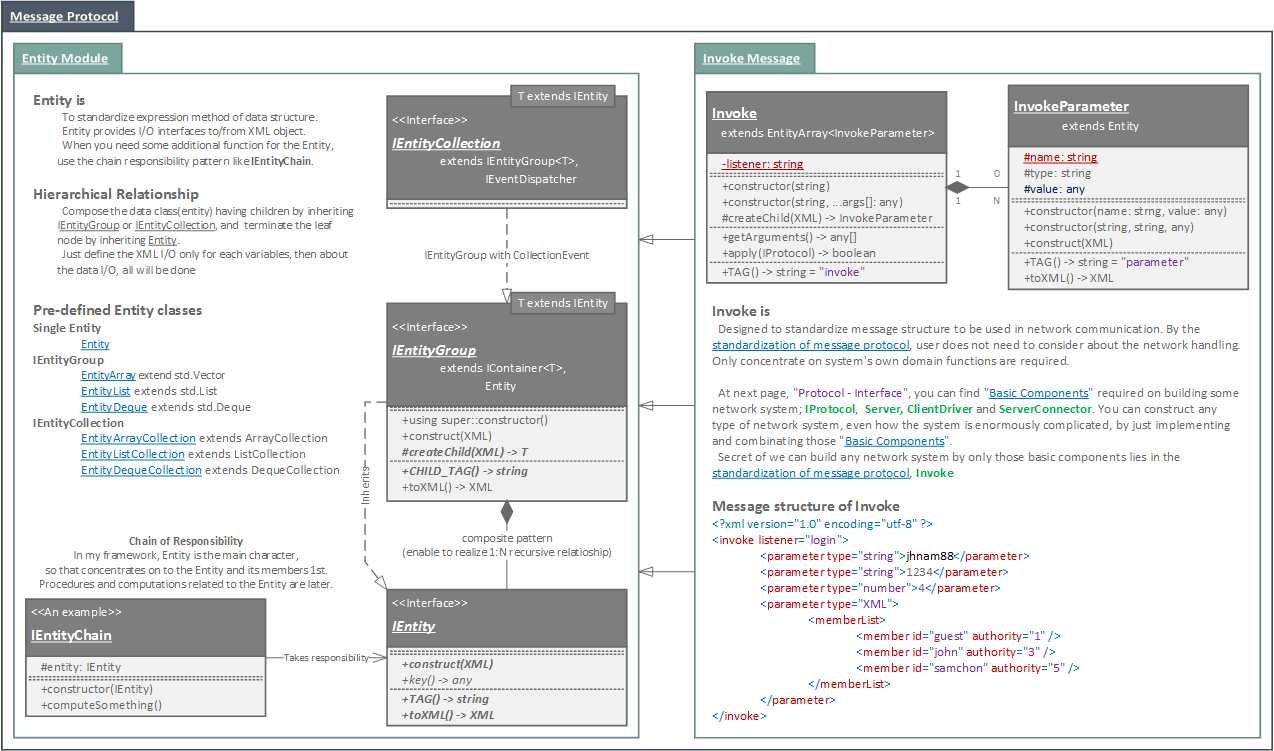
|
||
*
|
||
* @author Jeongho Nam <http://samchon.org>
|
||
*/
|
||
interface IEntity {
|
||
/**
|
||
* Construct data of the Entity from a XML object.
|
||
*
|
||
* Overrides the construct() method and fetch data of member variables from the XML.
|
||
*
|
||
* By recommended guidance, data representing member variables are contained in properties
|
||
* of the put XML object.
|
||
*
|
||
* @param xml An xml used to contruct data of entity.
|
||
*/
|
||
construct(xml: library.XML): void;
|
||
/**
|
||
* Get a key that can identify the Entity uniquely.
|
||
*
|
||
* If identifier of the Entity is not atomic value, returns a paired or tuple object
|
||
* that can represents the composite identifier.
|
||
*
|
||
* <code>
|
||
* class Point extends Entity
|
||
* {
|
||
* private x: number;
|
||
* private y: number;
|
||
*
|
||
* public key(): std.Pair<number, number>
|
||
* {
|
||
* return std.make_pair(this.x, this.y);
|
||
* }
|
||
* }
|
||
* </code>
|
||
*/
|
||
key(): any;
|
||
/**
|
||
* A tag name when represented by XML.
|
||
*
|
||
* <code> <TAG {...properties} /> </code>
|
||
*/
|
||
TAG(): string;
|
||
/**
|
||
* Get a XML object represents the Entity.
|
||
*
|
||
* A member variable (not object, but atomic value like number, string or date) is categorized
|
||
* as a property within the framework of entity side. Thus, when overriding a toXML() method and
|
||
* archiving member variables to an XML object to return, puts each variable to be a property
|
||
* belongs to only a XML object.
|
||
*
|
||
* Don't archive the member variable of atomic value to XML::value causing enormouse creation
|
||
* of XML objects to number of member variables. An Entity must be represented by only a XML
|
||
* instance (tag).
|
||
*
|
||
* <h4> Standard Usage. </h4>
|
||
* <code>
|
||
* <memberList>
|
||
* <member id='jhnam88' name='Jeongho Nam' birthdate='1988-03-11' />
|
||
* <member id='master' name='Administartor' birthdate='2011-07-28' />
|
||
* </memberList>
|
||
* </code>
|
||
*
|
||
* <h4> Non-standard usage abusing value. </h4>
|
||
* <code>
|
||
* <member>
|
||
* <id>jhnam88</id>
|
||
* <name>Jeongho Nam</name>
|
||
* <birthdate>1988-03-11</birthdate>
|
||
* </member>
|
||
* <member>
|
||
* <id>master</id>
|
||
* <name>Administartor</name>
|
||
* <birthdate>2011-07-28</birthdate>
|
||
* </member>
|
||
* </code>
|
||
*
|
||
* @return An XML object representing the Entity.
|
||
*/
|
||
toXML(): library.XML;
|
||
}
|
||
/**
|
||
* @hidden
|
||
*/
|
||
namespace IEntity {
|
||
function construct(entity: IEntity, xml: library.XML, ...prohibited_names: string[]): void;
|
||
function toXML(entity: IEntity, ...prohibited_names: string[]): library.XML;
|
||
}
|
||
/**
|
||
* An entity, a standard data class.
|
||
*
|
||
* Entity is a class for standardization of expression method using on network I/O by XML. If
|
||
* Invoke is a standard message protocol of Samchon Framework which must be kept, Entity is a
|
||
* recommended semi-protocol of message for expressing a data class. Following the semi-protocol
|
||
* Entity is not imposed but encouraged.
|
||
*
|
||
* As we could get advantages from standardization of message for network I/O with Invoke,
|
||
* we can get additional advantage from standardizing expression method of data class with Entity.
|
||
* We do not need to know a part of network communication. Thus, with the Entity, we can only
|
||
* concentrate on entity's own logics and relationships between another entities. Entity does not
|
||
* need to how network communications are being done.
|
||
*
|
||
* I say repeatedly. Expression method of Entity is recommended, but not imposed. It's a semi
|
||
* protocol for network I/O but not a essential protocol must be kept. The expression method of
|
||
* Entity, using on network I/O, is expressed by XML string.
|
||
*
|
||
* If your own network system has a critical performance issue on communication data class,
|
||
* it would be better to using binary communication (with ByteArray).
|
||
* Don't worry about the problem! Invoke also provides methods for binary data (ByteArray).
|
||
*
|
||
* 
|
||
*
|
||
* @author Jeongho Nam <http://samchon.org>
|
||
*/
|
||
abstract class Entity implements IEntity {
|
||
/**
|
||
* Default Constructor.
|
||
*/
|
||
constructor();
|
||
construct(xml: library.XML): void;
|
||
/**
|
||
* @inheritdoc
|
||
*/
|
||
key(): any;
|
||
/**
|
||
* @inheritdoc
|
||
*/
|
||
abstract TAG(): string;
|
||
/**
|
||
* @inheritdoc
|
||
*/
|
||
toXML(): library.XML;
|
||
}
|
||
}
|
||
declare namespace samchon.protocol {
|
||
/**
|
||
* @inheritdoc
|
||
*/
|
||
interface IEntityCollection<T extends IEntity> extends IEntityGroup<T>, collections.ICollection<T> {
|
||
}
|
||
}
|
||
declare namespace samchon.protocol {
|
||
/**
|
||
* @inheritdoc
|
||
*/
|
||
abstract class EntityArrayCollection<T extends IEntity> extends collections.ArrayCollection<T> implements IEntityCollection<T> {
|
||
/**
|
||
* @inheritdoc
|
||
*/
|
||
construct(xml: library.XML): void;
|
||
/**
|
||
* @inheritdoc
|
||
*/
|
||
abstract createChild(xml: library.XML): T;
|
||
/**
|
||
* @inheritdoc
|
||
*/
|
||
key(): any;
|
||
/**
|
||
* @inheritdoc
|
||
*/
|
||
has(key: any): boolean;
|
||
/**
|
||
* @inheritdoc
|
||
*/
|
||
count(key: any): number;
|
||
/**
|
||
* @inheritdoc
|
||
*/
|
||
get(key: any): T;
|
||
/**
|
||
* @inheritdoc
|
||
*/
|
||
abstract TAG(): string;
|
||
/**
|
||
* @inheritdoc
|
||
*/
|
||
abstract CHILD_TAG(): string;
|
||
/**
|
||
* @inheritdoc
|
||
*/
|
||
toXML(): library.XML;
|
||
}
|
||
}
|
||
declare namespace samchon.protocol {
|
||
/**
|
||
* @inheritdoc
|
||
*/
|
||
abstract class EntityListCollection<T extends IEntity> extends collections.ListCollection<T> implements IEntityCollection<T> {
|
||
/**
|
||
* @inheritdoc
|
||
*/
|
||
construct(xml: library.XML): void;
|
||
/**
|
||
* @inheritdoc
|
||
*/
|
||
abstract createChild(xml: library.XML): T;
|
||
/**
|
||
* @inheritdoc
|
||
*/
|
||
key(): any;
|
||
/**
|
||
* @inheritdoc
|
||
*/
|
||
has(key: any): boolean;
|
||
/**
|
||
* @inheritdoc
|
||
*/
|
||
count(key: any): number;
|
||
/**
|
||
* @inheritdoc
|
||
*/
|
||
get(key: any): T;
|
||
/**
|
||
* @inheritdoc
|
||
*/
|
||
abstract TAG(): string;
|
||
/**
|
||
* @inheritdoc
|
||
*/
|
||
abstract CHILD_TAG(): string;
|
||
/**
|
||
* @inheritdoc
|
||
*/
|
||
toXML(): library.XML;
|
||
}
|
||
}
|
||
declare namespace samchon.protocol {
|
||
/**
|
||
* @inheritdoc
|
||
*/
|
||
abstract class EntityDequeCollection<T extends IEntity> extends collections.DequeCollection<T> implements IEntityCollection<T> {
|
||
/**
|
||
* @inheritdoc
|
||
*/
|
||
construct(xml: library.XML): void;
|
||
/**
|
||
* @inheritdoc
|
||
*/
|
||
abstract createChild(xml: library.XML): T;
|
||
/**
|
||
* @inheritdoc
|
||
*/
|
||
key(): any;
|
||
/**
|
||
* @inheritdoc
|
||
*/
|
||
has(key: any): boolean;
|
||
/**
|
||
* @inheritdoc
|
||
*/
|
||
count(key: any): number;
|
||
/**
|
||
* @inheritdoc
|
||
*/
|
||
get(key: any): T;
|
||
/**
|
||
* @inheritdoc
|
||
*/
|
||
abstract TAG(): string;
|
||
/**
|
||
* @inheritdoc
|
||
*/
|
||
abstract CHILD_TAG(): string;
|
||
/**
|
||
* @inheritdoc
|
||
*/
|
||
toXML(): library.XML;
|
||
}
|
||
}
|
||
/**
|
||
* A template for External Systems Manager.
|
||
*
|
||
* @handbook [Templates - External System](https://github.com/samchon/framework/wiki/TypeScript-Templates-External_System)
|
||
* @author Jeongho Nam <http://samchon.org>
|
||
*/
|
||
declare namespace samchon.templates.external {
|
||
/**
|
||
* An array and manager of {@link ExternalSystem external system drivers}.
|
||
*
|
||
* The {@link ExternalSystemArray} is an abstract class containing and managing external system drivers,
|
||
* {@link ExternalSystem} objects. Within framewokr of network, {@link ExternalSystemArray} represents your system
|
||
* and children {@link ExternalSystem} objects represent remote, external systems connected with your system.
|
||
* With this {@link ExternalSystemArray}, you can manage multiple external systems as a group.
|
||
*
|
||
* You can specify this {@link ExternalSystemArray} class to be *a server accepting external clients* or
|
||
* *a client connecting to external servers*. Even both of them is also possible.
|
||
*
|
||
* - {@link ExternalClientArray}: A server accepting {@link ExternalSystem external clients}.
|
||
* - {@link ExternalServerArray}: A client connecting to {@link ExternalServer external servers}.
|
||
* - {@link ExternalServerClientArray}: Both of them. Accepts {@link ExternalSystem external clients} and connects to
|
||
* {@link ExternalServer external servers} at the same time.
|
||
*
|
||
* <a href="http://samchon.github.io/framework/images/design/ts_class_diagram/templates_external_system.png"
|
||
* target="_blank">
|
||
* <img src="http://samchon.github.io/framework/images/design/ts_class_diagram/templates_external_system.png"
|
||
* style="max-width: 100%" />
|
||
* </a>
|
||
*
|
||
* #### Proxy Pattern
|
||
* The {@link ExternalSystemArray} class can use *Proxy Pattern*. In framework within user, which
|
||
* {@link ExternalSystem external system} is connected with {@link ExternalSystemArray this system}, it's not
|
||
* important. Only interested in user's perspective is *which can be done*.
|
||
*
|
||
* By using the *logical proxy*, user dont't need to know which {@link ExternalSystemRole role} is belonged
|
||
* to which {@link ExternalSystem system}. Just access to a role directly from {@link ExternalSystemArray.getRole}.
|
||
* Sends and receives {@link Invoke} message via the {@link ExternalSystemRole role}.
|
||
*
|
||
* <ul>
|
||
* <li>
|
||
* {@link ExternalSystemRole} can be accessed from {@link ExternalSystemArray} directly, without inteferring
|
||
* from {@link ExternalSystem}, with {@link ExternalSystemArray.getRole}.
|
||
* </li>
|
||
* <li>
|
||
* When you want to send an {@link Invoke} message to the belonged {@link ExternalSystem system}, just call
|
||
* {@link ExternalSystemRole.sendData ExternalSystemRole.sendData()}. Then, the message will be sent to the
|
||
* external system.
|
||
* </li>
|
||
* <li> Those strategy is called *Proxy Pattern*. </li>
|
||
* </ul>
|
||
*
|
||
* @handbook [Templates - External System](https://github.com/samchon/framework/wiki/TypeScript-Templates-External_System)
|
||
* @author Jeongho Nam <http://samchon.org>
|
||
*/
|
||
abstract class ExternalSystemArray<System extends ExternalSystem> extends protocol.EntityDequeCollection<System> implements protocol.IProtocol {
|
||
/**
|
||
* Default Constructor.
|
||
*/
|
||
constructor();
|
||
/**
|
||
* @hidden
|
||
*/
|
||
private handle_system_erase(event);
|
||
/**
|
||
* Test whether the role exists.
|
||
*
|
||
* @param name Name, identifier of target {@link ExternalSystemRole role}.
|
||
*
|
||
* @return Whether the role has or not.
|
||
*/
|
||
hasRole(name: string): boolean;
|
||
/**
|
||
* Get a role.
|
||
*
|
||
* @param name Name, identifier of target {@link ExternalSystemRole role}.
|
||
*
|
||
* @return The specified role.
|
||
*/
|
||
getRole(name: string): ExternalSystemRole;
|
||
/**
|
||
* Send an {@link Invoke} message.
|
||
*
|
||
* @param invoke An {@link Invoke} message to send.
|
||
*/
|
||
sendData(invoke: protocol.Invoke): void;
|
||
/**
|
||
* Handle an {@Invoke} message have received.
|
||
*
|
||
* @param invoke An {@link Invoke} message have received.
|
||
*/
|
||
replyData(invoke: protocol.Invoke): void;
|
||
/**
|
||
* Tag name of the {@link ExternalSytemArray} in {@link XML}.
|
||
*
|
||
* @return *systemArray*.
|
||
*/
|
||
TAG(): string;
|
||
/**
|
||
* Tag name of {@link ExternalSystem children elements} belonged to the {@link ExternalSytemArray} in {@link XML}.
|
||
*
|
||
* @return *system*.
|
||
*/
|
||
CHILD_TAG(): string;
|
||
}
|
||
}
|
||
/**
|
||
* A template for Parallel Processing System.
|
||
*
|
||
* @handbook [Templates - Parallel System](https://github.com/samchon/framework/wiki/TypeScript-Templates-Parallel_System)
|
||
* @author Jeongho Nam <http://samchon.org>
|
||
*/
|
||
declare namespace samchon.templates.parallel {
|
||
/**
|
||
* Master of Parallel Processing System.
|
||
*
|
||
* The {@link ParallelSystemArray} is an abstract class containing and managing remote parallel **slave** system
|
||
* drivers, {@link ParallelSystem} objects. Within framework of network, {@link ParallelSystemArray} represents your
|
||
* system, a **Master** of *Parallel Processing System* that requesting *parallel process* to **slave** systems and the
|
||
* children {@link ParallelSystem} objects represent the remote **slave** systems, who is being requested the
|
||
* *parallel processes*.
|
||
*
|
||
* You can specify this {@link ParallelSystemArray} class to be *a server accepting parallel clients* or
|
||
* *a client connecting to parallel servers*. Even both of them is possible. Extends one of them below and overrides
|
||
* abstract factory method(s) creating the child {@link ParallelSystem} object.
|
||
*
|
||
* - {@link ParallelClientArray}: A server accepting {@link ParallelSystem parallel clients}.
|
||
* - {@link ParallelServerArray}: A client connecting to {@link ParallelServer parallel servers}.
|
||
* - {@link ParallelServerClientArray}: Both of them. Accepts {@link ParallelSystem parallel clients} and connects to
|
||
* {@link ParallelServer parallel servers} at the same time.
|
||
*
|
||
* When you need the **parallel process**, then call one of them: {@link sendSegmentData} or {@link sendPieceData}.
|
||
* When the **parallel process** has completed, {@link ParallelSystemArray} estimates each {@link ParallelSystem}'s
|
||
* {@link ParallelSystem.getPerformance performance index} basis on their execution time. Those performance indices
|
||
* will be reflected to the next **parallel process**, how much pieces to allocate to each {@link ParallelSystem}.
|
||
*
|
||
* <a href="http://samchon.github.io/framework/images/design/ts_class_diagram/templates_parallel_system.png"
|
||
* target="_blank">
|
||
* <img src="http://samchon.github.io/framework/images/design/ts_class_diagram/templates_parallel_system.png"
|
||
* style="max-width: 100%" />
|
||
* </a>
|
||
*
|
||
* #### Proxy Pattern
|
||
* This class {@link ParallelSystemArray} is derived from the {@link ExternalSystemArray} class. Thus, you can take
|
||
* advantage of the *Proxy Pattern* in the {@link ParallelSystemArray} class. If a process to request is not the
|
||
* *parallel process* (to be distrubted to all slaves), but the **exclusive process** handled in a system, then it
|
||
* may better to utilizing the *Proxy Pattern*:
|
||
*
|
||
* The {@link ExternalSystemArray} class can use *Proxy Pattern*. In framework within user, which
|
||
* {@link ExternalSystem external system} is connected with {@link ExternalSystemArray this system}, it's not
|
||
* important. Only interested in user's perspective is *which can be done*.
|
||
*
|
||
* By using the *logical proxy*, user dont't need to know which {@link ExternalSystemRole role} is belonged
|
||
* to which {@link ExternalSystem system}. Just access to a role directly from {@link ExternalSystemArray.getRole}.
|
||
* Sends and receives {@link Invoke} message via the {@link ExternalSystemRole role}.
|
||
*
|
||
* <ul>
|
||
* <li>
|
||
* {@link ExternalSystemRole} can be accessed from {@link ExternalSystemArray} directly, without inteferring
|
||
* from {@link ExternalSystem}, with {@link ExternalSystemArray.getRole}.
|
||
* </li>
|
||
* <li>
|
||
* When you want to send an {@link Invoke} message to the belonged {@link ExternalSystem system}, just call
|
||
* {@link ExternalSystemRole.sendData ExternalSystemRole.sendData()}. Then, the message will be sent to the
|
||
* external system.
|
||
* </li>
|
||
* <li> Those strategy is called *Proxy Pattern*. </li>
|
||
* </ul>
|
||
*
|
||
* @handbook [Templates - Parallel System](https://github.com/samchon/framework/wiki/TypeScript-Templates-Parallel_System)
|
||
* @author Jeongho Nam <http://samchon.org>
|
||
*/
|
||
abstract class ParallelSystemArray<System extends ParallelSystem> extends external.ExternalSystemArray<System> {
|
||
/**
|
||
* @hidden
|
||
*/
|
||
private history_sequence_;
|
||
/**
|
||
* Default Constructor.
|
||
*/
|
||
constructor();
|
||
/**
|
||
* Send an {@link Invoke} message with segment size.
|
||
*
|
||
* Sends an {@link Invoke} message requesting a **parallel process** with its *segment size*. The {@link Invoke}
|
||
* message will be delivered to children {@link ParallelSystem} objects with the *piece size*, which is divided
|
||
* from the *segment size*, basis on their {@link ParallelSystem.getPerformance performance indices}.
|
||
*
|
||
* - If segment size is 100,
|
||
* - The segment will be allocated such below:
|
||
*
|
||
* Name | Performance index | Number of pieces to be allocated | Formula
|
||
* --------|-------------------|----------------------------------|--------------
|
||
* Snail | 1 | 10 | 100 / 10 * 1
|
||
* Cheetah | 4 | 40 | 100 / 10 * 4
|
||
* Rabbit | 3 | 30 | 100 / 10 * 3
|
||
* Turtle | 2 | 20 | 100 / 10 * 2
|
||
*
|
||
* When the **parallel process** has completed, then this {@link ParallelSystemArraY} will estimate
|
||
* {@link ParallelSystem.getPerformance performance indices} of {@link ParallelSystem} objects basis on their
|
||
* execution time.
|
||
*
|
||
* @param invoke An {@link Invoke} message requesting parallel process.
|
||
* @param size Number of pieces to segment.
|
||
*
|
||
* @return Number of {@link ParallelSystem slave systems} participating in the *Parallel Process*.
|
||
*
|
||
* @see {@link sendPieceData}, {@link ParallelSystem.getPerformacen}
|
||
*/
|
||
sendSegmentData(invoke: protocol.Invoke, size: number): number;
|
||
/**
|
||
* Send an {@link Invoke} message with range of pieces.
|
||
*
|
||
* Sends an {@link Invoke} message requesting a **parallel process** with its *range of pieces [first, last)*.
|
||
* The {@link Invoke} will be delivered to children {@link ParallelSystem} objects with the newly computed
|
||
* *range of sub-pieces*, which is divided from the *range of pieces (first to last)*, basis on their
|
||
* {@link ParallelSystem.getPerformance performance indices}.
|
||
*
|
||
* - If indices of pieces are 0 to 50,
|
||
* - The sub-pieces will be allocated such below:
|
||
*
|
||
* Name | Performance index | Range of sub-pieces to be allocated | Formula
|
||
* --------|-------------------|-------------------------------------|------------------------
|
||
* Snail | 1 | ( 0, 5] | (50 - 0) / 10 * 1
|
||
* Cheetah | 4 | ( 5, 25] | (50 - 0) / 10 * 4 + 5
|
||
* Rabbit | 3 | (25, 40] | (50 - 0) / 10 * 3 + 25
|
||
* Turtle | 2 | (40, 50] | (50 - 0) / 10 * 2 + 40
|
||
*
|
||
* When the **parallel process** has completed, then this {@link ParallelSystemArraY} will estimate
|
||
* {@link ParallelSystem.getPerformance performance indices} of {@link ParallelSystem} objects basis on their
|
||
* execution time.
|
||
*
|
||
* @param invoke An {@link Invoke} message requesting parallel process.
|
||
* @param first Initial piece's index in a section.
|
||
* @param last Final piece's index in a section. The range used is [*first*, *last*), which contains
|
||
* all the pieces' indices between *first* and *last*, including the piece pointed by index
|
||
* *first*, but not the piece pointed by the index *last*.
|
||
*
|
||
* @return Number of {@link ParallelSystem slave systems} participating in the *Parallel Process*.
|
||
*
|
||
* @see {@link sendSegmentData}, {@link ParallelSystem.getPerformacen}
|
||
*/
|
||
sendPieceData(invoke: protocol.Invoke, first: number, last: number): number;
|
||
/**
|
||
* @hidden
|
||
*/
|
||
protected _Complete_history(history: protocol.InvokeHistory): boolean;
|
||
/**
|
||
* @hidden
|
||
*/
|
||
protected _Normalize_performance(): void;
|
||
}
|
||
}
|
||
/**
|
||
* A template for Distributed Processing System.
|
||
*
|
||
* @handbook [Templates - Distributed System](https://github.com/samchon/framework/wiki/TypeScript-Templates-Distributed_System)
|
||
* @author Jeongho Nam <http://samchon.org>
|
||
*/
|
||
declare namespace samchon.templates.distributed {
|
||
/**
|
||
* Master of Distributed Processing System.
|
||
*
|
||
* The {@link DistributedSystemArray} is an abstract class containing and managing remote distributed **slave** system
|
||
* drivers, {@link DistributedSystem} objects. Within framework of network, {@link DistributedSystemArray} represents
|
||
* your system, a **Master** of *Distributed Processing System* that requesting *distributed process* to **slave**
|
||
* systems and the children {@link DistributedSystem} objects represent the remote **slave** systems, who is being
|
||
* requested the *distributed processes*.
|
||
*
|
||
* You can specify this {@link DistributedSystemArray} class to be *a server accepting distributed clients* or
|
||
* *a client connecting to distributed servers*. Even both of them is possible. Extends one of them below and overrides
|
||
* abstract factory method(s) creating the child {@link DistributedSystem} object.
|
||
*
|
||
* - {@link DistributedClientArray}: A server accepting {@link DistributedSystem distributed clients}.
|
||
* - {@link DistributedServerArray}: A client connecting to {@link DistributedServer distributed servers}.
|
||
* - {@link DistributedServerClientArray}: Both of them. Accepts {@link DistributedSystem distributed clients} and
|
||
* connects to {@link DistributedServer distributed servers} at the same time.
|
||
*
|
||
* The {@link DistributedSystemArray} contains {@link DistributedProcess} objects directly. You can request a
|
||
* **distributed process** through the {@link DistributedProcess} object. You can access the
|
||
* {@link DistributedProcess} object(s) with those methods:
|
||
*
|
||
* - {@link hasProcess}
|
||
* - {@link getProcess}
|
||
* - {@link insertProcess}
|
||
* - {@link eraseProcess}
|
||
* - {@link getProcessMap}
|
||
*
|
||
* When you need the **distributed process**, call the {@link DistributedProcess.sendData} method. Then the
|
||
* {@link DistributedProcess} will find the most idle {@link DistributedSystem} object who represents a distributed
|
||
* **slave **system. The {@link Invoke} message will be sent to the most idle {@link DistributedSystem} object. When
|
||
* the **distributed process** has completed, then {@link DistributedSystem.getPerformance performance index} and
|
||
* {@link DistributedProcess.getResource resource index} of related objects will be revaluated.
|
||
*
|
||
* <a href="http://samchon.github.io/framework/images/design/ts_class_diagram/templates_distributed_system.png"
|
||
* target="_blank">
|
||
* <img src="http://samchon.github.io/framework/images/design/ts_class_diagram/templates_distributed_system.png"
|
||
* style="max-width: 100%" />
|
||
* </a>
|
||
*
|
||
* #### Parallel Process
|
||
* This {@link DistributedSystemArray} class is derived from the {@link ParallelSystemArray} class, so you can request
|
||
* a **parallel process**, too.
|
||
*
|
||
* When you need the **parallel process**, then call one of them: {@link sendSegmentData} or {@link sendPieceData}.
|
||
* When the **parallel process** has completed, {@link ParallelSystemArray} estimates each {@link ParallelSystem}'s
|
||
* {@link ParallelSystem.getPerformance performance index} basis on their execution time. Those performance indices will
|
||
* be reflected to the next **parallel process**, how much pieces to allocate to each {@link ParallelSystem}.
|
||
*
|
||
* #### Proxy Pattern
|
||
* This class {@link DistributedSystemArray} is derived from the {@link ExternalSystemArray} class. Thus, you can take
|
||
* advantage of the *Proxy Pattern* in the {@link DistributedSystemArray} class. If a process to request is not the
|
||
* *parallel process* (to be distrubted to all slaves), but the **exclusive process** handled in a system, then it
|
||
* may better to utilizing the *Proxy Pattern*:
|
||
*
|
||
* The {@link ExternalSystemArray} class can use *Proxy Pattern*. In framework within user, which
|
||
* {@link ExternalSystem external system} is connected with {@link ExternalSystemArray this system}, it's not
|
||
* important. Only interested in user's perspective is *which can be done*.
|
||
*
|
||
* By using the *logical proxy*, user dont't need to know which {@link ExternalSystemRole role} is belonged
|
||
* to which {@link ExternalSystem system}. Just access to a role directly from {@link ExternalSystemArray.getRole}.
|
||
* Sends and receives {@link Invoke} message via the {@link ExternalSystemRole role}.
|
||
*
|
||
* <ul>
|
||
* <li>
|
||
* {@link ExternalSystemRole} can be accessed from {@link ExternalSystemArray} directly, without inteferring
|
||
* from {@link ExternalSystem}, with {@link ExternalSystemArray.getRole}.
|
||
* </li>
|
||
* <li>
|
||
* When you want to send an {@link Invoke} message to the belonged {@link ExternalSystem system}, just call
|
||
* {@link ExternalSystemRole.sendData ExternalSystemRole.sendData()}. Then, the message will be sent to the
|
||
* external system.
|
||
* </li>
|
||
* <li> Those strategy is called *Proxy Pattern*. </li>
|
||
* </ul>
|
||
*
|
||
* @handbook [Templates - Distributed System](https://github.com/samchon/framework/wiki/TypeScript-Templates-Distributed_System)
|
||
* @author Jeongho Nam <http://samchon.org>
|
||
*/
|
||
abstract class DistributedSystemArray<System extends DistributedSystem> extends parallel.ParallelSystemArray<System> {
|
||
/**
|
||
* @hidden
|
||
*/
|
||
private process_map_;
|
||
/**
|
||
* Default Constructor.
|
||
*/
|
||
constructor();
|
||
/**
|
||
* @inheritdoc
|
||
*/
|
||
construct(xml: library.XML): void;
|
||
/**
|
||
* Factory method creating a child {@link DistributedProcess process} object.
|
||
*
|
||
* @param xml {@link XML} represents the {@link DistributedProcess child} object.
|
||
* @return A new {@link DistributedProcess} object.
|
||
*/
|
||
protected abstract createProcess(xml: library.XML): DistributedProcess;
|
||
/**
|
||
* Get process map.
|
||
*
|
||
* Gets an {@link HashMap} containing {@link DistributedProcess} objects with their *key*.
|
||
*
|
||
* @return An {@link HasmMap> containing pairs of string and {@link DistributedProcess} object.
|
||
*/
|
||
getProcessMap(): std.HashMap<string, DistributedProcess>;
|
||
/**
|
||
* Test whether the process exists.
|
||
*
|
||
* @param name Name, identifier of target {@link DistributedProcess process}.
|
||
*
|
||
* @return Whether the process has or not.
|
||
*/
|
||
hasProcess(name: string): boolean;
|
||
/**
|
||
* Get a process.
|
||
*
|
||
* @param name Name, identifier of target {@link DistributedProcess process}.
|
||
*
|
||
* @return The specified process.
|
||
*/
|
||
getProcess(name: string): DistributedProcess;
|
||
/**
|
||
* Insert a process.
|
||
*
|
||
* @param process A process to be inserted.
|
||
* @return Success flag.
|
||
*/
|
||
insertProcess(process: DistributedProcess): boolean;
|
||
/**
|
||
* Erase a process.
|
||
*
|
||
* @param name Name, identifier of target {@link DistributedProcess process}.
|
||
*/
|
||
eraseProcess(name: string): boolean;
|
||
/**
|
||
* @hidden
|
||
*/
|
||
protected _Complete_history(history: protocol.InvokeHistory): boolean;
|
||
/**
|
||
* @hidden
|
||
*/
|
||
private estimate_process_resource(history);
|
||
/**
|
||
* @hidden
|
||
*/
|
||
private estimate_system_performance(history);
|
||
/**
|
||
* @hidden
|
||
*/
|
||
protected _Normalize_performance(): void;
|
||
/**
|
||
* @inheritdoc
|
||
*/
|
||
toXML(): library.XML;
|
||
}
|
||
}
|
||
declare namespace samchon.templates.distributed {
|
||
/**
|
||
* Mediator of Distributed Processing System.
|
||
*
|
||
* The {@link DistributedSystemArrayMediator} class be a master for its slave systems, and be a slave to its master
|
||
* system at the same time. This {@link DistributedSystemArrayMediator} be a master system, containing and managing
|
||
* {@link DistributedSystem} objects, which represent distributed slave systems, by extending
|
||
* {@link DistributedSystemArray} class. Also, be a slave system through {@link getMediator mediator} object, which is
|
||
* derived from the {@link SlaveSystem} class.
|
||
*
|
||
* As a master, you can specify this {@link DistributedSystemArrayMediator} class to be <i>a master server accepting
|
||
* slave clients<i> or <i>a master client to connecting slave servers</i>. Even both of them is possible. Extends one
|
||
* of them below and overrides abstract factory method(s) creating the child {@link DistributedSystem} object.
|
||
*
|
||
* - {@link DistributedClientArrayMediator}: A server accepting {@link DistributedSystem distributed clients}.
|
||
* - {@link DistributedServerArrayMediator}: A client connecting to {@link DistributedServer distributed servers}.
|
||
* - {@link DistributedServerClientArrayMediator}: Both of them. Accepts {@link DistributedSystem distributed clients} and
|
||
* connects to {@link DistributedServer distributed servers} at the same time.
|
||
*
|
||
* As a slave, you can specify this {@link DistributedSystemArrayMediator} to be <i>a client slave connecting to master
|
||
* server</i> or <i>a server slave accepting master client</i> by overriding the {@link createMediator} method.
|
||
* Overrides the {@link createMediator createMediator()} method and return one of them:
|
||
*
|
||
* - A client slave connecting to master server:
|
||
* - {@link MediatorClient}
|
||
* - {@link MediatorWebClient}
|
||
* - {@link MediatorSharedWorkerClient}
|
||
* - A server slave accepting master client:
|
||
* - {@link MediatorServer}
|
||
* - {@link MediatorWebServer}
|
||
* - {@link MediatorDedicatedWorkerServer}
|
||
* - {@link MediatorSharedWorkerServer}
|
||
*
|
||
* #### [Inherited] {@link DistributedSystemArray}
|
||
* The {@link DistributedSystemArray} is an abstract class containing and managing remote distributed **slave** system
|
||
* drivers, {@link DistributedSystem} objects. Within framework of network, {@link DistributedSystemArray} represents
|
||
* your system, a **Master** of *Distributed Processing System* that requesting *distributed process* to **slave**
|
||
* systems and the children {@link DistributedSystem} objects represent the remote **slave** systems, who is being
|
||
* requested the *distributed processes*.
|
||
*
|
||
* The {@link DistributedSystemArray} contains {@link DistributedProcess} objects directly. You can request a
|
||
* **distributed process** through the {@link DistributedProcess} object. You can access the
|
||
* {@link DistributedProcess} object(s) with those methods:
|
||
*
|
||
* - {@link hasProcess}
|
||
* - {@link getProcess}
|
||
* - {@link insertProcess}
|
||
* - {@link eraseProcess}
|
||
* - {@link getProcessMap}
|
||
*
|
||
* When you need the **distributed process**, call the {@link DistributedProcess.sendData} method. Then the
|
||
* {@link DistributedProcess} will find the most idle {@link DistributedSystem} object who represents a distributed
|
||
* **slave **system. The {@link Invoke} message will be sent to the most idle {@link DistributedSystem} object. When
|
||
* the **distributed process** has completed, then {@link DistributedSystem.getPerformance performance index} and
|
||
* {@link DistributedProcess.getResource resource index} of related objects will be revaluated.
|
||
*
|
||
* <a href="http://samchon.github.io/framework/images/design/ts_class_diagram/templates_distributed_system.png"
|
||
* target="_blank">
|
||
* <img src="http://samchon.github.io/framework/images/design/ts_class_diagram/templates_distributed_system.png"
|
||
* style="max-width: 100%" />
|
||
* </a>
|
||
*
|
||
* #### Parallel Process
|
||
* This {@link DistributedSystemArray} class is derived from the {@link ParallelSystemArray} class, so you can request
|
||
* a **parallel process**, too.
|
||
*
|
||
* When you need the **parallel process**, then call one of them: {@link sendSegmentData} or {@link sendPieceData}.
|
||
* When the **parallel process** has completed, {@link ParallelSystemArray} estimates each {@link ParallelSystem}'s
|
||
* {@link ParallelSystem.getPerformance performance index} basis on their execution time. Those performance indices will
|
||
* be reflected to the next **parallel process**, how much pieces to allocate to each {@link ParallelSystem}.
|
||
*
|
||
* #### Proxy Pattern
|
||
* This class {@link DistributedSystemArray} is derived from the {@link ExternalSystemArray} class. Thus, you can take
|
||
* advantage of the *Proxy Pattern* in the {@link DistributedSystemArray} class. If a process to request is not the
|
||
* *parallel process* (to be distrubted to all slaves), but the **exclusive process** handled in a system, then it
|
||
* may better to utilizing the *Proxy Pattern*:
|
||
*
|
||
* The {@link ExternalSystemArray} class can use *Proxy Pattern*. In framework within user, which
|
||
* {@link ExternalSystem external system} is connected with {@link ExternalSystemArray this system}, it's not
|
||
* important. Only interested in user's perspective is *which can be done*.
|
||
*
|
||
* By using the *logical proxy*, user dont't need to know which {@link ExternalSystemRole role} is belonged
|
||
* to which {@link ExternalSystem system}. Just access to a role directly from {@link ExternalSystemArray.getRole}.
|
||
* Sends and receives {@link Invoke} message via the {@link ExternalSystemRole role}.
|
||
*
|
||
* <ul>
|
||
* <li>
|
||
* {@link ExternalSystemRole} can be accessed from {@link ExternalSystemArray} directly, without inteferring
|
||
* from {@link ExternalSystem}, with {@link ExternalSystemArray.getRole}.
|
||
* </li>
|
||
* <li>
|
||
* When you want to send an {@link Invoke} message to the belonged {@link ExternalSystem system}, just call
|
||
* {@link ExternalSystemRole.sendData ExternalSystemRole.sendData()}. Then, the message will be sent to the
|
||
* external system.
|
||
* </li>
|
||
* <li> Those strategy is called *Proxy Pattern*. </li>
|
||
* </ul>
|
||
*
|
||
* @handbook [Templates - Distributed System](https://github.com/samchon/framework/wiki/TypeScript-Templates-Distributed_System)
|
||
* @author Jeongho Nam <http://samchon.org>
|
||
*/
|
||
abstract class DistributedSystemArrayMediator<System extends DistributedSystem> extends DistributedSystemArray<System> {
|
||
/**
|
||
* @hidden
|
||
*/
|
||
private mediator_;
|
||
/**
|
||
* Default Constructor.
|
||
*/
|
||
constructor();
|
||
/**
|
||
* Factory method creating a {@link MediatorSystem} object.
|
||
*
|
||
* The {@link createMediator createMediator()} is an abstract method creating the {@link MediatorSystem} object.
|
||
*
|
||
* You know what? this {@link DistributedSystemArrayMediator} class be a master for its slave systems, and be a
|
||
* slave to its master system at the same time. The {@link MediatorSystem} object makes it possible; be a slave
|
||
* system. This {@link createMediator} determines specific type of the {@link MediatorSystem}.
|
||
*
|
||
* Overrides the {@link createMediator createMediator()} method to create and return one of them following which
|
||
* protocol and which type of remote connection (server or client) will be used:
|
||
*
|
||
* - A client slave connecting to master server:
|
||
* - {@link MediatorClient}
|
||
* - {@link MediatorWebClient}
|
||
* - {@link MediatorSharedWorkerClient}
|
||
* - A server slave accepting master client:
|
||
* - {@link MediatorServer}
|
||
* - {@link MediatorWebServer}
|
||
* - {@link MediatorDedicatedWorkerServer}
|
||
* - {@link MediatorSharedWorkerServer}
|
||
*
|
||
* @return A newly created {@link MediatorSystem} object.
|
||
*/
|
||
protected abstract createMediator(): parallel.MediatorSystem;
|
||
/**
|
||
* Start mediator.
|
||
*
|
||
* If the {@link getMediator mediator} is a type of server, then opens the server accepting master client.
|
||
* Otherwise, the {@link getMediator mediator} is a type of client, then connects the master server.
|
||
*/
|
||
protected startMediator(): void;
|
||
/**
|
||
* Get {@link MediatorSystem} object.
|
||
*
|
||
* When you need to send an {@link Invoke} message to the master system of this
|
||
* {@link DistributedSystemArrayMediator}, then send to the {@link MediatorSystem} through this
|
||
* {@link getMediator}.
|
||
*
|
||
* ```typescript
|
||
* this.getMediator().sendData(...);
|
||
* ```
|
||
*
|
||
* @return The {@link MediatorSystem} object.
|
||
*/
|
||
getMediator(): parallel.MediatorSystem;
|
||
/**
|
||
* @hidden
|
||
*/
|
||
protected _Complete_history(history: parallel.PRInvokeHistory): boolean;
|
||
}
|
||
}
|
||
declare namespace samchon.protocol {
|
||
/**
|
||
* An interface taking full charge of network communication.
|
||
*
|
||
* {@link ICommunicator} is an interface for communicator classes who take full charge of network communication with
|
||
* remote system, without reference to whether the remote system is a server or a client. Type of the
|
||
* {@link ICommunicator} is specified to {@link IServerConnector} and {@link IClientDriver} whether the remote system
|
||
* is a server (that I've to connect) or a client (a client connected to my server).
|
||
*
|
||
* Whenever a replied message comes from the remote system, the message will be converted to an {@link Invoke} class
|
||
* and the {@link Invoke} object will be shifted to the {@link IProtocol listener}'s
|
||
* {@link IProtocol.replyData IProtocol.replyData()} method.
|
||
*
|
||
* <a href="http://samchon.github.io/framework/images/design/ts_class_diagram/protocol_basic_components.png"
|
||
* target="_blank">
|
||
* <img src="http://samchon.github.io/framework/images/design/ts_class_diagram/protocol_basic_components.png"
|
||
* style="max-width: 100%" />
|
||
* </a>
|
||
*
|
||
* @see {@link IClientDriver}, {@link IServerConnector}, {@link IProtocol}
|
||
* @handbook [Protocol - Basic Components](https://github.com/samchon/framework/wiki/TypeScript-Protocol-Basic_Components#icommunicator)
|
||
* @author Jeongho Nam <http://samchon.org>
|
||
*/
|
||
interface ICommunicator extends IProtocol {
|
||
/**
|
||
* Callback function for connection closed.
|
||
*/
|
||
onClose: Function;
|
||
/**
|
||
* Close connection.
|
||
*/
|
||
close(): void;
|
||
/**
|
||
* Test connection.
|
||
*
|
||
* Test whether this {@link ICommunicator communicator} object is connected with the remote system. If the
|
||
* connection is alive, then returns ```true```. Otherwise, the connection is not alive or this
|
||
* {@link ICommunicator communicator has not connected with the remote system yet, then returns ```false```.
|
||
*
|
||
* @return true if connected, otherwise false.
|
||
*/
|
||
isConnected(): boolean;
|
||
/**
|
||
* Send message.
|
||
*
|
||
* Send {@link Invoke} message to remote system.
|
||
*
|
||
* @param invoke An {@link Invoke} message to send.
|
||
*/
|
||
sendData(invoke: protocol.Invoke): void;
|
||
/**
|
||
* Handle replied message.
|
||
*
|
||
* Handles replied {@link Invoke} message recived from remove system. The {@link Invoke} message will be shifted
|
||
* to the {@link IProtocol listener}'s {@link IProtocol.replyData IProtocol.replyData()} by this method.
|
||
*
|
||
* @param invoke An {@link Invoke} message received from remote system.
|
||
*/
|
||
replyData(invoke: protocol.Invoke): void;
|
||
}
|
||
}
|
||
declare namespace samchon.protocol {
|
||
/**
|
||
* An abstract, basic class for communicators.
|
||
*
|
||
* {@link CommunicatorBase} is an abstract class implemented from the {@link ICommunicator}. Mechanism of converting
|
||
* raw data to {@link Invoke} messag has realized in this abstract class. Type of this {@link CommunicatorBase} class
|
||
* is specified to as below following which protocol is used.
|
||
*
|
||
* - {@link Communicator}: Samchon Framework's own protocool.
|
||
* - {@link WebCommunicator}: Web-socket protocol
|
||
* - {@link SharedWorkerCommunicator}: SharedWorker's message protocol.
|
||
*
|
||
* #### [Inherited] {@link ICommunicator}
|
||
* {@link ICommunicator} is an interface for communicator classes who take full charge of network communication with
|
||
* remote system, without reference to whether the remote system is a server or a client. Type of the
|
||
* {@link ICommunicator} is specified to {@link IServerConnector} and {@link IClientDriver} whether the remote system
|
||
* is a server (that I've to connect) or a client (a client connected to my server).
|
||
*
|
||
* Whenever a replied message comes from the remote system, the message will be converted to an {@link Invoke} class
|
||
* and the {@link Invoke} object will be shifted to the {@link IProtocol listener}'s
|
||
* {@link IProtocol.replyData IProtocol.replyData()} method.
|
||
*
|
||
* <a href="http://samchon.github.io/framework/images/design/ts_class_diagram/protocol_basic_components.png"
|
||
* target="_blank">
|
||
* <img src="http://samchon.github.io/framework/images/design/ts_class_diagram/protocol_basic_components.png"
|
||
* style="max-width: 100%" />
|
||
* </a>
|
||
*
|
||
* @see {@link IClientDriver}, {@link IServerConnector}, {@link IProtocol}
|
||
* @handbook [Protocol - Basic Components](https://github.com/samchon/framework/wiki/TypeScript-Protocol-Basic_Components#icommunicator)
|
||
* @author Jeongho Nam <http://samchon.org>
|
||
*/
|
||
abstract class CommunicatorBase implements ICommunicator {
|
||
/**
|
||
* @hidden
|
||
*/
|
||
protected listener_: IProtocol;
|
||
/**
|
||
* @inheritdoc
|
||
*/
|
||
onClose: Function;
|
||
/**
|
||
* @hidden
|
||
*/
|
||
protected connected_: boolean;
|
||
/**
|
||
* @hidden
|
||
*/
|
||
private binary_invoke_;
|
||
/**
|
||
* @hidden
|
||
*/
|
||
private binary_parameters_;
|
||
/**
|
||
* @hidden
|
||
*/
|
||
private unhandled_invokes;
|
||
/**
|
||
* Default Constructor.
|
||
*/
|
||
constructor();
|
||
/**
|
||
* Construct from *listener*.
|
||
*
|
||
* @param listener An {@link IProtocol} object to listen {@link Invoke} messages.
|
||
*/
|
||
constructor(listener: IProtocol);
|
||
/**
|
||
* @inheritdoc
|
||
*/
|
||
abstract close(): void;
|
||
/**
|
||
* @inheritdoc
|
||
*/
|
||
isConnected(): boolean;
|
||
/**
|
||
* @hidden
|
||
*/
|
||
protected is_binary_invoke(): boolean;
|
||
/**
|
||
* @inheritdoc
|
||
*/
|
||
abstract sendData(invoke: Invoke): void;
|
||
/**
|
||
* @inheritdoc
|
||
*/
|
||
replyData(invoke: Invoke): void;
|
||
/**
|
||
* @hidden
|
||
*/
|
||
protected handle_string(str: string): void;
|
||
/**
|
||
* @hidden
|
||
*/
|
||
protected handle_binary(binary: Uint8Array): void;
|
||
}
|
||
}
|
||
declare namespace samchon.protocol {
|
||
/**
|
||
* A communicator following Samchon Framework's own protocol.
|
||
*
|
||
* {@link Communicator} is an abstract class following Samchon Framework's own protocol. This {@link Communicator}
|
||
* class is specified to {@link ServerConnector} and {@link ClientDriver} whether the remote system is a server (that
|
||
* my system is connecting to) or a client (a client conneting to to my server).
|
||
*
|
||
* Note that, if one of this or remote system is web-browser based, then you don't have to use this
|
||
* {@link Communicator} class who follows Samchon Framework's own protocol. Web-browser supports only Web-socket
|
||
* protocol. Thus in that case, you have to use {@link WebCommunicator} instead.
|
||
*
|
||
* #### [Inherited] {@link ICommunicator}
|
||
* {@link ICommunicator} is an interface for communicator classes who take full charge of network communication with
|
||
* remote system, without reference to whether the remote system is a server or a client. Type of the
|
||
* {@link ICommunicator} is specified to {@link IServerConnector} and {@link IClientDriver} whether the remote system
|
||
* is a server (that I've to connect) or a client (a client connected to my server).
|
||
*
|
||
* Whenever a replied message comes from the remote system, the message will be converted to an {@link Invoke} class
|
||
* and the {@link Invoke} object will be shifted to the {@link IProtocol listener}'s
|
||
* {@link IProtocol.replyData IProtocol.replyData()} method.
|
||
*
|
||
* <a href="http://samchon.github.io/framework/images/design/ts_class_diagram/protocol_basic_components.png"
|
||
* target="_blank">
|
||
* <img src="http://samchon.github.io/framework/images/design/ts_class_diagram/protocol_basic_components.png"
|
||
* style="max-width: 100%" />
|
||
* </a>
|
||
*
|
||
* @see {@link ClientDriver}, {@link ServerConnector}, {@link IProtocol}
|
||
* @handbook [Protocol - Basic Components](https://github.com/samchon/framework/wiki/TypeScript-Protocol-Basic_Components#icommunicator)
|
||
* @author Jeongho Nam <http://samchon.org>
|
||
*/
|
||
abstract class Communicator extends CommunicatorBase {
|
||
/**
|
||
* @hidden
|
||
*/
|
||
protected socket_: socket.socket;
|
||
/**
|
||
* @hidden
|
||
*/
|
||
private header_bytes_;
|
||
/**
|
||
* @hidden
|
||
*/
|
||
private data_;
|
||
/**
|
||
* @hidden
|
||
*/
|
||
private data_index_;
|
||
/**
|
||
* @hidden
|
||
*/
|
||
private listening_;
|
||
/**
|
||
* @inheritdoc
|
||
*/
|
||
close(): void;
|
||
/**
|
||
* @hidden
|
||
*/
|
||
protected start_listen(): void;
|
||
/**
|
||
* @hidden
|
||
*/
|
||
private handle_error();
|
||
/**
|
||
* @hidden
|
||
*/
|
||
private handle_close();
|
||
/**
|
||
* @inheritdoc
|
||
*/
|
||
sendData(invoke: Invoke): void;
|
||
/**
|
||
* @hidden
|
||
*/
|
||
private listen_piece(piece);
|
||
/**
|
||
* @hidden
|
||
*/
|
||
private listen_header(piece, piece_index);
|
||
/**
|
||
* @hidden
|
||
*/
|
||
private listen_data(piece, piece_index);
|
||
}
|
||
}
|
||
declare namespace samchon.protocol {
|
||
/**
|
||
* A communicator following Web-socket protocol.
|
||
*
|
||
* {@link WebCommunicator} is an abstract class following Web-socket protocol. This {@link WebCommunicator} class is
|
||
* specified to {@link WebServerConnector} and {@link WebClientDriver} whether the remote system is a server (that my
|
||
* system is connecting to) or a client (a client conneting to to my server).
|
||
*
|
||
* Note that, one of this or remote system is web-browser based, then there's not any alternative choice. Web browser
|
||
* supports only Web-socket protocol. In that case, you've use this {@link WebCommunicator} class.
|
||
*
|
||
* #### [Inherited] {@link ICommunicator}
|
||
* {@link ICommunicator} is an interface for communicator classes who take full charge of network communication with
|
||
* remote system, without reference to whether the remote system is a server or a client. Type of the
|
||
* {@link ICommunicator} is specified to {@link IServerConnector} and {@link IClientDriver} whether the remote system
|
||
* is a server (that I've to connect) or a client (a client connected to my server).
|
||
*
|
||
* Whenever a replied message comes from the remote system, the message will be converted to an {@link Invoke} class
|
||
* and the {@link Invoke} object will be shifted to the {@link IProtocol listener}'s
|
||
* {@link IProtocol.replyData IProtocol.replyData()} method.
|
||
*
|
||
* <a href="http://samchon.github.io/framework/images/design/ts_class_diagram/protocol_basic_components.png"
|
||
* target="_blank">
|
||
* <img src="http://samchon.github.io/framework/images/design/ts_class_diagram/protocol_basic_components.png"
|
||
* style="max-width: 100%" />
|
||
* </a>
|
||
*
|
||
* @see {@link WebClientDriver}, {@link WebServerConnector}, {@link IProtocol}
|
||
* @handbook [Protocol - Basic Components](https://github.com/samchon/framework/wiki/TypeScript-Protocol-Basic_Components#icommunicator)
|
||
* @author Jeongho Nam <http://samchon.org>
|
||
*/
|
||
abstract class WebCommunicator extends CommunicatorBase {
|
||
/**
|
||
* @hidden
|
||
*/
|
||
protected connection_: websocket.connection;
|
||
/**
|
||
* @inheritdoc
|
||
*/
|
||
close(): void;
|
||
/**
|
||
* @inheritdoc
|
||
*/
|
||
sendData(invoke: Invoke): void;
|
||
/**
|
||
* @hidden
|
||
*/
|
||
protected handle_message(message: websocket.IMessage): void;
|
||
/**
|
||
* @hidden
|
||
*/
|
||
protected handle_close(): void;
|
||
}
|
||
}
|
||
declare namespace samchon.protocol {
|
||
/**
|
||
* A communicator for shared worker.
|
||
*
|
||
* {@link DedicatedWorkerCommunicator} is an abstract class for communication between DedicatedWorker and Web-browser.
|
||
* This {@link DedicatedWorkerCommunicator} is specified to {@link DedicatedWorkerServerConnector} and
|
||
* {@link DedicatedWorkerClientDriver} whether the remote system is a server (that my system is connecting to) or a
|
||
* client (a client conneting to to my server).
|
||
*
|
||
* #### Why DedicatedWorker be a server?
|
||
* In JavaScript environment, there's no way to implement multi-threading function. Instead, JavaScript supports the
|
||
* **Worker**, creating a new process. However, the **Worker** does not shares memory addresses. To integrate the
|
||
* **Worker** with its master, only communication with string or binary data is allowed. Doesn't it seem like a network
|
||
* communication? Furthermore, there's not any difference between the worker communication and network communication.
|
||
* It's the reason why Samchon Framework considers the **Worker** as a network node.
|
||
*
|
||
* The class {@link DedicatedWorkerCommunicator} is designed make such relationship. From now on, DedicatedWorker is a
|
||
* {@link DedicatedWorkerServer server} and {@link DedicatedWorkerServerConnector browser} is a client. Integrate the
|
||
* server and clients with this {@link DedicatedWorkerCommunicator}.
|
||
*
|
||
* #### [Inherited] {@link ICommunicator}
|
||
* {@link ICommunicator} is an interface for communicator classes who take full charge of network communication with
|
||
* remote system, without reference to whether the remote system is a server or a client. Type of the
|
||
* {@link ICommunicator} is specified to {@link IServerConnector} and {@link IClientDriver} whether the remote system
|
||
* is a server (that I've to connect) or a client (a client connected to my server).
|
||
*
|
||
* Whenever a replied message comes from the remote system, the message will be converted to an {@link Invoke} class
|
||
* and the {@link Invoke} object will be shifted to the {@link IProtocol listener}'s
|
||
* {@link IProtocol.replyData IProtocol.replyData()} method.
|
||
*
|
||
* <a href="http://samchon.github.io/framework/images/design/ts_class_diagram/protocol_basic_components.png"
|
||
* target="_blank">
|
||
* <img src="http://samchon.github.io/framework/images/design/ts_class_diagram/protocol_basic_components.png"
|
||
* style="max-width: 100%" />
|
||
* </a>
|
||
*
|
||
* @see {@link DedicatedWorkerClientDriver}, {@link DedicatedWorkerServerConnector}, {@link IProtocol}
|
||
* @reference https://developer.mozilla.org/en-US/docs/Web/API/DedicatedWorker
|
||
* @handbook [Protocol - Basic Components](https://github.com/samchon/framework/wiki/TypeScript-Protocol-Basic_Components#icommunicator)
|
||
* @author Jeongho Nam <http://samchon.org>
|
||
*/
|
||
abstract class DedicatedWorkerCommunicator extends CommunicatorBase {
|
||
/**
|
||
* @hidden
|
||
*/
|
||
protected handle_message(event: MessageEvent): void;
|
||
}
|
||
}
|
||
declare namespace samchon.protocol {
|
||
/**
|
||
* A communicator for shared worker.
|
||
*
|
||
* {@link SharedWorkerCommunicator} is an abstract class for communication between SharedWorker and Web-browser. This
|
||
* {@link SharedWorkerCommunicator} is specified to {@link SharedWorkerServerConnector} and
|
||
* {@link SharedWorkerClientDriver} whether the remote system is a server (that my system is connecting to) or a client
|
||
* (a client conneting to to my server).
|
||
*
|
||
* Note that, SharedWorker is a conception only existed in web-browser. This {@link SharedWorkerCommunicator} is not
|
||
* supported in NodeJS. Only web-browser environment can utilize this {@link SharedWorkerCommunicator}.
|
||
*
|
||
* #### Why SharedWorker be a server?
|
||
* SharedWorker, it allows only an instance (process) to be created whether the SharedWorker is declared in a browser
|
||
* or multiple browsers. To integrate them, messages are being sent and received. Doesn't it seem like a relationship
|
||
* between a server and clients? Thus, Samchon Framework consider the SharedWorker as a server and browsers as
|
||
* clients.
|
||
*
|
||
* The class {@link SharedWorkerCommunicator} is designed make such relationship. From now on, SharedWorker is a
|
||
* {@link SharedWorkerServer server} and {@link SharedWorkerServerConnector browsers} are clients. Integrate the
|
||
* server and clients with this {@link SharedWorkerCommunicator}.
|
||
*
|
||
* #### [Inherited] {@link ICommunicator}
|
||
* {@link ICommunicator} is an interface for communicator classes who take full charge of network communication with
|
||
* remote system, without reference to whether the remote system is a server or a client. Type of the
|
||
* {@link ICommunicator} is specified to {@link IServerConnector} and {@link IClientDriver} whether the remote system
|
||
* is a server (that I've to connect) or a client (a client connected to my server).
|
||
*
|
||
* Whenever a replied message comes from the remote system, the message will be converted to an {@link Invoke} class
|
||
* and the {@link Invoke} object will be shifted to the {@link IProtocol listener}'s
|
||
* {@link IProtocol.replyData IProtocol.replyData()} method.
|
||
*
|
||
* <a href="http://samchon.github.io/framework/images/design/ts_class_diagram/protocol_basic_components.png"
|
||
* target="_blank">
|
||
* <img src="http://samchon.github.io/framework/images/design/ts_class_diagram/protocol_basic_components.png"
|
||
* style="max-width: 100%" />
|
||
* </a>
|
||
*
|
||
* @see {@link SharedWorkerClientDriver}, {@link SharedWorkerServerConnector}, {@link IProtocol}
|
||
* @reference https://developer.mozilla.org/en-US/docs/Web/API/SharedWorker
|
||
* @handbook [Protocol - Basic Components](https://github.com/samchon/framework/wiki/TypeScript-Protocol-Basic_Components#icommunicator)
|
||
* @author Jeongho Nam <http://samchon.org>
|
||
*/
|
||
abstract class SharedWorkerCommunicator extends CommunicatorBase {
|
||
/**
|
||
* @hidden
|
||
*/
|
||
protected port_: MessagePort;
|
||
/**
|
||
* @inheritdoc
|
||
*/
|
||
close(): void;
|
||
/**
|
||
* @inheritdoc
|
||
*/
|
||
sendData(invoke: Invoke): void;
|
||
/**
|
||
* @hidden
|
||
*/
|
||
protected handle_message(event: MessageEvent): void;
|
||
}
|
||
}
|
||
declare namespace samchon.protocol {
|
||
/**
|
||
* An interface for communicator with remote client.
|
||
*
|
||
* {@link IClientDriver} is a type of {@link ICommunicator}, specified for communication with remote client who has
|
||
* connected in a {@link IServer server}. It takes full charge of network communication with the remote client.
|
||
*
|
||
* The {@link IClientDriver} object is created and delivered from {@link IServer} and
|
||
* {@link IServer.addClient IServer.addClient()}. Those are derived types from this {@link IClientDriver}, being
|
||
* created by the matched {@link IServer} object.
|
||
*
|
||
* Protocol | Derived Type | Created By
|
||
* ------------------------|-------------------------------------|----------------------------
|
||
* Samchon Framework's own | {@link ClientDriver} | {@link Server}
|
||
* Web-socket protocol | {@link WebClientDriver} | {@link WebServer}
|
||
* DedicatedWorker | {@link DedicatedWorkerClinetDriver} | {@link DedicatedWorkerServer}
|
||
* SharedWorker | {@link SharedWorkerClientDriver} | {@link SharedWorkerServer}
|
||
*
|
||
* When you've got an {@link IClientDriver} object from the {@link IServer.addClient IServer.addClient()}, then
|
||
* specify {@link IProtocol listener} with {@link IClient.listen IClient.listen()}. Whenever a replied message comes
|
||
* from the remote system, the message will be converted to an {@link Invoke} class and the {@link Invoke} object
|
||
* will be shifted to the {@link IProtocol listener}'s {@link IProtocol.replyData IProtocol.replyData()} method.
|
||
* Below code is an example specifying and managing the {@link IProtocol listener} objects.
|
||
*
|
||
* - https://github.com/samchon/framework/blob/master/ts/examples/calculator/calculator-server.ts
|
||
*
|
||
* <a href="http://samchon.github.io/framework/images/design/ts_class_diagram/protocol_basic_components.png"
|
||
* target="_blank">
|
||
* <img src="http://samchon.github.io/framework/images/design/ts_class_diagram/protocol_basic_components.png"
|
||
* style="max-width: 100%" />
|
||
* </a>
|
||
*
|
||
* @see {@link IServer}, {@link IProtocol}
|
||
* @handbook [Protocol - Basic Components](https://github.com/samchon/framework/wiki/TypeScript-Protocol-Basic_Components#iclientdriver)
|
||
* @author Jeongho Nam <http://samchon.org>
|
||
*/
|
||
interface IClientDriver extends ICommunicator {
|
||
/**
|
||
* Listen message from the newly connected client.
|
||
*
|
||
* Starts listening message from the newly connected client. Replied message from the connected client will be
|
||
* converted to {@link Invoke} classes and shifted to the *listener*'s {@link IProtocol.replyData replyData()}
|
||
* method.
|
||
*
|
||
* @param listener A listener object to listen replied message from newly connected client in
|
||
* {@link IProtocol.replyData replyData()} as an {@link Invoke} object.
|
||
*/
|
||
listen(listener: IProtocol): void;
|
||
}
|
||
}
|
||
declare namespace samchon.protocol {
|
||
/**
|
||
* Communicator with remote client.
|
||
*
|
||
* {@link ClientDriver} is a class taking full charge of network communication with remote client who follows Samchon
|
||
* Framework's own protocol. This {@link ClientDriver} object is always created by {@link Server} class. When you got
|
||
* this {@link ClientDriver} object from the {@link Server.addClient Server.addClient()}, then specify
|
||
* {@link IProtocol listener} with the {@link ClientDriver.listen ClientDriver.listen()} method.
|
||
*
|
||
* #### [Inherited] {@link IClientDriver}
|
||
* {@link IClientDriver} is a type of {@link ICommunicator}, specified for communication with remote client who has
|
||
* connected in a {@link IServer server}. It takes full charge of network communication with the remote client.
|
||
*
|
||
* The {@link IClientDriver} object is created and delivered from {@link IServer} and
|
||
* {@link IServer.addClient IServer.addClient()}. Those are derived types from this {@link IClientDriver}, being
|
||
* created by the matched {@link IServer} object.
|
||
*
|
||
* Protocol | Derived Type | Created By
|
||
* ------------------------|-------------------------------------|----------------------------
|
||
* Samchon Framework's own | {@link ClientDriver} | {@link Server}
|
||
* Web-socket protocol | {@link WebClientDriver} | {@link WebServer}
|
||
* DedicatedWorker | {@link DedicatedWorkerClinetDriver} | {@link DedicatedWorkerServer}
|
||
* SharedWorker | {@link SharedWorkerClientDriver} | {@link SharedWorkerServer}
|
||
*
|
||
* When you've got an {@link IClientDriver} object from the {@link IServer.addClient IServer.addClient()}, then
|
||
* specify {@link IProtocol listener} with {@link IClient.listen IClient.listen()}. Whenever a replied message comes
|
||
* from the remote system, the message will be converted to an {@link Invoke} class and the {@link Invoke} object
|
||
* will be shifted to the {@link IProtocol listener}'s {@link IProtocol.replyData IProtocol.replyData()} method.
|
||
* Below code is an example specifying and managing the {@link IProtocol listener} objects.
|
||
*
|
||
* - https://github.com/samchon/framework/blob/master/ts/examples/calculator/calculator-server.ts
|
||
*
|
||
* <a href="http://samchon.github.io/framework/images/design/ts_class_diagram/protocol_basic_components.png"
|
||
* target="_blank">
|
||
* <img src="http://samchon.github.io/framework/images/design/ts_class_diagram/protocol_basic_components.png"
|
||
* style="max-width: 100%" />
|
||
* </a>
|
||
*
|
||
* @see {@link Server}, {@link IProtocol}
|
||
* @handbook [Protocol - Basic Components](https://github.com/samchon/framework/wiki/TypeScript-Protocol-Basic_Components#iclientdriver)
|
||
* @author Jeongho Nam <http://samchon.org>
|
||
*/
|
||
class ClientDriver extends Communicator implements IClientDriver {
|
||
/**
|
||
* Construct from a socket.
|
||
*/
|
||
constructor(socket: socket.socket);
|
||
/**
|
||
* @inheritdoc
|
||
*/
|
||
listen(listener: IProtocol): void;
|
||
}
|
||
}
|
||
declare namespace samchon.protocol {
|
||
/**
|
||
* Communicator with remote web-client.
|
||
*
|
||
* {@link WebClientDriver} is a class taking full charge of network communication with remote client who follows
|
||
* Web-socket protocol. This {@link WebClientDriver} object is always created by {@link WebServer} class. When you
|
||
* got this {@link WebClientDriver} object from the {@link WebServer.addClient WebServer.addClient()}, then specify
|
||
* {@link IProtocol listener} with the {@link WebClientDriver.listen WebClientDriver.listen()} method.
|
||
*
|
||
* Unlike other protocol, Web-socket protocol's clients notify two parameters on their connection;
|
||
* {@link getSessionID session-id} and {@link getPath path}. The {@link getSessionID session-id} can be used to
|
||
* identify *user* of each client, and the {@link getPath path} can be used which type of *service* that client wants.
|
||
* In {@link service} module, you can see the best utilization case of them.
|
||
* - {@link service.User}: utlization of the {@link getSessionID session-id}.
|
||
* - {@link service.Service}: utilization of the {@link getPath path}.
|
||
*
|
||
* #### [Inherited] {@link IClientDriver}
|
||
* {@link IClientDriver} is a type of {@link ICommunicator}, specified for communication with remote client who has
|
||
* connected in a {@link IServer server}. It takes full charge of network communication with the remote client.
|
||
*
|
||
* The {@link IClientDriver} object is created and delivered from {@link IServer} and
|
||
* {@link IServer.addClient IServer.addClient()}. Those are derived types from this {@link IClientDriver}, being
|
||
* created by the matched {@link IServer} object.
|
||
*
|
||
* Protocol | Derived Type | Created By
|
||
* ------------------------|-------------------------------------|----------------------------
|
||
* Samchon Framework's own | {@link ClientDriver} | {@link Server}
|
||
* Web-socket protocol | {@link WebClientDriver} | {@link WebServer}
|
||
* DedicatedWorker | {@link DedicatedWorkerClinetDriver} | {@link DedicatedWorkerServer}
|
||
* SharedWorker | {@link SharedWorkerClientDriver} | {@link SharedWorkerServer}
|
||
*
|
||
* When you've got an {@link IClientDriver} object from the {@link IServer.addClient IServer.addClient()}, then
|
||
* specify {@link IProtocol listener} with {@link IClient.listen IClient.listen()}. Whenever a replied message comes
|
||
* from the remote system, the message will be converted to an {@link Invoke} class and the {@link Invoke} object
|
||
* will be shifted to the {@link IProtocol listener}'s {@link IProtocol.replyData IProtocol.replyData()} method.
|
||
* Below code is an example specifying and managing the {@link IProtocol listener} objects.
|
||
*
|
||
* - https://github.com/samchon/framework/blob/master/ts/examples/calculator/calculator-server.ts
|
||
*
|
||
* <a href="http://samchon.github.io/framework/images/design/ts_class_diagram/protocol_basic_components.png"
|
||
* target="_blank">
|
||
* <img src="http://samchon.github.io/framework/images/design/ts_class_diagram/protocol_basic_components.png"
|
||
* style="max-width: 100%" />
|
||
* </a>
|
||
*
|
||
* @see {@link WebServer}, {@link IProtocol}
|
||
* @handbook [Protocol - Basic Components](https://github.com/samchon/framework/wiki/TypeScript-Protocol-Basic_Components#iclientdriver)
|
||
* @author Jeongho Nam <http://samchon.org>
|
||
*/
|
||
class WebClientDriver extends WebCommunicator implements IClientDriver {
|
||
/**
|
||
* @hidden
|
||
*/
|
||
private path_;
|
||
/**
|
||
* @hidden
|
||
*/
|
||
private session_id_;
|
||
/**
|
||
* @hidden
|
||
*/
|
||
private listening_;
|
||
/**
|
||
* Initialization Constructor.
|
||
*
|
||
* @param connection Connection driver, a socket for web-socket.
|
||
* @param path Requested path.
|
||
* @param session_id Session ID, an identifier of the remote client.
|
||
*/
|
||
constructor(connection: websocket.connection, path: string, session_id: string);
|
||
/**
|
||
* @inheritdoc
|
||
*/
|
||
listen(listener: IProtocol): void;
|
||
/**
|
||
* Get requested path.
|
||
*/
|
||
getPath(): string;
|
||
/**
|
||
* Get session ID, an identifier of the remote client.
|
||
*/
|
||
getSessionID(): string;
|
||
}
|
||
}
|
||
declare namespace samchon.protocol {
|
||
/**
|
||
* Communicator with master web-browser.
|
||
*
|
||
* {@link DedicatedWorkerClientDriver} is a class taking full charge of network communication with web browsers. This
|
||
* {@link DedicatedWorkerClientDriver} object is always created by {@link DedicatedWorkerServer} class. When you got
|
||
* this {@link DedicatedWorkerClientDriver} object from
|
||
* {@link DedicatedWorkerServer.addClient DedicatedWorkerServer.addClient()}, then specify {@link IProtocol listener}
|
||
* with the {@link DedicatedWorkerClientDriver.listen DedicatedWorkerClientDriver.listen()} method.
|
||
*
|
||
* #### Why DedicatedWorker be a server?
|
||
* In JavaScript environment, there's no way to implement multi-threading function. Instead, JavaScript supports the
|
||
* **Worker**, creating a new process. However, the **Worker** does not shares memory addresses. To integrate the
|
||
* **Worker** with its master, only communication with string or binary data is allowed. Doesn't it seem like a network
|
||
* communication? Furthermore, there's not any difference between the worker communication and network communication.
|
||
* It's the reason why Samchon Framework considers the **Worker** as a network node.
|
||
*
|
||
* The class {@link DedicatedWorkerCommunicator} is designed make such relationship. From now on, DedicatedWorker is a
|
||
* {@link DedicatedWorkerServer server} and {@link DedicatedWorkerServerConnector browser} is a client. Integrate the
|
||
* server and clients with this {@link DedicatedWorkerCommunicator}.
|
||
*
|
||
* #### [Inherited] {@link IClientDriver}
|
||
* {@link IClientDriver} is a type of {@link ICommunicator}, specified for communication with remote client who has
|
||
* connected in a {@link IServer server}. It takes full charge of network communication with the remote client.
|
||
*
|
||
* The {@link IClientDriver} object is created and delivered from {@link IServer} and
|
||
* {@link IServer.addClient IServer.addClient()}. Those are derived types from this {@link IClientDriver}, being
|
||
* created by the matched {@link IServer} object.
|
||
*
|
||
* Protocol | Derived Type | Created By
|
||
* ------------------------|-------------------------------------|----------------------------
|
||
* Samchon Framework's own | {@link ClientDriver} | {@link Server}
|
||
* Web-socket protocol | {@link WebClientDriver} | {@link WebServer}
|
||
* DedicatedWorker | {@link DedicatedWorkerClinetDriver} | {@link DedicatedWorkerServer}
|
||
* SharedWorker | {@link SharedWorkerClientDriver} | {@link SharedWorkerServer}
|
||
*
|
||
* When you've got an {@link IClientDriver} object from the {@link IServer.addClient IServer.addClient()}, then
|
||
* specify {@link IProtocol listener} with {@link IClient.listen IClient.listen()}. Whenever a replied message comes
|
||
* from the remote system, the message will be converted to an {@link Invoke} class and the {@link Invoke} object
|
||
* will be shifted to the {@link IProtocol listener}'s {@link IProtocol.replyData IProtocol.replyData()} method.
|
||
* Below code is an example specifying and managing the {@link IProtocol listener} objects.
|
||
*
|
||
* - https://github.com/samchon/framework/blob/master/ts/examples/calculator/calculator-server.ts
|
||
*
|
||
* <a href="http://samchon.github.io/framework/images/design/ts_class_diagram/protocol_basic_components.png"
|
||
* target="_blank">
|
||
* <img src="http://samchon.github.io/framework/images/design/ts_class_diagram/protocol_basic_components.png"
|
||
* style="max-width: 100%" />
|
||
* </a>
|
||
*
|
||
* @see {@link DedicatedWorkerServer}, {@link IProtocol}
|
||
* @handbook [Protocol - Basic Components](https://github.com/samchon/framework/wiki/TypeScript-Protocol-Basic_Components#iclientdriver)
|
||
* @author Jeongho Nam <http://samchon.org>
|
||
*/
|
||
class DedicatedWorkerClientDriver extends DedicatedWorkerCommunicator implements IClientDriver {
|
||
/**
|
||
* Default Constructor.
|
||
*/
|
||
constructor();
|
||
/**
|
||
* @inheritdoc
|
||
*/
|
||
listen(listener: IProtocol): void;
|
||
/**
|
||
* @inheritdoc
|
||
*/
|
||
close(): void;
|
||
/**
|
||
* @inheritdoc
|
||
*/
|
||
sendData(invoke: Invoke): void;
|
||
}
|
||
}
|
||
declare namespace samchon.protocol {
|
||
/**
|
||
* Communicator with remote web-browser.
|
||
*
|
||
* {@link SharedWorkerClientDriver} is a class taking full charge of network communication with web browsers. This
|
||
* {@link SharedWorkerClientDriver} object is always created by {@link SharedWorkerServer} class. When you got this
|
||
* {@link SharedWorkerClientDriver} object from {@link SharedWorkerServer.addClient SharedWorkerServer.addClient()},
|
||
* then specify {@link IProtocol listener} with the
|
||
* {@link SharedWorkerClientDriver.listen SharedWorkerClientDriver.listen()} method.
|
||
*
|
||
* #### Why SharedWorker be a server?
|
||
* SharedWorker, it allows only an instance (process) to be created whether the SharedWorker is declared in a browser
|
||
* or multiple browsers. To integrate them, messages are being sent and received. Doesn't it seem like a relationship
|
||
* between a server and clients? Thus, Samchon Framework consider the SharedWorker as a server and browsers as
|
||
* clients.
|
||
*
|
||
* The class {@link SharedWorkerCommunicator} is designed make such relationship. From now on, SharedWorker is a
|
||
* {@link SharedWorkerServer server} and {@link SharedWorkerServerConnector browsers} are clients. Integrate the
|
||
* server and clients with this {@link SharedWorkerCommunicator}.
|
||
*
|
||
* #### [Inherited] {@link IClientDriver}
|
||
* {@link IClientDriver} is a type of {@link ICommunicator}, specified for communication with remote client who has
|
||
* connected in a {@link IServer server}. It takes full charge of network communication with the remote client.
|
||
*
|
||
* The {@link IClientDriver} object is created and delivered from {@link IServer} and
|
||
* {@link IServer.addClient IServer.addClient()}. Those are derived types from this {@link IClientDriver}, being
|
||
* created by the matched {@link IServer} object.
|
||
*
|
||
* Protocol | Derived Type | Created By
|
||
* ------------------------|-------------------------------------|----------------------------
|
||
* Samchon Framework's own | {@link ClientDriver} | {@link Server}
|
||
* Web-socket protocol | {@link WebClientDriver} | {@link WebServer}
|
||
* DedicatedWorker | {@link DedicatedWorkerClinetDriver} | {@link DedicatedWorkerServer}
|
||
* SharedWorker | {@link SharedWorkerClientDriver} | {@link SharedWorkerServer}
|
||
*
|
||
* When you've got an {@link IClientDriver} object from the {@link IServer.addClient IServer.addClient()}, then
|
||
* specify {@link IProtocol listener} with {@link IClient.listen IClient.listen()}. Whenever a replied message comes
|
||
* from the remote system, the message will be converted to an {@link Invoke} class and the {@link Invoke} object
|
||
* will be shifted to the {@link IProtocol listener}'s {@link IProtocol.replyData IProtocol.replyData()} method.
|
||
* Below code is an example specifying and managing the {@link IProtocol listener} objects.
|
||
*
|
||
* - https://github.com/samchon/framework/blob/master/ts/examples/calculator/calculator-server.ts
|
||
*
|
||
* <a href="http://samchon.github.io/framework/images/design/ts_class_diagram/protocol_basic_components.png"
|
||
* target="_blank">
|
||
* <img src="http://samchon.github.io/framework/images/design/ts_class_diagram/protocol_basic_components.png"
|
||
* style="max-width: 100%" />
|
||
* </a>
|
||
*
|
||
* @see {@link SharedWorkerServer}, {@link IProtocol}
|
||
* @handbook [Protocol - Basic Components](https://github.com/samchon/framework/wiki/TypeScript-Protocol-Basic_Components#iclientdriver)
|
||
* @author Jeongho Nam <http://samchon.org>
|
||
*/
|
||
class SharedWorkerClientDriver extends SharedWorkerCommunicator implements IClientDriver {
|
||
private listening_;
|
||
/**
|
||
* Construct from a MessagePort object.
|
||
*/
|
||
constructor(port: MessagePort);
|
||
/**
|
||
* @inheritdoc
|
||
*/
|
||
listen(listener: IProtocol): void;
|
||
}
|
||
}
|
||
declare namespace samchon.protocol {
|
||
/**
|
||
* A container of entity, and it's a type of entity, too.
|
||
*
|
||
* 
|
||
*
|
||
* @handbook [Protocol - Standard Message](https://github.com/samchon/framework/wiki/TypeScript-Protocol-Standard_Message)
|
||
* @author Jeongho Nam <http://samchon.org>
|
||
*/
|
||
interface IEntityGroup<T extends IEntity> extends IEntity, std.base.IContainer<T> {
|
||
/**
|
||
* Construct data of the Entity from an XML object.
|
||
*
|
||
* Constructs the EntityArray's own member variables only from the input XML object.
|
||
*
|
||
* Do not consider about constructing children Entity objects' data in EntityArray::construct().
|
||
* Those children Entity objects' data will constructed by their own construct() method. Even insertion
|
||
* of XML objects representing children are done by abstract method of EntityArray::toXML().
|
||
*
|
||
* Constructs only data of EntityArray's own.
|
||
*/
|
||
construct(xml: library.XML): void;
|
||
/**
|
||
* Factory method of a child Entity.
|
||
*
|
||
* EntityArray::createChild() is a factory method creating a new child Entity which is belonged
|
||
* to the EntityArray. This method is called by EntityArray::construct(). The children construction
|
||
* methods Entity::construct() will be called by abstract method of the EntityArray::construct().
|
||
*
|
||
* @return A new child Entity belongs to EntityArray.
|
||
*/
|
||
createChild(xml: library.XML): T;
|
||
/**
|
||
* Get iterator to element.
|
||
*
|
||
* Searches the container for an element with a identifier equivalent to *key* and returns an
|
||
* iterator to it if found, otherwise it returns an iterator to {@link end end()}.
|
||
*
|
||
* Two keys are considered equivalent if the container's comparison object returns false reflexively
|
||
* (i.e., no matter the order in which the elements are passed as arguments).
|
||
*
|
||
* Another member functions, {@link has has()} and {@link count count()}, can be used to just check
|
||
* whether a particular *key* exists.
|
||
*
|
||
* @param key Key to be searched for
|
||
* @return An iterator to the element, if an element with specified *key* is found, or
|
||
* {@link end end()} otherwise.
|
||
*/
|
||
/**
|
||
* Whether have the item or not.
|
||
*
|
||
* Indicates whether a map has an item having the specified identifier.
|
||
*
|
||
* @param key Key value of the element whose mapped value is accessed.
|
||
*
|
||
* @return Whether the map has an item having the specified identifier.
|
||
*/
|
||
has(key: any): boolean;
|
||
/**
|
||
* Count elements with a specific key.
|
||
*
|
||
* Searches the container for elements whose key is *key* and returns the number of elements found.
|
||
*
|
||
* @param key Key value to be searched for.
|
||
*
|
||
* @return The number of elements in the container with a *key*.
|
||
*/
|
||
count(key: any): number;
|
||
/**
|
||
* Get an element
|
||
*
|
||
* Returns a reference to the mapped value of the element identified with *key*.
|
||
*
|
||
* @param key Key value of the element whose mapped value is accessed.
|
||
*
|
||
* @throw exception out of range
|
||
*
|
||
* @return A reference object of the mapped value (_Ty)
|
||
*/
|
||
get(key: any): T;
|
||
/**
|
||
* A tag name of children objects.
|
||
*/
|
||
CHILD_TAG(): string;
|
||
/**
|
||
* Get an XML object represents the EntityArray.
|
||
*
|
||
* Archives the EntityArray's own member variables only to the returned XML object.
|
||
*
|
||
* Do not consider about archiving children Entity objects' data in EntityArray::toXML().
|
||
* Those children Entity objects will converted to XML object by their own toXML() method. The
|
||
* insertion of XML objects representing children are done by abstract method of
|
||
* EntityArray::toXML().
|
||
*
|
||
* Archives only data of EntityArray's own.
|
||
*/
|
||
toXML(): library.XML;
|
||
}
|
||
/**
|
||
* @hidden
|
||
*/
|
||
namespace IEntityGroup {
|
||
/**
|
||
* @hidden
|
||
*/
|
||
function construct<T extends IEntity>(entityGroup: IEntityGroup<T>, xml: library.XML, ...prohibited_names: string[]): void;
|
||
/**
|
||
* @hidden
|
||
*/
|
||
function toXML<T extends IEntity>(entityGroup: IEntityGroup<T>, ...prohibited_names: string[]): library.XML;
|
||
function has<T extends IEntity>(entityGroup: IEntityGroup<T>, key: any): boolean;
|
||
function count<T extends IEntity>(entityGroup: IEntityGroup<T>, key: any): number;
|
||
function get<T extends IEntity>(entityGroup: IEntityGroup<T>, key: any): T;
|
||
}
|
||
}
|
||
declare namespace samchon.protocol {
|
||
/**
|
||
* @inheritdoc
|
||
*/
|
||
abstract class EntityArray<T extends IEntity> extends std.Vector<T> implements IEntityGroup<T> {
|
||
/**
|
||
* @inheritdoc
|
||
*/
|
||
construct(xml: library.XML): void;
|
||
/**
|
||
* @inheritdoc
|
||
*/
|
||
abstract createChild(xml: library.XML): T;
|
||
/**
|
||
* @inheritdoc
|
||
*/
|
||
key(): any;
|
||
/**
|
||
* @inheritdoc
|
||
*/
|
||
has(key: any): boolean;
|
||
/**
|
||
* @inheritdoc
|
||
*/
|
||
count(key: any): number;
|
||
/**
|
||
* @inheritdoc
|
||
*/
|
||
get(key: any): T;
|
||
/**
|
||
* @inheritdoc
|
||
*/
|
||
abstract TAG(): string;
|
||
/**
|
||
* @inheritdoc
|
||
*/
|
||
abstract CHILD_TAG(): string;
|
||
/**
|
||
* @inheritdoc
|
||
*/
|
||
toXML(): library.XML;
|
||
}
|
||
}
|
||
declare namespace samchon.protocol {
|
||
/**
|
||
* @inheritdoc
|
||
*/
|
||
abstract class EntityList<T extends IEntity> extends std.List<T> implements IEntityGroup<T> {
|
||
/**
|
||
* @inheritdoc
|
||
*/
|
||
construct(xml: library.XML): void;
|
||
/**
|
||
* @inheritdoc
|
||
*/
|
||
abstract createChild(xml: library.XML): T;
|
||
/**
|
||
* @inheritdoc
|
||
*/
|
||
key(): any;
|
||
/**
|
||
* @inheritdoc
|
||
*/
|
||
has(key: any): boolean;
|
||
/**
|
||
* @inheritdoc
|
||
*/
|
||
count(key: any): number;
|
||
/**
|
||
* @inheritdoc
|
||
*/
|
||
get(key: any): T;
|
||
/**
|
||
* @inheritdoc
|
||
*/
|
||
abstract TAG(): string;
|
||
/**
|
||
* @inheritdoc
|
||
*/
|
||
abstract CHILD_TAG(): string;
|
||
/**
|
||
* @inheritdoc
|
||
*/
|
||
toXML(): library.XML;
|
||
}
|
||
}
|
||
declare namespace samchon.protocol {
|
||
/**
|
||
* @inheritdoc
|
||
*/
|
||
abstract class EntityDeque<T extends IEntity> extends std.Deque<T> implements IEntityGroup<T> {
|
||
/**
|
||
* @inheritdoc
|
||
*/
|
||
construct(xml: library.XML): void;
|
||
/**
|
||
* @inheritdoc
|
||
*/
|
||
abstract createChild(xml: library.XML): T;
|
||
/**
|
||
* @inheritdoc
|
||
*/
|
||
key(): any;
|
||
/**
|
||
* @inheritdoc
|
||
*/
|
||
has(key: any): boolean;
|
||
/**
|
||
* @inheritdoc
|
||
*/
|
||
count(key: any): number;
|
||
/**
|
||
* @inheritdoc
|
||
*/
|
||
get(key: any): T;
|
||
/**
|
||
* @inheritdoc
|
||
*/
|
||
abstract TAG(): string;
|
||
/**
|
||
* @inheritdoc
|
||
*/
|
||
abstract CHILD_TAG(): string;
|
||
/**
|
||
* @inheritdoc
|
||
*/
|
||
toXML(): library.XML;
|
||
}
|
||
}
|
||
declare namespace samchon.protocol {
|
||
/**
|
||
* Standard message of network I/O.
|
||
*
|
||
* {@link Invoke} is a class used in network I/O in protocol package of Samchon Framework.
|
||
*
|
||
* The Invoke message has an XML structure like the result screen of provided example in below.
|
||
* We can enjoy lots of benefits by the normalized and standardized message structure used in
|
||
* network I/O.
|
||
*
|
||
* The greatest advantage is that we can make any type of network system, even how the system
|
||
* is enourmously complicated. As network communication message is standardized, we only need to
|
||
* concentrate on logical relationships between network systems. We can handle each network system
|
||
* like a object (class) in OOD. And those relationships can be easily designed by using design
|
||
* pattern.
|
||
*
|
||
* In Samchon Framework, you can make any type of network system with basic componenets
|
||
* (IProtocol, IServer and ICommunicator) by implemens or inherits them, like designing
|
||
* classes of S/W architecture.
|
||
*
|
||
* 
|
||
*
|
||
* @see {@link IProtocol}
|
||
* @author Jeongho Nam <http://samchon.org>
|
||
*/
|
||
class Invoke extends EntityArray<InvokeParameter> {
|
||
/**
|
||
* Listener, represent function's name.
|
||
*/
|
||
private listener;
|
||
/**
|
||
* Default Constructor.
|
||
*/
|
||
constructor();
|
||
constructor(listener: string);
|
||
/**
|
||
* Copy Constructor.
|
||
*
|
||
* @param invoke
|
||
*/
|
||
constructor(invoke: Invoke);
|
||
/**
|
||
* Construct from listener and parametric values.
|
||
*
|
||
* @param listener
|
||
* @param parameters
|
||
*/
|
||
constructor(listener: string, ...parameters: Array<number | string | library.XML>);
|
||
/**
|
||
* @inheritdoc
|
||
*/
|
||
createChild(xml: library.XML): InvokeParameter;
|
||
/**
|
||
* Get listener.
|
||
*/
|
||
getListener(): string;
|
||
/**
|
||
* Get arguments for Function.apply().
|
||
*
|
||
* @return An array containing values of the contained parameters.
|
||
*/
|
||
getArguments(): Array<any>;
|
||
/**
|
||
* Apply to a matched function.
|
||
*
|
||
* @param obj Target {@link IProtocol} object to find matched function.
|
||
* @return Whether succeded to find matched function.
|
||
*/
|
||
apply(obj: IProtocol): boolean;
|
||
/**
|
||
* Apply to a function.
|
||
*
|
||
* @param thisArg Owner of the function.
|
||
* @param func Function to call.
|
||
*/
|
||
apply(thisArg: IProtocol, func: Function): void;
|
||
/**
|
||
* @inheritdoc
|
||
*/
|
||
TAG(): string;
|
||
/**
|
||
* @inheritdoc
|
||
*/
|
||
CHILD_TAG(): string;
|
||
}
|
||
}
|
||
declare namespace samchon.protocol {
|
||
/**
|
||
* A parameter belongs to an Invoke.
|
||
*
|
||
* 
|
||
*
|
||
* @author Jeongho Nam <http://samchon.org>
|
||
*/
|
||
class InvokeParameter extends Entity {
|
||
/**
|
||
* Name of the parameter.
|
||
*
|
||
* @details Optional property, can be omitted.
|
||
*/
|
||
protected name: string;
|
||
/**
|
||
* Type of the parameter.
|
||
*/
|
||
protected type: string;
|
||
/**
|
||
* Value of the parameter.
|
||
*/
|
||
protected value: string | number | library.XML | Uint8Array;
|
||
/**
|
||
* Default Constructor.
|
||
*/
|
||
constructor();
|
||
constructor(val: number);
|
||
constructor(val: string);
|
||
constructor(val: library.XML);
|
||
constructor(val: Uint8Array);
|
||
/**
|
||
* Construct from variable name and number value.
|
||
*
|
||
* @param name
|
||
* @param val
|
||
*/
|
||
constructor(name: string, val: number);
|
||
constructor(name: string, val: string);
|
||
constructor(name: string, val: library.XML);
|
||
constructor(name: string, val: Uint8Array);
|
||
/**
|
||
* @inheritdoc
|
||
*/
|
||
construct(xml: library.XML): void;
|
||
setValue(value: number): void;
|
||
setValue(value: string): void;
|
||
setValue(value: library.XML): void;
|
||
setValue(value: Uint8Array): void;
|
||
/**
|
||
* @inheritdoc
|
||
*/
|
||
key(): any;
|
||
/**
|
||
* Get name.
|
||
*/
|
||
getName(): string;
|
||
/**
|
||
* Get type.
|
||
*/
|
||
getType(): string;
|
||
/**
|
||
* Get value.
|
||
*/
|
||
getValue(): any;
|
||
/**
|
||
* @inheritdoc
|
||
*/
|
||
TAG(): string;
|
||
/**
|
||
* @inheritdoc
|
||
*/
|
||
toXML(): library.XML;
|
||
}
|
||
}
|
||
declare namespace samchon.protocol {
|
||
/**
|
||
* History of an {@link Invoke} message.
|
||
*
|
||
* The {@link InvokeHistory} is a class archiving history log of an {@link Invoke} message with elapsed time. This
|
||
* {@link InvokeHistory} class is used to report elapsed time of handling a requested process from **slave** to
|
||
* **master** system.
|
||
*
|
||
* The **master** system utilizes derived {@link InvokeHistory} objects to compute performance indices.
|
||
* - {@link ParallelSytem.getPerformance}
|
||
* - {@link DistributedProcess.getResource}
|
||
*
|
||
* @author Jeongho Nam <http://samchon.org>
|
||
*/
|
||
class InvokeHistory extends protocol.Entity {
|
||
/**
|
||
* @hidden
|
||
*/
|
||
private uid;
|
||
/**
|
||
* @hidden
|
||
*/
|
||
private listener;
|
||
/**
|
||
* @hidden
|
||
*/
|
||
private start_time_;
|
||
/**
|
||
* @hidden
|
||
*/
|
||
private end_time_;
|
||
/**
|
||
* Default Constructor.
|
||
*/
|
||
constructor();
|
||
/**
|
||
* Construct from an {@link Invoke} message.
|
||
*
|
||
* @param invoke An {@link Invoke} message requesting a *parallel or distributed process*.
|
||
*/
|
||
constructor(invoke: protocol.Invoke);
|
||
/**
|
||
* @inheritdoc
|
||
*/
|
||
construct(xml: library.XML): void;
|
||
/**
|
||
* Complete the history.
|
||
*
|
||
* Completes the history and determines the {@link getEndTime end time}.
|
||
*/
|
||
complete(): void;
|
||
key(): number;
|
||
/**
|
||
* Get unique ID.
|
||
*/
|
||
getUID(): number;
|
||
/**
|
||
* Get {@link Invoke.getListener listener} of the {@link Invoke} message.
|
||
*/
|
||
getListener(): string;
|
||
/**
|
||
* Get start time.
|
||
*/
|
||
getStartTime(): Date;
|
||
/**
|
||
* Get end time.
|
||
*/
|
||
getEndTime(): Date;
|
||
/**
|
||
* Compute elapsed time.
|
||
*
|
||
* @return nanoseconds.
|
||
*/
|
||
computeElapsedTime(): number;
|
||
/**
|
||
* @inheritdoc
|
||
*/
|
||
TAG(): string;
|
||
/**
|
||
* @inheritdoc
|
||
*/
|
||
toXML(): library.XML;
|
||
/**
|
||
* Convert to an {@link Invoke} message.
|
||
*
|
||
* Creates and returns an {@link Invoke} message that is used to reporting to the **master**.
|
||
*/
|
||
toInvoke(): protocol.Invoke;
|
||
}
|
||
}
|
||
declare namespace samchon.protocol {
|
||
/**
|
||
* An interface for {@link Invoke} message chain.
|
||
*
|
||
* {@link IProtocol} is an interface for {@link Invoke} message, which is standard message of network I/O in
|
||
* *Samchon Framework*, chain. The {@link IProtocol} interface is used to network drivers and some classes which are
|
||
* in a relationship of *Chain of Responsibility Pattern* with those network drivers.
|
||
*
|
||
* Implements {@link IProtocol} if the class sends and handles {@link Invoke} messages. Looking around source codes of
|
||
* the *Samchon Framework*, especially *Templates*, you can find out that all the classes and modules handling
|
||
* {@link Invoke} messages are always implementing this {@link IProtocol}.
|
||
*
|
||
* <a href="http://samchon.github.io/framework/images/design/ts_class_diagram/protocol_basic_components.png"
|
||
* target="_blank">
|
||
* <img src="http://samchon.github.io/framework/images/design/ts_class_diagram/protocol_basic_components.png"
|
||
* style="max-width: 100%" />
|
||
* </a>
|
||
*
|
||
* @see {@link Invoke}
|
||
* @handbook https://github.com/samchon/framework/wiki/TypeScript-Protocol-Basic_Components#iprotocol
|
||
* @author Jeongho Nam <http://samchon.org>
|
||
*/
|
||
interface IProtocol {
|
||
/**
|
||
* Sending message.
|
||
*
|
||
* Sends message to related system or shifts the responsibility to chain.
|
||
*
|
||
* @param invoke Invoke message to send
|
||
*/
|
||
replyData(invoke: Invoke): void;
|
||
/**
|
||
* Handling replied message.
|
||
*
|
||
* Handles replied message or shifts the responsibility to chain.
|
||
*
|
||
* @param invoke An {@link Invoke} message has received.
|
||
*/
|
||
sendData(invoke: Invoke): void;
|
||
}
|
||
}
|
||
declare namespace samchon.protocol {
|
||
/**
|
||
* An interface for a server.
|
||
*
|
||
* {@link IServer} is an interfaec for server classes who are providing methods for {@link open opening a server} and
|
||
* {@link IClientDriver accepting clients}.
|
||
*
|
||
* To open a server, extends one of derived class under below considedring which protocol to follow first. At next,
|
||
* overrides {@link addClient addClient()} method who accepts a newly connected client as an {@link IClientDriver}
|
||
* object. Then at last, call {@link open open()} method with specified port number.
|
||
*
|
||
* Protocol | Derived Type | Related {@link IClientDriver}
|
||
* ------------------------|-------------------------------|-------------------------------------
|
||
* Samchon Framework's own | {@link Server} | {@link ClientDriver}
|
||
* Web-socket protocol | {@link WebServer} | {@link WebClientDriver}
|
||
* DedicatedWorker | {@link DedicatedWorkerServer} | {@link DedicatedWorkerClientDriver}
|
||
* SharedWorker | {@link SharedWorkerServer} | {@link SharedWorkerClientDriver}
|
||
*
|
||
* Below codes and classes will be good examples for comprehending how to open a server and handle remote clients.
|
||
* - https://github.com/samchon/framework/blob/master/ts/examples/calculator/calculator-server.ts
|
||
* - https://github.com/samchon/framework/blob/master/ts/examples/chat-server/server.ts
|
||
* - {@link service.Server}
|
||
* - {@link external.ExternalClientArray}
|
||
* - {@link slave.SlaveServer}
|
||
*
|
||
* If you're embarrased because your class already extended another one, then use {@link IServerBase}.
|
||
*
|
||
* <a href="http://samchon.github.io/framework/images/design/ts_class_diagram/protocol_basic_components.png"
|
||
* target="_blank">
|
||
* <img src="http://samchon.github.io/framework/images/design/ts_class_diagram/protocol_basic_components.png"
|
||
* style="max-width: 100%" />
|
||
* </a>
|
||
*
|
||
* @see {@link IClientDriver}, {@link IServerBase}
|
||
* @handbook [Protocol - Basic Components](https://github.com/samchon/framework/wiki/TypeScript-Protocol-Basic_Components#iserver)
|
||
* @author Jeongho Nam <http://samchon.org>
|
||
*/
|
||
interface IServer {
|
||
/**
|
||
* Open server.
|
||
*
|
||
* @param port Port number to open.
|
||
*/
|
||
open(port: number): void;
|
||
/**
|
||
* Close server.
|
||
*
|
||
* Close opened server. All remote clients, have connected with this server, are also closed and their call back
|
||
* functions, for closed connection, {@link IClientDriver.onClose} are also called.
|
||
*/
|
||
close(): void;
|
||
/**
|
||
* Add a newly connected remote client.
|
||
*
|
||
* The {@link addClient addClient()} is an abstract method being called when a remote client is newly connected
|
||
* with {@link IClientDriver} object who communicates with the remote system. Overrides this method and defines
|
||
* what to do with the *driver*, a newly connected remote client.
|
||
*
|
||
* Below methods and example codes may be good for comprehending how to utilize this {@link addClient} method.
|
||
*
|
||
* - https://github.com/samchon/framework/blob/master/ts/examples/calculator/calculator-server.ts
|
||
* - https://github.com/samchon/framework/blob/master/ts/examples/chat-server/server.ts
|
||
* - {@link service.Server.addClient}
|
||
* - {@link external.ExternalClientArray.addClient}
|
||
* - {@link slave.SlaveServer.addClient}
|
||
*
|
||
* @param driver A {@link ICommunicator communicator} with (newly connected) remote client.
|
||
*/
|
||
addClient(driver: IClientDriver): void;
|
||
}
|
||
}
|
||
declare namespace samchon.protocol {
|
||
/**
|
||
* A server.
|
||
*
|
||
* The {@link Server} is an abstract class designed to open a server and accept clients who are following Samchon
|
||
* Framework's own protocol. Extends this {@link Server} class and overrides {@link addClient addClient()} method to
|
||
* define what to do with newly connected {@link ClientDriver remote clients}.
|
||
*
|
||
* #### [Inherited] {@link IServer}
|
||
* {@link IServer} is an interfaec for server classes who are providing methods for {@link open opening a server} and
|
||
* {@link IClientDriver accepting clients}.
|
||
*
|
||
* To open a server, extends one of derived class under below considedring which protocol to follow first. At next,
|
||
* overrides {@link addClient addClient()} method who accepts a newly connected client as an {@link IClientDriver}
|
||
* object. Then at last, call {@link open open()} method with specified port number.
|
||
*
|
||
* Protocol | Derived Type | Related {@link IClientDriver}
|
||
* ------------------------|-------------------------------|-------------------------------------
|
||
* Samchon Framework's own | {@link Server} | {@link ClientDriver}
|
||
* Web-socket protocol | {@link WebServer} | {@link WebClientDriver}
|
||
* DedicatedWorker | {@link DedicatedWorkerServer} | {@link DedicatedWorkerClientDriver}
|
||
* SharedWorker | {@link SharedWorkerServer} | {@link SharedWorkerClientDriver}
|
||
*
|
||
* Below codes and classes will be good examples for comprehending how to open a server and handle remote clients.
|
||
* - https://github.com/samchon/framework/blob/master/ts/examples/calculator/calculator-server.ts
|
||
* - https://github.com/samchon/framework/blob/master/ts/examples/chat-server/server.ts
|
||
* - {@link service.Server}
|
||
* - {@link external.ExternalClientArray}
|
||
* - {@link slave.SlaveServer}
|
||
*
|
||
* If you're embarrased because your class already extended another one, then use {@link IServerBase}.
|
||
*
|
||
* <a href="http://samchon.github.io/framework/images/design/ts_class_diagram/protocol_basic_components.png"
|
||
* target="_blank">
|
||
* <img src="http://samchon.github.io/framework/images/design/ts_class_diagram/protocol_basic_components.png"
|
||
* style="max-width: 100%" />
|
||
* </a>
|
||
*
|
||
* @see {@link ClientDriver}, {@link ServerBase}
|
||
* @handbook [Protocol - Basic Components](https://github.com/samchon/framework/wiki/TypeScript-Protocol-Basic_Components#iserver)
|
||
* @author Jeongho Nam <http://samchon.org>
|
||
*/
|
||
abstract class Server implements IServer {
|
||
/**
|
||
* @hidden
|
||
*/
|
||
private server;
|
||
/**
|
||
* @inheritdoc
|
||
*/
|
||
abstract addClient(driver: ClientDriver): void;
|
||
/**
|
||
* @inheritdoc
|
||
*/
|
||
open(port: number): void;
|
||
/**
|
||
* @inheritdoc
|
||
*/
|
||
close(): void;
|
||
/**
|
||
* @hidden
|
||
*/
|
||
private handle_connect(socket);
|
||
}
|
||
}
|
||
declare namespace samchon.protocol {
|
||
/**
|
||
* A web server.
|
||
*
|
||
* The {@link WebServer} is an abstract class designed to open a server and accept clients who are following
|
||
* web-socket protocol. Extends this {@link WebServer} class and overrides {@link addClient addClient()} method to
|
||
* define what to do with newly connected {@link WebClientDriver remote clients}.
|
||
*
|
||
* #### [Inherited] {@link IServer}
|
||
* {@link IServer} is an interfaec for server classes who are providing methods for {@link open opening a server} and
|
||
* {@link IClientDriver accepting clients}.
|
||
*
|
||
* To open a server, extends one of derived class under below considedring which protocol to follow first. At next,
|
||
* overrides {@link addClient addClient()} method who accepts a newly connected client as an {@link IClientDriver}
|
||
* object. Then at last, call {@link open open()} method with specified port number.
|
||
*
|
||
* Protocol | Derived Type | Related {@link IClientDriver}
|
||
* ------------------------|-------------------------------|-------------------------------------
|
||
* Samchon Framework's own | {@link Server} | {@link ClientDriver}
|
||
* Web-socket protocol | {@link WebServer} | {@link WebClientDriver}
|
||
* DedicatedWorker | {@link DedicatedWorkerServer} | {@link DedicatedWorkerClientDriver}
|
||
* SharedWorker | {@link SharedWorkerServer} | {@link SharedWorkerClientDriver}
|
||
*
|
||
* Below codes and classes will be good examples for comprehending how to open a server and handle remote clients.
|
||
* - https://github.com/samchon/framework/blob/master/ts/examples/calculator/calculator-server.ts
|
||
* - https://github.com/samchon/framework/blob/master/ts/examples/chat-server/server.ts
|
||
* - {@link service.Server}
|
||
* - {@link external.ExternalClientArray}
|
||
* - {@link slave.SlaveServer}
|
||
*
|
||
* If you're embarrased because your class already extended another one, then use {@link IServerBase}.
|
||
*
|
||
* <a href="http://samchon.github.io/framework/images/design/ts_class_diagram/protocol_basic_components.png"
|
||
* target="_blank">
|
||
* <img src="http://samchon.github.io/framework/images/design/ts_class_diagram/protocol_basic_components.png"
|
||
* style="max-width: 100%" />
|
||
* </a>
|
||
*
|
||
* @see {@link WebClientDriver}, {@link WebServerBase}
|
||
* @handbook [Protocol - Basic Components](https://github.com/samchon/framework/wiki/TypeScript-Protocol-Basic_Components#iserver)
|
||
* @author Jeongho Nam <http://samchon.org>
|
||
*/
|
||
abstract class WebServer implements IServer {
|
||
/**
|
||
* @hidden
|
||
*/
|
||
private http_server_;
|
||
/**
|
||
* @hidden
|
||
*/
|
||
private sequence_;
|
||
/**
|
||
* @hidden
|
||
*/
|
||
private my_port_;
|
||
/**
|
||
* Default Constructor.
|
||
*/
|
||
constructor();
|
||
/**
|
||
* @inheritdoc
|
||
*/
|
||
open(port: number): void;
|
||
/**
|
||
* @inheritdoc
|
||
*/
|
||
close(): void;
|
||
/**
|
||
* @inheritdoc
|
||
*/
|
||
abstract addClient(driver: WebClientDriver): void;
|
||
/**
|
||
* @hidden
|
||
*/
|
||
private handle_request(request);
|
||
/**
|
||
* @hidden
|
||
*/
|
||
private get_session_id(cookies);
|
||
/**
|
||
* @hidden
|
||
*/
|
||
private issue_session_id();
|
||
}
|
||
}
|
||
declare namespace samchon.protocol {
|
||
/**
|
||
* A SharedWorker server.
|
||
*
|
||
* The {@link DedicatedWorkerServer} is an abstract class is realized to open a DedicatedWorker server and accept
|
||
* web-browser client (master). Extends this {@link DedicatedWorkerServer} class and overrides
|
||
* {@link addClient addClient()} method to define what to do with a newly connected
|
||
* {@link DedicatedWorkerClientDriver remote client}.
|
||
*
|
||
* #### Why DedicatedWorker be a server?
|
||
* In JavaScript environment, there's no way to implement multi-threading function. Instead, JavaScript supports the
|
||
* **Worker**, creating a new process. However, the **Worker** does not shares memory addresses. To integrate the
|
||
* **Worker** with its master, only communication with string or binary data is allowed. Doesn't it seem like a network
|
||
* communication? Furthermore, there's not any difference between the worker communication and network communication.
|
||
* It's the reason why Samchon Framework considers the **Worker** as a network node.
|
||
*
|
||
* The class {@link DedicatedWorkerCommunicator} is designed make such relationship. From now on, DedicatedWorker is a
|
||
* {@link DedicatedWorkerServer server} and {@link DedicatedWorkerServerConnector browser} is a client. Integrate the
|
||
* server and clients with this {@link DedicatedWorkerCommunicator}.
|
||
*
|
||
* #### [Inherited] {@link IServer}
|
||
* {@link IServer} is an interfaec for server classes who are providing methods for {@link open opening a server} and
|
||
* {@link IClientDriver accepting clients}.
|
||
*
|
||
* To open a server, extends one of derived class under below considedring which protocol to follow first. At next,
|
||
* overrides {@link addClient addClient()} method who accepts a newly connected client as an {@link IClientDriver}
|
||
* object. Then at last, call {@link open open()} method with specified port number.
|
||
*
|
||
* Protocol | Derived Type | Related {@link IClientDriver}
|
||
* ------------------------|-------------------------------|-------------------------------------
|
||
* Samchon Framework's own | {@link Server} | {@link ClientDriver}
|
||
* Web-socket protocol | {@link WebServer} | {@link WebClientDriver}
|
||
* DedicatedWorker | {@link DedicatedWorkerServer} | {@link DedicatedWorkerClientDriver}
|
||
* SharedWorker | {@link SharedWorkerServer} | {@link SharedWorkerClientDriver}
|
||
*
|
||
* Below codes and classes will be good examples for comprehending how to open a server and handle remote clients.
|
||
* - https://github.com/samchon/framework/blob/master/ts/examples/calculator/calculator-server.ts
|
||
* - https://github.com/samchon/framework/blob/master/ts/examples/chat-server/server.ts
|
||
* - {@link service.Server}
|
||
* - {@link external.ExternalClientArray}
|
||
* - {@link slave.SlaveServer}
|
||
*
|
||
* If you're embarrased because your class already extended another one, then use {@link IServerBase}.
|
||
*
|
||
* <a href="http://samchon.github.io/framework/images/design/ts_class_diagram/protocol_basic_components.png"
|
||
* target="_blank">
|
||
* <img src="http://samchon.github.io/framework/images/design/ts_class_diagram/protocol_basic_components.png"
|
||
* style="max-width: 100%" />
|
||
* </a>
|
||
*
|
||
* @see {@link DedicatedWorkerClientDriver}, {@link DedicatedWorkerServerBase}
|
||
* @handbook [Protocol - Basic Components](https://github.com/samchon/framework/wiki/TypeScript-Protocol-Basic_Components#iserver)
|
||
* @author Jeongho Nam <http://samchon.org>
|
||
*/
|
||
abstract class DedicatedWorkerServer implements IServer {
|
||
/**
|
||
* @inheritdoc
|
||
*/
|
||
open(): void;
|
||
/**
|
||
* @inheritdoc
|
||
*/
|
||
close(): void;
|
||
/**
|
||
* @inheritdoc
|
||
*/
|
||
abstract addClient(driver: DedicatedWorkerClientDriver): void;
|
||
}
|
||
}
|
||
declare namespace samchon.protocol {
|
||
/**
|
||
* A SharedWorker server.
|
||
*
|
||
* The {@link SharedWorker} is an abstract class is realized to open a SharedWorker server and accept web-browser
|
||
* clients. Extends this {@link SharedWorkerServer} class and overrides {@link addClient addClient()} method to
|
||
* define what to do with newly connected {@link SharedWorkerClientDriver remote clients}.
|
||
*
|
||
* #### Why SharedWorker be a server?
|
||
* SharedWorker, it allows only an instance (process) to be created whether the SharedWorker is declared in a browser
|
||
* or multiple browsers. To integrate them, messages are being sent and received. Doesn't it seem like a relationship
|
||
* between a server and clients? Thus, Samchon Framework consider the SharedWorker as a server and browsers as
|
||
* clients.
|
||
*
|
||
* The class {@link SharedWorkerCommunicator} is designed make such relationship. From now on, SharedWorker is a
|
||
* {@link SharedWorkerServer server} and {@link SharedWorkerServerConnector browsers} are clients. Integrate the
|
||
* server and clients with this {@link SharedWorkerCommunicator}.
|
||
*
|
||
* #### [Inherited] {@link IServer}
|
||
* {@link IServer} is an interfaec for server classes who are providing methods for {@link open opening a server} and
|
||
* {@link IClientDriver accepting clients}.
|
||
*
|
||
* To open a server, extends one of derived class under below considedring which protocol to follow first. At next,
|
||
* overrides {@link addClient addClient()} method who accepts a newly connected client as an {@link IClientDriver}
|
||
* object. Then at last, call {@link open open()} method with specified port number.
|
||
*
|
||
* Protocol | Derived Type | Related {@link IClientDriver}
|
||
* ------------------------|-------------------------------|-------------------------------------
|
||
* Samchon Framework's own | {@link Server} | {@link ClientDriver}
|
||
* Web-socket protocol | {@link WebServer} | {@link WebClientDriver}
|
||
* DedicatedWorker | {@link DedicatedWorkerServer} | {@link DedicatedWorkerClientDriver}
|
||
* SharedWorker | {@link SharedWorkerServer} | {@link SharedWorkerClientDriver}
|
||
*
|
||
* Below codes and classes will be good examples for comprehending how to open a server and handle remote clients.
|
||
* - https://github.com/samchon/framework/blob/master/ts/examples/calculator/calculator-server.ts
|
||
* - https://github.com/samchon/framework/blob/master/ts/examples/chat-server/server.ts
|
||
* - {@link service.Server}
|
||
* - {@link external.ExternalClientArray}
|
||
* - {@link slave.SlaveServer}
|
||
*
|
||
* If you're embarrased because your class already extended another one, then use {@link IServerBase}.
|
||
*
|
||
* <a href="http://samchon.github.io/framework/images/design/ts_class_diagram/protocol_basic_components.png"
|
||
* target="_blank">
|
||
* <img src="http://samchon.github.io/framework/images/design/ts_class_diagram/protocol_basic_components.png"
|
||
* style="max-width: 100%" />
|
||
* </a>
|
||
*
|
||
* @see {@link SharedWorkerClientDriver}, {@link SharedWorkerServerBase}
|
||
* @handbook [Protocol - Basic Components](https://github.com/samchon/framework/wiki/TypeScript-Protocol-Basic_Components#iserver)
|
||
* @author Jeongho Nam <http://samchon.org>
|
||
*/
|
||
abstract class SharedWorkerServer implements IServer {
|
||
/**
|
||
* @inheritdoc
|
||
*/
|
||
abstract addClient(driver: SharedWorkerClientDriver): void;
|
||
/**
|
||
* @inheritdoc
|
||
*/
|
||
open(): void;
|
||
/**
|
||
* @inheritdoc
|
||
*/
|
||
close(): void;
|
||
/**
|
||
* @hidden
|
||
*/
|
||
private handle_connect(event);
|
||
}
|
||
}
|
||
declare namespace samchon.protocol {
|
||
/**
|
||
* An interface for substitute server classes.
|
||
*
|
||
* {@link IServerBase} is an interface for substitue server classes who subrogate server's role.
|
||
*
|
||
* The easiest way to defining a server class is to extending one of them below, who implemented the {@link IServer}.
|
||
* However, it is impossible (that is, if the class is already extending another class), you can instead implement
|
||
* the {@link IServer} interface, create an {@link IServerBase} member, and write simple hooks to route calls into
|
||
* the aggregated {@link IServerBase}.
|
||
*
|
||
* Protocol | {@link IServer} | {@link IServerBase} | {@link IClientDriver}
|
||
* ------------------------|-------------------------------|-----------------------------------|-------------------------------------
|
||
* Samchon Framework's own | {@link Server} | {@link ServerBase} | {@link ClientDriver}
|
||
* Web-socket protocol | {@link WebServer} | {@link WebServerBase} | {@link WebClientDriver}
|
||
* DedicatedWorker | {@link DedicatedWorkerServer} | {@link DedicatedWorkerServerBase} | {@link DedicatedWorkerClientDriver}
|
||
* SharedWorker | {@link SharedWorkerServer} | {@link SharedWorkerServerBase} | {@link SharedWorkerClientDriver}
|
||
*
|
||
* After the hooking to aggregated {@link IServerBase} object, overrides {@link addClient addClient()} method who
|
||
* accepts a newly connected client as an {@link IClientDriver} object. At last, call {@link open open()} method with
|
||
* specified port number.
|
||
*
|
||
* ```typescript
|
||
* class MyServer extends Something implements IServer
|
||
* {
|
||
* private server_base_: IServerBase = new WebServerBase(this);
|
||
*
|
||
* public addClient(driver: IClientDriver): void
|
||
* {
|
||
* // WHAT TO DO WHEN A CLIENT HAS CONNECTED
|
||
* }
|
||
*
|
||
* public open(port: number): void
|
||
* {
|
||
* this.server_base_.open();
|
||
* }
|
||
* public close(): void
|
||
* {
|
||
* this.server_base_.close();
|
||
* }
|
||
* }
|
||
* ```
|
||
*
|
||
* <a href="http://samchon.github.io/framework/images/design/ts_class_diagram/protocol_basic_components.png"
|
||
* target="_blank">
|
||
* <img src="http://samchon.github.io/framework/images/design/ts_class_diagram/protocol_basic_components.png"
|
||
* style="max-width: 100%" />
|
||
* </a>
|
||
*
|
||
* @see {@link IServer}, {@link IClientDriver}
|
||
* @handbook [Protocol - Basic Components](https://github.com/samchon/framework/wiki/TypeScript-Protocol-Basic_Components#iserverbase)
|
||
* @author Jeongho Nam <http://samchon.org>
|
||
*/
|
||
interface IServerBase extends IServer {
|
||
}
|
||
}
|
||
declare namespace samchon.protocol {
|
||
/**
|
||
* A substitute {@link Server}.
|
||
*
|
||
* The {@link ServerBase} is a substitute class who subrogates {@link Server}'s responsibility.
|
||
*
|
||
* #### [Inherited] {@link IServerBase}
|
||
* {@link IServerBase} is an interface for substitue server classes who subrogate server's role.
|
||
*
|
||
* The easiest way to defining a server class is to extending one of them below, who implemented the {@link IServer}.
|
||
* However, it is impossible (that is, if the class is already extending another class), you can instead implement
|
||
* the {@link IServer} interface, create an {@link IServerBase} member, and write simple hooks to route calls into
|
||
* the aggregated {@link IServerBase}.
|
||
*
|
||
* Protocol | {@link IServer} | {@link IServerBase} | {@link IClientDriver}
|
||
* ------------------------|-------------------------------|-----------------------------------|-------------------------------------
|
||
* Samchon Framework's own | {@link Server} | {@link ServerBase} | {@link ClientDriver}
|
||
* Web-socket protocol | {@link WebServer} | {@link WebServerBase} | {@link WebClientDriver}
|
||
* DedicatedWorker | {@link DedicatedWorkerServer} | {@link DedicatedWorkerServerBase} | {@link DedicatedWorkerClientDriver}
|
||
* SharedWorker | {@link SharedWorkerServer} | {@link SharedWorkerServerBase} | {@link SharedWorkerClientDriver}
|
||
*
|
||
* After the hooking to aggregated {@link IServerBase} object, overrides {@link addClient addClient()} method who
|
||
* accepts a newly connected client as an {@link IClientDriver} object. At last, call {@link open open()} method with
|
||
* specified port number.
|
||
*
|
||
* ```typescript
|
||
* class MyServer extends Something implements IServer
|
||
* {
|
||
* private server_base_: IServerBase = new WebServerBase(this);
|
||
*
|
||
* public addClient(driver: IClientDriver): void
|
||
* {
|
||
* // WHAT TO DO WHEN A CLIENT HAS CONNECTED
|
||
* }
|
||
*
|
||
* public open(port: number): void
|
||
* {
|
||
* this.server_base_.open();
|
||
* }
|
||
* public close(): void
|
||
* {
|
||
* this.server_base_.close();
|
||
* }
|
||
* }
|
||
* ```
|
||
*
|
||
* <a href="http://samchon.github.io/framework/images/design/ts_class_diagram/protocol_basic_components.png"
|
||
* target="_blank">
|
||
* <img src="http://samchon.github.io/framework/images/design/ts_class_diagram/protocol_basic_components.png"
|
||
* style="max-width: 100%" />
|
||
* </a>
|
||
*
|
||
*
|
||
* @see {@link Server}, {@link ClientDriver}
|
||
* @handbook [Protocol - Basic Components](https://github.com/samchon/framework/wiki/TypeScript-Protocol-Basic_Components#iserverbase)
|
||
* @author Jeongho Nam <http://samchon.org>
|
||
*/
|
||
class ServerBase extends Server implements IServerBase {
|
||
/**
|
||
* @hidden
|
||
*/
|
||
private hooker_;
|
||
/**
|
||
* Construct from a *hooker*.
|
||
*
|
||
* @param hooker A hooker throwing responsibility of server's role.
|
||
*/
|
||
constructor(hooker: IServer);
|
||
/**
|
||
* @inheritdoc
|
||
*/
|
||
addClient(driver: IClientDriver): void;
|
||
}
|
||
}
|
||
declare namespace samchon.protocol {
|
||
/**
|
||
* A substitute {@link WebServer}.
|
||
*
|
||
* The {@link WebServerBase} is a substitute class who subrogates {@link WebServer}'s responsibility.
|
||
*
|
||
* #### [Inherited] {@link IServerBase}
|
||
* {@link IServerBase} is an interface for substitue server classes who subrogate server's role.
|
||
*
|
||
* The easiest way to defining a server class is to extending one of them below, who implemented the {@link IServer}.
|
||
* However, it is impossible (that is, if the class is already extending another class), you can instead implement
|
||
* the {@link IServer} interface, create an {@link IServerBase} member, and write simple hooks to route calls into
|
||
* the aggregated {@link IServerBase}.
|
||
*
|
||
* Protocol | {@link IServer} | {@link IServerBase} | {@link IClientDriver}
|
||
* ------------------------|-------------------------------|-----------------------------------|-------------------------------------
|
||
* Samchon Framework's own | {@link Server} | {@link ServerBase} | {@link ClientDriver}
|
||
* Web-socket protocol | {@link WebServer} | {@link WebServerBase} | {@link WebClientDriver}
|
||
* DedicatedWorker | {@link DedicatedWorkerServer} | {@link DedicatedWorkerServerBase} | {@link DedicatedWorkerClientDriver}
|
||
* SharedWorker | {@link SharedWorkerServer} | {@link SharedWorkerServerBase} | {@link SharedWorkerClientDriver}
|
||
*
|
||
* After the hooking to aggregated {@link IServerBase} object, overrides {@link addClient addClient()} method who
|
||
* accepts a newly connected client as an {@link IClientDriver} object. At last, call {@link open open()} method with
|
||
* specified port number.
|
||
*
|
||
* ```typescript
|
||
* class MyServer extends Something implements IServer
|
||
* {
|
||
* private server_base_: IServerBase = new WebServerBase(this);
|
||
*
|
||
* public addClient(driver: IClientDriver): void
|
||
* {
|
||
* // WHAT TO DO WHEN A CLIENT HAS CONNECTED
|
||
* }
|
||
*
|
||
* public open(port: number): void
|
||
* {
|
||
* this.server_base_.open();
|
||
* }
|
||
* public close(): void
|
||
* {
|
||
* this.server_base_.close();
|
||
* }
|
||
* }
|
||
* ```
|
||
*
|
||
* <a href="http://samchon.github.io/framework/images/design/ts_class_diagram/protocol_basic_components.png"
|
||
* target="_blank">
|
||
* <img src="http://samchon.github.io/framework/images/design/ts_class_diagram/protocol_basic_components.png"
|
||
* style="max-width: 100%" />
|
||
* </a>
|
||
*
|
||
* @see {@link WebServer}, {@link WebClientDriver}
|
||
* @handbook [Protocol - Basic Components](https://github.com/samchon/framework/wiki/TypeScript-Protocol-Basic_Components#iserverbase)
|
||
* @author Jeongho Nam <http://samchon.org>
|
||
*/
|
||
class WebServerBase extends WebServer implements IServerBase {
|
||
/**
|
||
* @hidden
|
||
*/
|
||
private hooker_;
|
||
/**
|
||
* Construct from a *hooker*.
|
||
*
|
||
* @param hooker A hooker throwing responsibility of server's role.
|
||
*/
|
||
constructor(hooker: IServer);
|
||
/**
|
||
* @inheritdoc
|
||
*/
|
||
addClient(driver: IClientDriver): void;
|
||
}
|
||
}
|
||
declare namespace samchon.protocol {
|
||
/**
|
||
* A substitute {@link DedicatedWorkerServer}.
|
||
*
|
||
* The {@link DedicatedWorkerServerBase} is a substitute class who subrogates {@link DedicatedWorkerServer}'s
|
||
* responsibility.
|
||
*
|
||
* #### [Inherited] {@link IServerBase}
|
||
* {@link IServerBase} is an interface for substitue server classes who subrogate server's role.
|
||
*
|
||
* The easiest way to defining a server class is to extending one of them below, who implemented the {@link IServer}.
|
||
* However, it is impossible (that is, if the class is already extending another class), you can instead implement
|
||
* the {@link IServer} interface, create an {@link IServerBase} member, and write simple hooks to route calls into
|
||
* the aggregated {@link IServerBase}.
|
||
*
|
||
* Protocol | {@link IServer} | {@link IServerBase} | {@link IClientDriver}
|
||
* ------------------------|-------------------------------|-----------------------------------|-------------------------------------
|
||
* Samchon Framework's own | {@link Server} | {@link ServerBase} | {@link ClientDriver}
|
||
* Web-socket protocol | {@link WebServer} | {@link WebServerBase} | {@link WebClientDriver}
|
||
* DedicatedWorker | {@link DedicatedWorkerServer} | {@link DedicatedWorkerServerBase} | {@link DedicatedWorkerClientDriver}
|
||
* SharedWorker | {@link SharedWorkerServer} | {@link SharedWorkerServerBase} | {@link SharedWorkerClientDriver}
|
||
*
|
||
* After the hooking to aggregated {@link IServerBase} object, overrides {@link addClient addClient()} method who
|
||
* accepts a newly connected client as an {@link IClientDriver} object. At last, call {@link open open()} method with
|
||
* specified port number.
|
||
*
|
||
* ```typescript
|
||
* class MyServer extends Something implements IServer
|
||
* {
|
||
* private server_base_: IServerBase = new WebServerBase(this);
|
||
*
|
||
* public addClient(driver: IClientDriver): void
|
||
* {
|
||
* // WHAT TO DO WHEN A CLIENT HAS CONNECTED
|
||
* }
|
||
*
|
||
* public open(port: number): void
|
||
* {
|
||
* this.server_base_.open();
|
||
* }
|
||
* public close(): void
|
||
* {
|
||
* this.server_base_.close();
|
||
* }
|
||
* }
|
||
* ```
|
||
*
|
||
* <a href="http://samchon.github.io/framework/images/design/ts_class_diagram/protocol_basic_components.png"
|
||
* target="_blank">
|
||
* <img src="http://samchon.github.io/framework/images/design/ts_class_diagram/protocol_basic_components.png"
|
||
* style="max-width: 100%" />
|
||
* </a>
|
||
*
|
||
* @see {@link DedicatedWorkerServer}, {@link DedicatedWorkerClientDriver}
|
||
* @handbook [Protocol - Basic Components](https://github.com/samchon/framework/wiki/TypeScript-Protocol-Basic_Components#iserverbase)
|
||
* @author Jeongho Nam <http://samchon.org>
|
||
*/
|
||
class DedicatedWorkerServerBase extends DedicatedWorkerServer implements IServerBase {
|
||
/**
|
||
* @hidden
|
||
*/
|
||
private hooker_;
|
||
/**
|
||
* Construct from a *hooker*.
|
||
*
|
||
* @param hooker A hooker throwing responsibility of server's role.
|
||
*/
|
||
constructor(hooker: IServer);
|
||
/**
|
||
* @inheritdoc
|
||
*/
|
||
addClient(driver: IClientDriver): void;
|
||
}
|
||
}
|
||
declare namespace samchon.protocol {
|
||
/**
|
||
* A substitute {@link SharedWorkerServer}.
|
||
*
|
||
* The {@link SharedWorkerServerBase} is a substitute class who subrogates {@link SharedWorkerServer}'s
|
||
* responsibility.
|
||
*
|
||
* #### [Inherited] {@link IServerBase}
|
||
* {@link IServerBase} is an interface for substitue server classes who subrogate server's role.
|
||
*
|
||
* The easiest way to defining a server class is to extending one of them below, who implemented the {@link IServer}.
|
||
* However, it is impossible (that is, if the class is already extending another class), you can instead implement
|
||
* the {@link IServer} interface, create an {@link IServerBase} member, and write simple hooks to route calls into
|
||
* the aggregated {@link IServerBase}.
|
||
*
|
||
* Protocol | {@link IServer} | {@link IServerBase} | {@link IClientDriver}
|
||
* ------------------------|-------------------------------|-----------------------------------|-------------------------------------
|
||
* Samchon Framework's own | {@link Server} | {@link ServerBase} | {@link ClientDriver}
|
||
* Web-socket protocol | {@link WebServer} | {@link WebServerBase} | {@link WebClientDriver}
|
||
* DedicatedWorker | {@link DedicatedWorkerServer} | {@link DedicatedWorkerServerBase} | {@link DedicatedWorkerClientDriver}
|
||
* SharedWorker | {@link SharedWorkerServer} | {@link SharedWorkerServerBase} | {@link SharedWorkerClientDriver}
|
||
*
|
||
* After the hooking to aggregated {@link IServerBase} object, overrides {@link addClient addClient()} method who
|
||
* accepts a newly connected client as an {@link IClientDriver} object. At last, call {@link open open()} method with
|
||
* specified port number.
|
||
*
|
||
* ```typescript
|
||
* class MyServer extends Something implements IServer
|
||
* {
|
||
* private server_base_: IServerBase = new WebServerBase(this);
|
||
*
|
||
* public addClient(driver: IClientDriver): void
|
||
* {
|
||
* // WHAT TO DO WHEN A CLIENT HAS CONNECTED
|
||
* }
|
||
*
|
||
* public open(port: number): void
|
||
* {
|
||
* this.server_base_.open();
|
||
* }
|
||
* public close(): void
|
||
* {
|
||
* this.server_base_.close();
|
||
* }
|
||
* }
|
||
* ```
|
||
*
|
||
* <a href="http://samchon.github.io/framework/images/design/ts_class_diagram/protocol_basic_components.png"
|
||
* target="_blank">
|
||
* <img src="http://samchon.github.io/framework/images/design/ts_class_diagram/protocol_basic_components.png"
|
||
* style="max-width: 100%" />
|
||
* </a>
|
||
*
|
||
* @see {@link SharedWorkerServer}, {@link SharedWorkerClientDriver}
|
||
* @handbook [Protocol - Basic Components](https://github.com/samchon/framework/wiki/TypeScript-Protocol-Basic_Components#iserverbase)
|
||
* @author Jeongho Nam <http://samchon.org>
|
||
*/
|
||
class SharedWorkerServerBase extends SharedWorkerServer implements IServerBase {
|
||
/**
|
||
* @hidden
|
||
*/
|
||
private hooker_;
|
||
/**
|
||
* Construct from a *hooker*.
|
||
*
|
||
* @param hooker A hooker throwing responsibility of server's role.
|
||
*/
|
||
constructor(hooker: IServer);
|
||
/**
|
||
* @inheritdoc
|
||
*/
|
||
addClient(driver: IClientDriver): void;
|
||
}
|
||
}
|
||
declare namespace samchon.protocol {
|
||
/**
|
||
* An interface for server connector.
|
||
*
|
||
* {@link IServerConnector} is a type of {@link ICommunicator}, specified for server connector classes who connect to
|
||
* the remote server as a client. {@link IServerConnector} provides {@link connect connection method} and takes full
|
||
* charge of network communication with the remote server.
|
||
*
|
||
* Declare specific type of {@link IServerConnector} from {@link IProtocol listener} and call the
|
||
* {@link connect connect()} method. Then whenever a replied message comes from the remote system, the message will
|
||
* be converted to an {@link Invoke} object and the {@link Invoke} object will be shifted to the
|
||
* {@link IProtocol listener}'s {@link IProtocol.replyData IProtocol.replyData()} method. Below code is an example
|
||
* connecting to remote server and interacting with it.
|
||
*
|
||
* - https://github.com/samchon/framework/blob/master/ts/examples/calculator/calculator-application.ts
|
||
*
|
||
* Note that, protocol of this client and remote server must be matched. Thus, before determining specific type of
|
||
* this {@link IServerConnector}, you've to consider which protocol and type the remote server follows.
|
||
*
|
||
* Protocol | Derived Type | Connect to
|
||
* ------------------------|----------------------------------------|-------------------------------
|
||
* Samchon Framework's own | {@link ServerConnector} | {@link Server}
|
||
* Web-socket protocol | {@link WebServerConnector} | {@link WebServer}
|
||
* DedicatedWorker | {@link DedicatedWorkerServerConnector} | {@link DedicatedWorkerServer}
|
||
* SharedWorker | {@link SharedWorkerServerConnector} | {@link SharedWorkerServer}
|
||
*
|
||
* 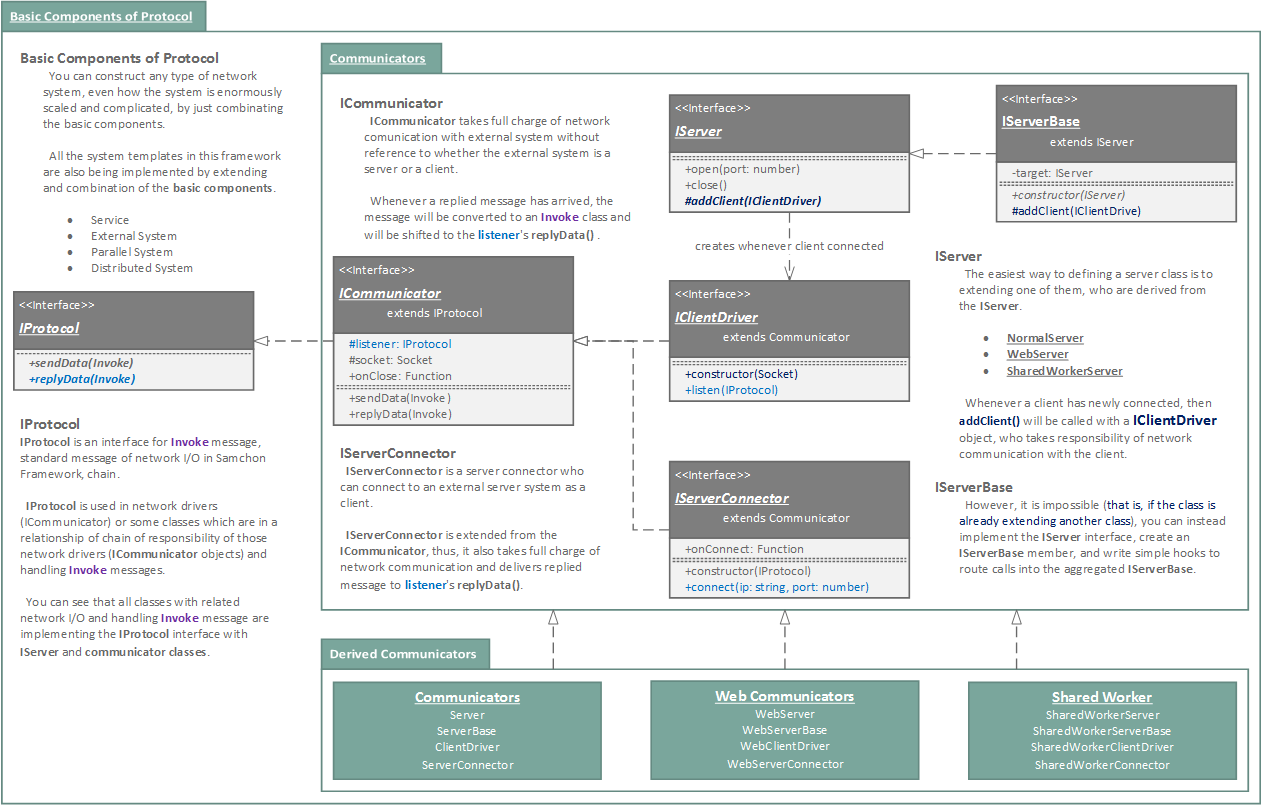
|
||
*
|
||
* @see {@link IServer}, {@link IProtocol}
|
||
* @handbook [Protocol - Basic Components](https://github.com/samchon/framework/wiki/TypeScript-Protocol-Basic_Components#iserverconnector)
|
||
* @author Jeongho Nam <http://samchon.org>
|
||
*/
|
||
interface IServerConnector extends ICommunicator {
|
||
/**
|
||
* Callback function for connection completed.
|
||
*
|
||
* When you call {@link connect connect()} and the connection has completed, then this call back function
|
||
* {@link onConnect} will be called. Note that, if the listener of this {@link onConnect} is a member method of
|
||
* some class, then you've use the ```bind```.
|
||
*/
|
||
onConnect: Function;
|
||
/**
|
||
* Connect to a server.
|
||
*
|
||
* Connects to a server with specified *host* address and *port* number. After the connection has
|
||
* succeeded, callback function {@link onConnect} is called. Listening data from the connected server also begins.
|
||
* Replied messages from the connected server will be converted to {@link Invoke} classes and will be shifted to
|
||
* the {@link WebCommunicator.listener listener}'s {@link IProtocol.replyData replyData()} method.
|
||
*
|
||
* If the connection fails immediately, either an event is dispatched or an exception is thrown: an error
|
||
* event is dispatched if a host was specified, and an exception is thrown if no host was specified. Otherwise,
|
||
* the status of the connection is reported by an event. If the socket is already connected, the existing
|
||
* connection is closed first.
|
||
*
|
||
* @param ip The name or IP address of the host to connect to.
|
||
* If no host is specified, the host that is contacted is the host where the calling file resides.
|
||
* If you do not specify a host, use an event listener to determine whether the connection was
|
||
* successful.
|
||
* @param port The port number to connect to.
|
||
*/
|
||
connect(ip: string, port: number): void;
|
||
}
|
||
}
|
||
declare namespace samchon.protocol {
|
||
/**
|
||
* Server connnector.
|
||
*
|
||
* {@link ServerConnector} is a class connecting to remote server who follows Samchon Framework's own protocol and
|
||
* taking full charge of network communication with the remote server. Create a {@link ServerConnector} instance from
|
||
* the {@IProtocol listener} and call the {@link connect connect()} method.
|
||
*
|
||
* #### [Inherited] {@link IServerConnector}
|
||
* {@link IServerConnector} is a type of {@link ICommunicator}, specified for server connector classes who connect to
|
||
* the remote server as a client. {@link IServerConnector} provides {@link connect connection method} and takes full
|
||
* charge of network communication with the remote server.
|
||
*
|
||
* Declare specific type of {@link IServerConnector} from {@link IProtocol listener} and call the
|
||
* {@link connect connect()} method. Then whenever a replied message comes from the remote system, the message will
|
||
* be converted to an {@link Invoke} object and the {@link Invoke} object will be shifted to the
|
||
* {@link IProtocol listener}'s {@link IProtocol.replyData IProtocol.replyData()} method.
|
||
*
|
||
* Note that, protocol of this client and remote server must be matched. Thus, before determining specific type of
|
||
* this {@link IServerConnector}, you've to consider which protocol and type the remote server follows.
|
||
*
|
||
* Protocol | Derived Type | Connect to
|
||
* ------------------------|----------------------------------------|-------------------------------
|
||
* Samchon Framework's own | {@link ServerConnector} | {@link Server}
|
||
* Web-socket protocol | {@link WebServerConnector} | {@link WebServer}
|
||
* DedicatedWorker | {@link DedicatedWorkerServerConnector} | {@link DedicatedWorkerServer}
|
||
* SharedWorker | {@link SharedWorkerServerConnector} | {@link SharedWorkerServer}
|
||
*
|
||
* 
|
||
*
|
||
* @see {@link Server}, {@link IProtocol}
|
||
* @handbook [Protocol - Basic Components](https://github.com/samchon/framework/wiki/TypeScript-Protocol-Basic_Components#iserverconnector)
|
||
* @author Jeongho Nam <http://samchon.org>
|
||
*/
|
||
class ServerConnector extends Communicator implements IServerConnector {
|
||
/**
|
||
* @inheritdoc
|
||
*/
|
||
onConnect: Function;
|
||
/**
|
||
* Construct from *listener*.
|
||
*
|
||
* @param listener A listener object to listen replied message from newly connected client in
|
||
* {@link IProtocol.replyData replyData()} as an {@link Invoke} object.
|
||
*/
|
||
constructor(listener: IProtocol);
|
||
/**
|
||
* @inheritdoc
|
||
*/
|
||
connect(ip: string, port: number): void;
|
||
/**
|
||
* @hidden
|
||
*/
|
||
private handle_connect(...arg);
|
||
}
|
||
}
|
||
declare namespace samchon.protocol {
|
||
/**
|
||
* A server connector for web-socket protocol.
|
||
*
|
||
* {@link WebServerConnector} is a class connecting to remote server who follows Web-socket protocol and taking full
|
||
* charge of network communication with the remote server. Create an {@link WebServerConnector} instance from the
|
||
* {@IProtocol listener} and call the {@link connect connect()} method.
|
||
*
|
||
* #### [Inherited] {@link IServerConnector}
|
||
* {@link IServerConnector} is a type of {@link ICommunicator}, specified for server connector classes who connect to
|
||
* the remote server as a client. {@link IServerConnector} provides {@link connect connection method} and takes full
|
||
* charge of network communication with the remote server.
|
||
*
|
||
* Declare specific type of {@link IServerConnector} from {@link IProtocol listener} and call the
|
||
* {@link connect connect()} method. Then whenever a replied message comes from the remote system, the message will
|
||
* be converted to an {@link Invoke} class and the {@link Invoke} object will be shifted to the
|
||
* {@link IProtocol listener}'s {@link IProtocol.replyData IProtocol.replyData()} method.
|
||
*
|
||
* Note that, protocol of this client and remote server must be matched. Thus, before determining specific type of
|
||
* this {@link IServerConnector}, you've to consider which protocol and type the remote server follows.
|
||
*
|
||
* Protocol | Derived Type | Connect to
|
||
* ------------------------|----------------------------------------|-------------------------------
|
||
* Samchon Framework's own | {@link ServerConnector} | {@link Server}
|
||
* Web-socket protocol | {@link WebServerConnector} | {@link WebServer}
|
||
* DedicatedWorker | {@link DedicatedWorkerServerConnector} | {@link DedicatedWorkerServer}
|
||
* SharedWorker | {@link SharedWorkerServerConnector} | {@link SharedWorkerServer}
|
||
*
|
||
* 
|
||
*
|
||
* @see {@link WebServer}, {@link IProtocol}
|
||
* @handbook [Protocol - Basic Components](https://github.com/samchon/framework/wiki/TypeScript-Protocol-Basic_Components#iserverconnector)
|
||
* @author Jeongho Nam <http://samchon.org>
|
||
*/
|
||
class WebServerConnector extends WebCommunicator implements IServerConnector {
|
||
/**
|
||
* @hidden
|
||
*/
|
||
private browser_socket_;
|
||
/**
|
||
* @hidden
|
||
*/
|
||
private node_client_;
|
||
/**
|
||
* @inheritdoc
|
||
*/
|
||
onConnect: Function;
|
||
/**
|
||
* Construct from *listener*.
|
||
*
|
||
* @param listener A listener object to listen replied message from newly connected client in
|
||
* {@link IProtocol.replyData replyData()} as an {@link Invoke} object.
|
||
*/
|
||
constructor(listener: IProtocol);
|
||
/**
|
||
* Connect to a web server.
|
||
*
|
||
* Connects to a server with specified *host* address, *port* number and *path*. After the connection has
|
||
* succeeded, callback function {@link onConnect} is called. Listening data from the connected server also begins.
|
||
* Replied messages from the connected server will be converted to {@link Invoke} classes and will be shifted to
|
||
* the {@link WebCommunicator.listener listener}'s {@link IProtocol.replyData replyData()} method.
|
||
*
|
||
* If the connection fails immediately, either an event is dispatched or an exception is thrown: an error
|
||
* event is dispatched if a host was specified, and an exception is thrown if no host was specified. Otherwise,
|
||
* the status of the connection is reported by an event. If the socket is already connected, the existing
|
||
* connection is closed first.
|
||
*
|
||
* @param ip The name or IP address of the host to connect to.
|
||
* If no host is specified, the host that is contacted is the host where the calling file resides.
|
||
* If you do not specify a host, use an event listener to determine whether the connection was
|
||
* successful.
|
||
* @param port The port number to connect to.
|
||
* @param path Path of service which you want.
|
||
*/
|
||
connect(ip: string, port: number, path?: string): void;
|
||
/**
|
||
* @inheritdoc
|
||
*/
|
||
close(): void;
|
||
/**
|
||
* @inheritdoc
|
||
*/
|
||
sendData(invoke: Invoke): void;
|
||
/**
|
||
* @hidden
|
||
*/
|
||
private handle_browser_connect(event);
|
||
/**
|
||
* @hidden
|
||
*/
|
||
private handle_browser_message(event);
|
||
/**
|
||
* @hidden
|
||
*/
|
||
private handle_node_connect(connection);
|
||
}
|
||
}
|
||
declare namespace samchon.protocol {
|
||
/**
|
||
* A server connector for DedicatedWorker.
|
||
*
|
||
* {@link DedicatedWorkerServerConnector} is a class connecting to SharedWorker and taking full charge of network
|
||
* communication with the SharedWorker. Create an {@link DedicatedWorkerServer} instance from the
|
||
* {@IProtocol listener} and call the {@link connect connect()} method.
|
||
*
|
||
* #### Why DedicatedWorker be a server?
|
||
* In JavaScript environment, there's no way to implement multi-threading function. Instead, JavaScript supports the
|
||
* **Worker**, creating a new process. However, the **Worker** does not shares memory addresses. To integrate the
|
||
* **Worker** with its master, only communication with string or binary data is allowed. Doesn't it seem like a network
|
||
* communication? Furthermore, there's not any difference between the worker communication and network communication.
|
||
* It's the reason why Samchon Framework considers the **Worker** as a network node.
|
||
*
|
||
* The class {@link DedicatedWorkerCommunicator} is designed make such relationship. From now on, DedicatedWorker is a
|
||
* {@link DedicatedWorkerServer server} and {@link DedicatedWorkerServerConnector browser} is a client. Integrate the
|
||
* server and clients with this {@link DedicatedWorkerCommunicator}.
|
||
*
|
||
* #### [Inherited] {@link IServerConnector}
|
||
* {@link IServerConnector} is a type of {@link ICommunicator}, specified for server connector classes who connect to
|
||
* the remote server as a client. {@link IServerConnector} provides {@link connect connection method} and takes full
|
||
* charge of network communication with the remote server.
|
||
*
|
||
* Declare specific type of {@link IServerConnector} from {@link IProtocol listener} and call the
|
||
* {@link connect connect()} method. Then whenever a replied message comes from the remote system, the message will
|
||
* be converted to an {@link Invoke} class and the {@link Invoke} object will be shifted to the
|
||
* {@link IProtocol listener}'s {@link IProtocol.replyData IProtocol.replyData()} method.
|
||
*
|
||
* Note that, protocol of this client and remote server must be matched. Thus, before determining specific type of
|
||
* this {@link IServerConnector}, you've to consider which protocol and type the remote server follows.
|
||
*
|
||
* Protocol | Derived Type | Connect to
|
||
* ------------------------|----------------------------------------|-------------------------------
|
||
* Samchon Framework's own | {@link ServerConnector} | {@link Server}
|
||
* Web-socket protocol | {@link WebServerConnector} | {@link WebServer}
|
||
* DedicatedWorker | {@link DedicatedWorkerServerConnector} | {@link DedicatedWorkerServer}
|
||
* SharedWorker | {@link SharedWorkerServerConnector} | {@link SharedWorkerServer}
|
||
*
|
||
* 
|
||
*
|
||
* @see {@link DedicatedWorkerServer}, {@link IProtocol}
|
||
* @handbook [Protocol - Basic Components](https://github.com/samchon/framework/wiki/TypeScript-Protocol-Basic_Components#iserverconnector)
|
||
* @author Jeongho Nam <http://samchon.org>
|
||
*/
|
||
class DedicatedWorkerServerConnector extends DedicatedWorkerCommunicator implements IServerConnector {
|
||
/**
|
||
* @hidden
|
||
*/
|
||
private worker;
|
||
/**
|
||
* @inheritdoc
|
||
*/
|
||
onConnect: Function;
|
||
/**
|
||
* Construct from *listener*.
|
||
*
|
||
* @param listener A listener object to listen replied message from newly connected client in
|
||
* {@link IProtocol.replyData replyData()} as an {@link Invoke} object.
|
||
*/
|
||
constructor(listener: IProtocol);
|
||
/**
|
||
* @inheritdoc
|
||
*/
|
||
connect(jsFile: string): void;
|
||
/**
|
||
* @inheritdoc
|
||
*/
|
||
close(): void;
|
||
/**
|
||
* @inheritdoc
|
||
*/
|
||
sendData(invoke: Invoke): void;
|
||
}
|
||
}
|
||
declare namespace samchon.protocol {
|
||
/**
|
||
* A server connector for SharedWorker.
|
||
*
|
||
* {@link SharedWorkerServerConnector} is a class connecting to SharedWorker and taking full charge of network
|
||
* communication with the SharedWorker. Create an {@link SharedWorkerServerConnector} instance from the
|
||
* {@IProtocol listener} and call the {@link connect connect()} method.
|
||
*
|
||
* #### Why SharedWorker be a server?
|
||
* SharedWorker, it allows only an instance (process) to be created whether the SharedWorker is declared in a browser
|
||
* or multiple browsers. To integrate them, messages are being sent and received. Doesn't it seem like a relationship
|
||
* between a server and clients? Thus, Samchon Framework consider the SharedWorker as a server and browsers as
|
||
* clients.
|
||
*
|
||
* The class {@link SharedWorkerCommunicator} is designed make such relationship. From now on, SharedWorker is a
|
||
* {@link SharedWorkerServer server} and {@link SharedWorkerServerConnector browsers} are clients. Integrate the
|
||
* server and clients with this {@link SharedWorkerCommunicator}.
|
||
*
|
||
* #### [Inherited] {@link IServerConnector}
|
||
* {@link IServerConnector} is a type of {@link ICommunicator}, specified for server connector classes who connect to
|
||
* the remote server as a client. {@link IServerConnector} provides {@link connect connection method} and takes full
|
||
* charge of network communication with the remote server.
|
||
*
|
||
* Declare specific type of {@link IServerConnector} from {@link IProtocol listener} and call the
|
||
* {@link connect connect()} method. Then whenever a replied message comes from the remote system, the message will
|
||
* be converted to an {@link Invoke} class and the {@link Invoke} object will be shifted to the
|
||
* {@link IProtocol listener}'s {@link IProtocol.replyData IProtocol.replyData()} method.
|
||
*
|
||
* Note that, protocol of this client and remote server must be matched. Thus, before determining specific type of
|
||
* this {@link IServerConnector}, you've to consider which protocol and type the remote server follows.
|
||
*
|
||
* Protocol | Derived Type | Connect to
|
||
* ------------------------|----------------------------------------|-------------------------------
|
||
* Samchon Framework's own | {@link ServerConnector} | {@link Server}
|
||
* Web-socket protocol | {@link WebServerConnector} | {@link WebServer}
|
||
* DedicatedWorker | {@link DedicatedWorkerServerConnector} | {@link DedicatedWorkerServer}
|
||
* SharedWorker | {@link SharedWorkerServerConnector} | {@link SharedWorkerServer}
|
||
*
|
||
* 
|
||
*
|
||
* @see {@link SharedWorkerServer}, {@link IProtocol}
|
||
* @handbook [Protocol - Basic Components](https://github.com/samchon/framework/wiki/TypeScript-Protocol-Basic_Components#iserverconnector)
|
||
* @author Jeongho Nam <http://samchon.org>
|
||
*/
|
||
class SharedWorkerServerConnector extends SharedWorkerCommunicator implements IServerConnector {
|
||
/**
|
||
* @inheritdoc
|
||
*/
|
||
onConnect: Function;
|
||
/**
|
||
* Construct from *listener*.
|
||
*
|
||
* @param listener A listener object to listen replied message from newly connected client in
|
||
* {@link IProtocol.replyData replyData()} as an {@link Invoke} object.
|
||
*/
|
||
constructor(listener: IProtocol);
|
||
/**
|
||
* Connect to a SharedWorker.
|
||
*
|
||
* Connects to a server with specified *jstFile* path. If a SharedWorker instance of the *jsFile* is not
|
||
* constructed yet, then the SharedWorker will be newly constructed. Otherwise the SharedWorker already exists,
|
||
* then connect to the SharedWorker. After those processes, callback function {@link onConnect} is called.
|
||
* Listening data from the connected server also begins. Replied messages from the connected server will be
|
||
* converted to {@link Invoke} classes and will be shifted to the {@link WebCommunicator.listener listener}'s
|
||
* {@link IProtocol.replyData replyData()} method.
|
||
*
|
||
* If the connection fails immediately, either an event is dispatched or an exception is thrown: an error
|
||
* event is dispatched if a host was specified, and an exception is thrown if no host was specified. Otherwise,
|
||
* the status of the connection is reported by an event. If the socket is already connected, the existing
|
||
* connection is closed first.
|
||
*
|
||
* @param jsFile Path of JavaScript file to execute who defines SharedWorker.
|
||
*/
|
||
connect(jsFile: string): void;
|
||
}
|
||
}
|
||
declare namespace samchon.protocol {
|
||
/**
|
||
* @hidden
|
||
*/
|
||
namespace socket {
|
||
type socket = any;
|
||
type server = any;
|
||
type http_server = any;
|
||
}
|
||
/**
|
||
* @hidden
|
||
*/
|
||
namespace websocket {
|
||
type connection = any;
|
||
type request = any;
|
||
type IMessage = any;
|
||
type ICookie = any;
|
||
type client = any;
|
||
}
|
||
}
|
||
declare namespace samchon.templates.distributed {
|
||
/**
|
||
* Master of Distributed Processing System, a server accepting slave clients.
|
||
*
|
||
* The {@link DistributedClientArray} is an abstract class, derived from the {@link DistributedSystemArray} class,
|
||
* opening a server accepting {@link DistributedSystem distributed clients}.
|
||
*
|
||
* Extends this {@link DistributedClientArray}, overrides {@link createServerBase createServerBase()} to determine
|
||
* which protocol to follow and {@link createExternalClient createExternalClient()} creating child
|
||
* {@link DistributedSystem} object. After the extending and overridings, open this server using the
|
||
* {@link open open()} method.
|
||
*
|
||
* #### [Inherited] {@link DistributedSystemArray}
|
||
* The {@link DistributedSystemArray} is an abstract class containing and managing remote distributed **slave** system
|
||
* drivers, {@link DistributedSystem} objects. Within framework of network, {@link DistributedSystemArray} represents
|
||
* your system, a **Master** of *Distributed Processing System* that requesting *distributed process* to **slave**
|
||
* systems and the children {@link DistributedSystem} objects represent the remote **slave** systems, who is being
|
||
* requested the *distributed processes*.
|
||
*
|
||
* The {@link DistributedSystemArray} contains {@link DistributedProcess} objects directly. You can request a
|
||
* **distributed process** through the {@link DistributedProcess} object. You can access the
|
||
* {@link DistributedProcess} object(s) with those methods:
|
||
*
|
||
* - {@link hasProcess}
|
||
* - {@link getProcess}
|
||
* - {@link insertProcess}
|
||
* - {@link eraseProcess}
|
||
* - {@link getProcessMap}
|
||
*
|
||
* When you need the **distributed process**, call the {@link DistributedProcess.sendData} method. Then the
|
||
* {@link DistributedProcess} will find the most idle {@link DistributedSystem} object who represents a distributed
|
||
* **slave **system. The {@link Invoke} message will be sent to the most idle {@link DistributedSystem} object. When
|
||
* the **distributed process** has completed, then {@link DistributedSystem.getPerformance performance index} and
|
||
* {@link DistributedProcess.getResource resource index} of related objects will be revaluated.
|
||
*
|
||
* <a href="http://samchon.github.io/framework/images/design/ts_class_diagram/templates_distributed_system.png"
|
||
* target="_blank">
|
||
* <img src="http://samchon.github.io/framework/images/design/ts_class_diagram/templates_distributed_system.png"
|
||
* style="max-width: 100%" />
|
||
* </a>
|
||
*
|
||
* #### Parallel Process
|
||
* This {@link DistributedSystemArray} class is derived from the {@link ParallelSystemArray} class, so you can request
|
||
* a **parallel process**, too.
|
||
*
|
||
* When you need the **parallel process**, then call one of them: {@link sendSegmentData} or {@link sendPieceData}.
|
||
* When the **parallel process** has completed, {@link ParallelSystemArray} estimates each {@link ParallelSystem}'s
|
||
* {@link ParallelSystem.getPerformance performance index} basis on their execution time. Those performance indices will
|
||
* be reflected to the next **parallel process**, how much pieces to allocate to each {@link ParallelSystem}.
|
||
*
|
||
* #### Proxy Pattern
|
||
* This class {@link DistributedSystemArray} is derived from the {@link ExternalSystemArray} class. Thus, you can take
|
||
* advantage of the *Proxy Pattern* in the {@link DistributedSystemArray} class. If a process to request is not the
|
||
* *parallel process* (to be distrubted to all slaves), but the **exclusive process** handled in a system, then it
|
||
* may better to utilizing the *Proxy Pattern*:
|
||
*
|
||
* The {@link ExternalSystemArray} class can use *Proxy Pattern*. In framework within user, which
|
||
* {@link ExternalSystem external system} is connected with {@link ExternalSystemArray this system}, it's not
|
||
* important. Only interested in user's perspective is *which can be done*.
|
||
*
|
||
* By using the *logical proxy*, user dont't need to know which {@link ExternalSystemRole role} is belonged
|
||
* to which {@link ExternalSystem system}. Just access to a role directly from {@link ExternalSystemArray.getRole}.
|
||
* Sends and receives {@link Invoke} message via the {@link ExternalSystemRole role}.
|
||
*
|
||
* <ul>
|
||
* <li>
|
||
* {@link ExternalSystemRole} can be accessed from {@link ExternalSystemArray} directly, without inteferring
|
||
* from {@link ExternalSystem}, with {@link ExternalSystemArray.getRole}.
|
||
* </li>
|
||
* <li>
|
||
* When you want to send an {@link Invoke} message to the belonged {@link ExternalSystem system}, just call
|
||
* {@link ExternalSystemRole.sendData ExternalSystemRole.sendData()}. Then, the message will be sent to the
|
||
* external system.
|
||
* </li>
|
||
* <li> Those strategy is called *Proxy Pattern*. </li>
|
||
* </ul>
|
||
*
|
||
* @handbook [Templates - Distributed System](https://github.com/samchon/framework/wiki/TypeScript-Templates-Distributed_System)
|
||
* @author Jeongho Nam <http://samchon.org>
|
||
*/
|
||
abstract class DistributedClientArray<System extends DistributedSystem> extends DistributedSystemArray<System> implements external.IExternalClientArray<System> {
|
||
/**
|
||
* @hidden
|
||
*/
|
||
private server_base_;
|
||
/**
|
||
* Default Constructor.
|
||
*/
|
||
constructor();
|
||
/**
|
||
* Factory method creating {@link IServerBase} object.
|
||
*
|
||
* This method {@link createServerBase createServerBase()} determines which protocol is used in this server,
|
||
* {@link ExternalClientArray}. If the protocol is determined, then {@link ExternalSystem external clients} who
|
||
* may connect to {@link ExternalClientArray this server} must follow the specified protocol.
|
||
*
|
||
* Overrides the {@link createServerBase createServerBase()} method to create and return one of them:
|
||
*
|
||
* - {@link ServerBase}
|
||
* - {@link WebServerBase}
|
||
* - {@link SharedWorkerServerBase}
|
||
*
|
||
* @return A new {@link IServerBase} object.
|
||
*/
|
||
protected abstract createServerBase(): protocol.IServerBase;
|
||
/**
|
||
* Add a newly connected remote client.
|
||
*
|
||
* When a {@link IClientDriver remote client} connects to this *master server of parallel processing system*,
|
||
* then this {@link ParallelClientArray} creates a child {@link ParallelSystem parallel client} object through
|
||
* the {@link createExternalClient createExternalClient()} method and {@link insert inserts} it.
|
||
*
|
||
* @param driver A communicator for external client.
|
||
*/
|
||
addClient(driver: protocol.IClientDriver): void;
|
||
/**
|
||
* (Deprecated) Factory method creating child object.
|
||
*
|
||
* The method {@link createChild createChild()} is deprecated. Don't use and override this.
|
||
*
|
||
* Note that, the {@link ParallelClientArray} is a server accepting {@link ParallelSystem parallel clients}.
|
||
* There's no way to creating the {@link ParallelSystem parallel clients} in advance before opening the server.
|
||
*
|
||
* @param xml An {@link XML} object represents the child {@link ParallelSystem} object.
|
||
* @return ```null```
|
||
*/
|
||
createChild(xml: library.XML): System;
|
||
/**
|
||
* Factory method creating {@link DistributedSystem} object.
|
||
*
|
||
* The method {@link createExternalClient createExternalClient()} is a factory method creating a child
|
||
* {@link ParallelSystem} object, that is called whenever a parallel client has connected, by
|
||
* {@link addClient addClient()}.
|
||
*
|
||
* Overrides this {@link createExternalClient} method and creates a type of {@link DistributedSystem} object with
|
||
* the *driver* that communicates with the parallel client. After the creation, returns the object. Then whenever
|
||
* a parallel client has connected, matched {@link DistributedSystem} object will be constructed and
|
||
* {@link insert inserted} into this {@link DistributedSystemArray} object.
|
||
*
|
||
* @param driver A communicator with the parallel client.
|
||
* @return A newly created {@link ParallelSystem} object.
|
||
*/
|
||
protected abstract createExternalClient(driver: protocol.IClientDriver): System;
|
||
/**
|
||
* @inheritdoc
|
||
*/
|
||
open(port: number): void;
|
||
/**
|
||
* @inheritdoc
|
||
*/
|
||
close(): void;
|
||
}
|
||
}
|
||
declare namespace samchon.templates.distributed {
|
||
/**
|
||
* Mediator of Distributed Processing System, a server accepting slave clients.
|
||
*
|
||
* The {@link DistributedClientArrayMediator} is an abstract class, derived from {@link DistributedSystemArrayMediator}
|
||
* class, opening a server accepting {@link DistributedSystem distributed clients} as a **master**.
|
||
*
|
||
* Extends this {@link DistributedClientArrayMediator}, overrides {@link createServerBase createServerBase()} to
|
||
* determine which protocol to follow and {@link createExternalClient createExternalClient()} creating child
|
||
* {@link DistributedSystem} object. After the extending and overridings, open this server using the
|
||
* {@link open open()} method.
|
||
*
|
||
* #### [Inherited] {@link DistributedSystemArrayMediator}
|
||
* The {@link DistributedSystemArrayMediator} class be a master for its slave systems, and be a slave to its master
|
||
* system at the same time. This {@link DistributedSystemArrayMediator} be a master system, containing and managing
|
||
* {@link DistributedSystem} objects, which represent distributed slave systems, by extending
|
||
* {@link DistributedSystemArray} class. Also, be a slave system through {@link getMediator mediator} object, which is
|
||
* derived from the {@link SlaveSystem} class.
|
||
*
|
||
* As a slave, you can specify this {@link DistributedSystemArrayMediator} to be <i>a client slave connecting to master
|
||
* server</i> or <i>a server slave accepting master client</i> by overriding the {@link createMediator} method.
|
||
* Overrides the {@link createMediator createMediator()} method and return one of them:
|
||
*
|
||
* - A client slave connecting to master server:
|
||
* - {@link MediatorClient}
|
||
* - {@link MediatorWebClient}
|
||
* - {@link MediatorSharedWorkerClient}
|
||
* - A server slave accepting master client:
|
||
* - {@link MediatorServer}
|
||
* - {@link MediatorWebServer}
|
||
* - {@link MediatorDedicatedWorkerServer}
|
||
* - {@link MediatorSharedWorkerServer}
|
||
*
|
||
* #### [Inherited] {@link DistributedSystemArray}
|
||
* The {@link DistributedSystemArray} is an abstract class containing and managing remote distributed **slave** system
|
||
* drivers, {@link DistributedSystem} objects. Within framework of network, {@link DistributedSystemArray} represents
|
||
* your system, a **Master** of *Distributed Processing System* that requesting *distributed process* to **slave**
|
||
* systems and the children {@link DistributedSystem} objects represent the remote **slave** systems, who is being
|
||
* requested the *distributed processes*.
|
||
*
|
||
* The {@link DistributedSystemArray} contains {@link DistributedProcess} objects directly. You can request a
|
||
* **distributed process** through the {@link DistributedProcess} object. You can access the
|
||
* {@link DistributedProcess} object(s) with those methods:
|
||
*
|
||
* - {@link hasProcess}
|
||
* - {@link getProcess}
|
||
* - {@link insertProcess}
|
||
* - {@link eraseProcess}
|
||
* - {@link getProcessMap}
|
||
*
|
||
* When you need the **distributed process**, call the {@link DistributedProcess.sendData} method. Then the
|
||
* {@link DistributedProcess} will find the most idle {@link DistributedSystem} object who represents a distributed
|
||
* **slave **system. The {@link Invoke} message will be sent to the most idle {@link DistributedSystem} object. When
|
||
* the **distributed process** has completed, then {@link DistributedSystem.getPerformance performance index} and
|
||
* {@link DistributedProcess.getResource resource index} of related objects will be revaluated.
|
||
*
|
||
* <a href="http://samchon.github.io/framework/images/design/ts_class_diagram/templates_distributed_system.png"
|
||
* target="_blank">
|
||
* <img src="http://samchon.github.io/framework/images/design/ts_class_diagram/templates_distributed_system.png"
|
||
* style="max-width: 100%" />
|
||
* </a>
|
||
*
|
||
* #### Parallel Process
|
||
* This {@link DistributedSystemArray} class is derived from the {@link ParallelSystemArray} class, so you can request
|
||
* a **parallel process**, too.
|
||
*
|
||
* When you need the **parallel process**, then call one of them: {@link sendSegmentData} or {@link sendPieceData}.
|
||
* When the **parallel process** has completed, {@link ParallelSystemArray} estimates each {@link ParallelSystem}'s
|
||
* {@link ParallelSystem.getPerformance performance index} basis on their execution time. Those performance indices will
|
||
* be reflected to the next **parallel process**, how much pieces to allocate to each {@link ParallelSystem}.
|
||
*
|
||
* #### Proxy Pattern
|
||
* This class {@link DistributedSystemArray} is derived from the {@link ExternalSystemArray} class. Thus, you can take
|
||
* advantage of the *Proxy Pattern* in the {@link DistributedSystemArray} class. If a process to request is not the
|
||
* *parallel process* (to be distrubted to all slaves), but the **exclusive process** handled in a system, then it
|
||
* may better to utilizing the *Proxy Pattern*:
|
||
*
|
||
* The {@link ExternalSystemArray} class can use *Proxy Pattern*. In framework within user, which
|
||
* {@link ExternalSystem external system} is connected with {@link ExternalSystemArray this system}, it's not
|
||
* important. Only interested in user's perspective is *which can be done*.
|
||
*
|
||
* By using the *logical proxy*, user dont't need to know which {@link ExternalSystemRole role} is belonged
|
||
* to which {@link ExternalSystem system}. Just access to a role directly from {@link ExternalSystemArray.getRole}.
|
||
* Sends and receives {@link Invoke} message via the {@link ExternalSystemRole role}.
|
||
*
|
||
* <ul>
|
||
* <li>
|
||
* {@link ExternalSystemRole} can be accessed from {@link ExternalSystemArray} directly, without inteferring
|
||
* from {@link ExternalSystem}, with {@link ExternalSystemArray.getRole}.
|
||
* </li>
|
||
* <li>
|
||
* When you want to send an {@link Invoke} message to the belonged {@link ExternalSystem system}, just call
|
||
* {@link ExternalSystemRole.sendData ExternalSystemRole.sendData()}. Then, the message will be sent to the
|
||
* external system.
|
||
* </li>
|
||
* <li> Those strategy is called *Proxy Pattern*. </li>
|
||
* </ul>
|
||
*
|
||
* @handbook [Templates - Distributed System](https://github.com/samchon/framework/wiki/TypeScript-Templates-Distributed_System)
|
||
* @author Jeongho Nam <http://samchon.org>
|
||
*/
|
||
abstract class DistributedClientArrayMediator<System extends DistributedSystem> extends DistributedSystemArrayMediator<System> implements external.IExternalClientArray<System> {
|
||
/**
|
||
* A subrogator of {@link IServer server}'s role instead of this {@link ExternalClientArray}.
|
||
*/
|
||
private server_base_;
|
||
/**
|
||
* Default Constructor.
|
||
*/
|
||
constructor();
|
||
/**
|
||
* Factory method creating {@link IServerBase} object.
|
||
*
|
||
* This method {@link createServerBase createServerBase()} determines which protocol is used in this
|
||
* {@link DistributedClientArrayMediator} object as a **master**. If the protocol is determined, then
|
||
* {@link DistributedSystem distributed clients} who may connect to {@link DistributedClientArrayMediator this
|
||
* server} must follow the specified protocol.
|
||
*
|
||
* Overrides the {@link createServerBase createServerBase()} method to create and return one of them:
|
||
*
|
||
* - {@link ServerBase}
|
||
* - {@link WebServerBase}
|
||
* - {@link SharedWorkerServerBase}
|
||
*
|
||
* @return A new {@link IServerBase} object.
|
||
*/
|
||
protected abstract createServerBase(): protocol.IServerBase;
|
||
/**
|
||
* Add a newly connected remote client.
|
||
*
|
||
* When a {@link IClientDriver remote client} connects to this *master server of distributed processing system*,
|
||
* then this {@link DistributedClientArrayMediator} creates a child {@link Distributed distributed client} object
|
||
* through the {@link createExternalClient createExternalClient()} method.
|
||
*
|
||
* @param driver A communicator for external client.
|
||
*/
|
||
addClient(driver: protocol.IClientDriver): void;
|
||
/**
|
||
* (Deprecated) Factory method creating child object.
|
||
*
|
||
* The method {@link createChild createChild()} is deprecated. Don't use and override this.
|
||
*
|
||
* Note that, the {@link DistributedClientArrayMediator} is a server accepting {@link DistributedSystem distributed
|
||
* clients} as a master. There's no way to creating the {@link DistributedSystem distributed clients} in advance
|
||
* before opening the server.
|
||
*
|
||
* @param xml An {@link XML} object represents the child {@link DistributedSystem} object.
|
||
* @return null
|
||
*/
|
||
createChild(xml: library.XML): System;
|
||
/**
|
||
* Factory method creating {@link DistributedSystem} object.
|
||
*
|
||
* The method {@link createExternalClient createExternalClient()} is a factory method creating a child
|
||
* {@link DistributedSystem} object, that is called whenever a distributed client has connected, by
|
||
* {@link addClient addClient()}.
|
||
*
|
||
* Overrides this {@link createExternalClient} method and creates a type of {@link DistributedSystem} object with
|
||
* the *driver* that communicates with the distributed client. After the creation, returns the object. Then whenever
|
||
* a distributed client has connected, matched {@link DistributedSystem} object will be constructed and
|
||
* {@link insert inserted} into this {@link DistributedClientArrayMediator} object.
|
||
*
|
||
* @param driver A communicator with the distributed client.
|
||
* @return A newly created {@link DistributedSystem} object.
|
||
*/
|
||
protected abstract createExternalClient(driver: protocol.IClientDriver): System;
|
||
/**
|
||
* @inheritdoc
|
||
*/
|
||
open(port: number): void;
|
||
/**
|
||
* @inheritdoc
|
||
*/
|
||
close(): void;
|
||
}
|
||
}
|
||
declare namespace samchon.templates.distributed {
|
||
/**
|
||
* A process of Distributed Processing System.
|
||
*
|
||
* The {@link DistributedProcess} is an abstract class who represents a **process**, *SOMETHING TO DISTRIBUTE* in a Distributed
|
||
* Processing System. Overrides the {@link DistributedProcess} and defines the *SOMETHING TO DISTRIBUTE*.
|
||
*
|
||
* Relationship between {@link DistributedSystem} and {@link DistributedProcess} objects are **M: N Associative**.
|
||
* Unlike {@link ExternalSystemRole}, the {@link DistributedProcess} objects are not belonged to a specific
|
||
* {@link DistributedSystem} object. The {@link DistributedProcess} objects are belonged to the
|
||
* {@link DistributedSystemArrayMediator} directly.
|
||
*
|
||
* When you need the **distributed process**, then call {@link sendData sendData()}. The {@link sendData} will find
|
||
* the most idle {@link DistributedSystem slave system} considering not only number of processes on progress, but also
|
||
* {@link DistributedSystem.getPerformance performance index} of each {@link DistributedSystem} object and
|
||
* {@link getResource resource index} of this {@link DistributedProcess} object. The {@link Invoke} message
|
||
* requesting the **distributed process** will be sent to the most idle {@link DistributedSystem slave system}.
|
||
*
|
||
* Those {@link DistributedSystem.getPerformance performance index} and {@link getResource resource index} are
|
||
* revaluated whenever the **distributed process** has completed basis on the execution time.
|
||
*
|
||
* <a href="http://samchon.github.io/framework/images/design/ts_class_diagram/templates_distributed_system.png"
|
||
* target="_blank">
|
||
* <img src="http://samchon.github.io/framework/images/design/ts_class_diagram/templates_distributed_system.png"
|
||
* style="max-width: 100%" />
|
||
* </a>
|
||
*
|
||
* @handbook [Templates - Distributed System](https://github.com/samchon/framework/wiki/TypeScript-Templates-Distributed_System)
|
||
* @author Jeongho Nam <http://samchon.org>
|
||
*/
|
||
abstract class DistributedProcess extends protocol.Entity implements protocol.IProtocol {
|
||
/**
|
||
* @hidden
|
||
*/
|
||
private system_array_;
|
||
/**
|
||
* A name, represents and identifies this {@link DistributedProcess process}.
|
||
*
|
||
* This {@link name} is an identifier represents this {@link DistributedProcess process}. This {@link name} is
|
||
* used in {@link DistributedSystemArray.getProcess} and {@link DistributedSystemArray.getProcess}, as a key elements.
|
||
* Thus, this {@link name} should be unique in its parent {@link DistributedSystemArray} object.
|
||
*/
|
||
protected name: string;
|
||
/**
|
||
* @hidden
|
||
*/
|
||
private progress_list_;
|
||
/**
|
||
* @hidden
|
||
*/
|
||
private history_list_;
|
||
/**
|
||
* @hidden
|
||
*/
|
||
private resource;
|
||
/**
|
||
* @hidden
|
||
*/
|
||
private enforced_;
|
||
/**
|
||
* Constrct from parent {@link DistributedSystemArray} object.
|
||
*
|
||
* @param systemArray The parent {@link DistributedSystemArray} object.
|
||
*/
|
||
constructor(systemArray: DistributedSystemArray<DistributedSystem>);
|
||
/**
|
||
* Identifier of {@link ParallelProcess} is its {@link name}.
|
||
*/
|
||
key(): string;
|
||
/**
|
||
* Get parent {@link DistributedSystemArray} object.
|
||
*
|
||
* @return The parent {@link DistributedSystemArray} object.
|
||
*/
|
||
getSystemArray(): DistributedSystemArray<DistributedSystem>;
|
||
/**
|
||
* Get parent {@link DistributedSystemArray} object.
|
||
*
|
||
* @return The parent {@link DistributedSystemArray} object.
|
||
*/
|
||
getSystemArray<SystemArray extends DistributedSystemArray<DistributedSystem>>(): SystemArray;
|
||
/**
|
||
* Get name, who represents and identifies this process.
|
||
*/
|
||
getName(): string;
|
||
/**
|
||
* Get resource index.
|
||
*
|
||
* Get *resource index* that indicates how much this {@link DistributedProcess process} is heavy.
|
||
*
|
||
* If this {@link DistributedProcess process} does not have any {@link Invoke} message had handled, then the
|
||
* *resource index* will be ```1.0```, which means default and average value between all
|
||
* {@link DistributedProcess} instances (that are belonged to a same {@link DistributedSystemArray} object).
|
||
*
|
||
* You can specify the *resource index* by yourself, but notice that, if the *resource index* is higher than
|
||
* other {@link DistributedProcess} objects, then this {@link DistributedProcess process} will be ordered to
|
||
* handle less processes than other {@link DistributedProcess} objects. Otherwise, the *resource index* is
|
||
* lower than others, of course, much processes will be requested.
|
||
*
|
||
* - {@link setResource setResource()}
|
||
* - {@link enforceResource enforceResource()}
|
||
*
|
||
* Unless {@link enforceResource enforceResource()} is called, This *resource index* is **revaluated** whenever
|
||
* {@link sendData sendData()} is called.
|
||
*
|
||
* @return Resource index.
|
||
*/
|
||
getResource(): number;
|
||
/**
|
||
* Set resource index.
|
||
*
|
||
* Set *resource index* that indicates how much this {@link DistributedProcess process} is heavy. This
|
||
* *resource index* can be **revaulated**.
|
||
*
|
||
* Note that, initial and average *resource index* of {@link DistributedProcess} objects are ```1.0```. If the
|
||
* *resource index* is higher than other {@link DistributedProcess} objects, then this
|
||
* {@link DistributedProcess} will be ordered to handle more processes than other {@link DistributedProcess}
|
||
* objects. Otherwise, the *resource index* is lower than others, of course, less processes will be requested.
|
||
*
|
||
* Unlike {@link enforceResource}, configuring *resource index* by this {@link setResource} allows the
|
||
* **revaluation**. This **revaluation** prevents wrong valuation from user. For example, you *mis-valuated* the
|
||
* *resource index*. The {@link DistributedProcess process} is much heavier than any other, but you estimated it
|
||
* to the lightest one. It looks like a terrible case that causes
|
||
* {@link DistributedSystemArray entire distributed processing system} to be slower, however, don't mind. The
|
||
* {@link DistributedProcess process} will the direct to the *propriate resource index* eventually with the
|
||
* **revaluation**.
|
||
*
|
||
* - The **revaluation** is caused by the {@link sendData sendData()} method.
|
||
*
|
||
* @param val New resource index, but can be revaluated.
|
||
*/
|
||
setResource(val: number): void;
|
||
/**
|
||
* Enforce resource index.
|
||
*
|
||
* Enforce *resource index* that indicates how much heavy the {@link DistributedProcess process is}. The
|
||
* *resource index* will be fixed, never be **revaluated**.
|
||
*
|
||
* Note that, initial and average *resource index* of {@link DistributedProcess} objects are ```1.0```. If the
|
||
* *resource index* is higher than other {@link DistributedProcess} objects, then this
|
||
* {@link DistributedProcess} will be ordered to handle more processes than other {@link DistributedProcess}
|
||
* objects. Otherwise, the *resource index* is lower than others, of course, less processes will be requested.
|
||
*
|
||
* The difference between {@link setResource} and this {@link enforceResource} is allowing **revaluation** or not.
|
||
* This {@link enforceResource} does not allow the **revaluation**. The *resource index* is clearly fixed and
|
||
* never be changed by the **revaluation**. But you've to keep in mind that, you can't avoid the **mis-valuation**
|
||
* with this {@link enforceResource}.
|
||
*
|
||
* For example, there's a {@link DistributedProcess process} much heavier than any other, but you
|
||
* **mis-estimated** it to the lightest. In that case, there's no way. The
|
||
* {@link DistributedSystemArray entire distributed processing system} will be slower by the **mis-valuation**.
|
||
* By the reason, using {@link enforceResource}, it's recommended only when you can clearly certain the
|
||
* *resource index*. If you can't certain the *resource index* but want to recommend, then use {@link setResource}
|
||
* instead.
|
||
*
|
||
* @param val New resource index to be fixed.
|
||
*/
|
||
enforceResource(val: number): void;
|
||
/**
|
||
* @hidden
|
||
*/
|
||
private compute_average_elapsed_time();
|
||
/**
|
||
* @inheritdoc
|
||
*/
|
||
abstract replyData(invoke: protocol.Invoke): void;
|
||
/**
|
||
* Send an {@link Invoke} message.
|
||
*
|
||
* Sends an {@link Invoke} message requesting a **distributed process**. The {@link Invoke} message will be sent
|
||
* to the most idle {@link DistributedSystem} object, which represents a slave system, and the most idle
|
||
* {@link DistributedSystem} object will be returned.
|
||
*
|
||
* When the **distributed process** has completed, then the {@link DistributedSystemArray} object will revaluate
|
||
* {@link getResource resource index} and {@link DistributedSystem.getPerformance performance index} of this
|
||
* {@link DistributedSystem} and the most idle {@link DistributedSystem} objects basis on the execution time.
|
||
*
|
||
* @param invoke An {@link Invoke} message requesting distributed process.
|
||
* @return The most idle {@link DistributedSystem} object who may send the {@link Invoke} message.
|
||
*/
|
||
sendData(invoke: protocol.Invoke): DistributedSystem;
|
||
/**
|
||
* Send an {@link Invoke} message.
|
||
*
|
||
* Sends an {@link Invoke} message requesting a **distributed process**. The {@link Invoke} message will be sent
|
||
* to the most idle {@link DistributedSystem} object, which represents a slave system, and the most idle
|
||
* {@link DistributedSystem} object will be returned.
|
||
*
|
||
* When the **distributed process** has completed, then the {@link DistributedSystemArray} object will revaluate
|
||
* {@link getResource resource index} and {@link DistributedSystem.getPerformance performance index} of this
|
||
* {@link DistributedSystem} and the most idle {@link DistributedSystem} objects basis on the execution time.
|
||
*
|
||
* @param invoke An {@link Invoke} message requesting distributed process.
|
||
* @param weight Weight of resource which indicates how heavy this {@link Invoke} message is. Default is 1.
|
||
*
|
||
* @return The most idle {@link DistributedSystem} object who may send the {@link Invoke} message.
|
||
*/
|
||
sendData(invoke: protocol.Invoke, weight: number): DistributedSystem;
|
||
/**
|
||
* @hidden
|
||
*/
|
||
private complete_history(history);
|
||
/**
|
||
* @inheritdoc
|
||
*/
|
||
TAG(): string;
|
||
}
|
||
}
|
||
declare namespace samchon.templates.external {
|
||
/**
|
||
* An external system driver.
|
||
*
|
||
* The {@link ExternalSystem} class represents an external system, connected and interact with this system.
|
||
* {@link ExternalSystem} takes full charge of network communication with the remote, external system have connected.
|
||
* Replied {@link Invoke} messages from the external system is shifted to and processed in, children elements of this
|
||
* class, {@link ExternalSystemRole} objects.
|
||
*
|
||
* <a href="http://samchon.github.io/framework/images/design/ts_class_diagram/templates_external_system.png"
|
||
* target="_blank">
|
||
* <img src="http://samchon.github.io/framework/images/design/ts_class_diagram/templates_external_system.png"
|
||
* style="max-width: 100%" />
|
||
* </a>
|
||
*
|
||
* #### Bridge & Proxy Pattern
|
||
* The {@link ExternalSystem} class can be a *bridge* for *logical proxy*. In framework within user,
|
||
* which {@link ExternalSystem external system} is connected with {@link ExternalSystemArray this system}, it's not
|
||
* important. Only interested in user's perspective is *which can be done*.
|
||
*
|
||
* By using the *logical proxy*, user dont't need to know which {@link ExternalSystemRole role} is belonged
|
||
* to which {@link ExternalSystem system}. Just access to a role directly from {@link ExternalSystemArray.getRole}.
|
||
* Sends and receives {@link Invoke} message via the {@link ExternalSystemRole role}.
|
||
*
|
||
* <ul>
|
||
* <li>
|
||
* {@link ExternalSystemRole} can be accessed from {@link ExternalSystemArray} directly, without inteferring
|
||
* from {@link ExternalSystem}, with {@link ExternalSystemArray.getRole}.
|
||
* </li>
|
||
* <li>
|
||
* When you want to send an {@link Invoke} message to the belonged {@link ExternalSystem system}, just call
|
||
* {@link ExternalSystemRole.sendData ExternalSystemRole.sendData()}. Then, the message will be sent to the
|
||
* external system.
|
||
* </li>
|
||
* <li> Those strategy is called *Bridge Pattern* and *Proxy Pattern*. </li>
|
||
* </ul>
|
||
*
|
||
* @handbook [Templates - External System](https://github.com/samchon/framework/wiki/TypeScript-Templates-External_System)
|
||
* @author Jeongho Nam <http://samchon.org>
|
||
*/
|
||
abstract class ExternalSystem extends protocol.EntityDequeCollection<ExternalSystemRole> implements protocol.IProtocol {
|
||
/**
|
||
* The name represents external system have connected.
|
||
*/
|
||
protected name: string;
|
||
/**
|
||
* @hidden
|
||
*/
|
||
private system_array_;
|
||
/**
|
||
* @hidden
|
||
*/
|
||
private communicator_;
|
||
/**
|
||
* Construct from parent {@link ExternalSystemArray}.
|
||
*
|
||
* @param systemArray The parent {@link ExternalSystemArray} object.
|
||
*/
|
||
constructor(systemArray: ExternalSystemArray<ExternalSystem>);
|
||
/**
|
||
* Constrct from parent {@link ExternalSystemArray} and communicator.
|
||
*
|
||
* @param systemArray The parent {@link ExternalSystemArray} object.
|
||
* @param communicator Communicator with the remote, external system.
|
||
*/
|
||
constructor(systemArray: ExternalSystemArray<ExternalSystem>, communicator: protocol.IClientDriver);
|
||
/**
|
||
* Default Destructor.
|
||
*
|
||
* This {@link destructor destructor()} method is called when the {@link ExternalSystem} object is destructed and
|
||
* the {@link ExternalSystem} object is destructed when connection with the remote system is closed or this
|
||
* {@link ExternalSystem} object is {@link ExternalSystemArray.erase erased} from its parent
|
||
* {@link ExternalSystemArray} object.
|
||
*
|
||
* Note that, don't call this {@link destructor destructor()} method by yourself. It must be called automatically
|
||
* by those *destruction* cases. Also, if your derived {@link ExternalSystem} class has something to do on the
|
||
* *destruction*, then overrides this {@link destructor destructor()} method and defines the something to do.
|
||
* Overriding this {@link destructor destructor()}, don't forget to calling ```super.destructor();``` on tail.
|
||
*
|
||
* ```typescript
|
||
* class SomeSystem extends templates.external.ExternalSystem
|
||
* {
|
||
* protected destructor(): void
|
||
* {
|
||
* // DO SOMETHING
|
||
* this.do_something();
|
||
*
|
||
* // CALL SUPER.DESTRUCTOR() ON TAIL. DON'T FORGET THIS
|
||
* super.destructor();
|
||
* }
|
||
* }
|
||
* ```
|
||
*/
|
||
protected destructor(): void;
|
||
/**
|
||
* @hidden
|
||
*/
|
||
private handle_close();
|
||
/**
|
||
* Get parent {@link ExternalSystemArray} object.
|
||
*/
|
||
getSystemArray(): ExternalSystemArray<ExternalSystem>;
|
||
/**
|
||
* Get parent {@link ExternalSystemArray} object.
|
||
*/
|
||
getSystemArray<SystemArray extends ExternalSystemArray<ExternalSystem>>(): SystemArray;
|
||
/**
|
||
* Identifier of {@link ExternalSystem} is its {@link name}.
|
||
*
|
||
* @return name.
|
||
*/
|
||
key(): string;
|
||
/**
|
||
* Get {@link name}.
|
||
*/
|
||
getName(): string;
|
||
/**
|
||
* @hidden
|
||
*/
|
||
/**
|
||
* @hidden
|
||
*/
|
||
protected communicator: protocol.ICommunicator;
|
||
/**
|
||
* Close connection.
|
||
*/
|
||
close(): void;
|
||
/**
|
||
* Send {@link Invoke} message to external system.
|
||
*
|
||
* @param invoke An {@link Invoke} message to send.
|
||
*/
|
||
sendData(invoke: protocol.Invoke): void;
|
||
/**
|
||
* Handle an {@Invoke} message has received.
|
||
*
|
||
* @param invoke An {@link Invoke} message have received.
|
||
*/
|
||
replyData(invoke: protocol.Invoke): void;
|
||
/**
|
||
* Tag name of the {@link ExternalSystem} in {@link XML}.
|
||
*
|
||
* @return *system*.
|
||
*/
|
||
TAG(): string;
|
||
/**
|
||
* Tag name of {@link ExternalSystemRole children elements} belonged to the {@link ExternalSystem} in {@link XML}.
|
||
*
|
||
* @return *role*.
|
||
*/
|
||
CHILD_TAG(): string;
|
||
}
|
||
}
|
||
declare namespace samchon.templates.parallel {
|
||
/**
|
||
* A driver for a parallel slave system.
|
||
*
|
||
* The {@link ParallelSystem} is an abstract class represents a **slave** system in *Parallel Processing System*,
|
||
* connected with this **master** system. This {@link ParallelSystem} takes full charge of network communication with
|
||
* the remote, parallel **slave** system has connected.
|
||
*
|
||
* When a *parallel process* is requested (by {@link ParallelSystemArray.sendSegmentData} or
|
||
* {@link ParallelSystemArray.sendPieceData}), the number of pieces to be allocated to a {@link ParallelSystem} is
|
||
* turn on its {@link getPerformance performance index}. Higher {@link getPerformance performance index}, then
|
||
* more pieces are requested. The {@link getPerformance performance index} is revaluated whenever a *parallel process*
|
||
* has completed, basic on the execution time and number of pieces. You can sugguest or enforce the
|
||
* {@link getPerformance performance index} with {@link setPerformance} or {@link enforcePerformance}.
|
||
*
|
||
* <a href="http://samchon.github.io/framework/images/design/ts_class_diagram/templates_parallel_system.png"
|
||
* target="_blank">
|
||
* <img src="http://samchon.github.io/framework/images/design/ts_class_diagram/templates_parallel_system.png"
|
||
* style="max-width: 100%" />
|
||
* </a>
|
||
*
|
||
* #### Bridge & Proxy Pattern
|
||
* This class {@link ParallelSystem} is derived from the {@link ExternalSystem} class. Thus, you can take advantage
|
||
* of the *Bridge & Proxy Pattern* in this {@link ParallelSystem} class. If a process to request is not the
|
||
* *parallel process* (to be distrubted to all slaves), but the **exclusive process** handled in a system, then it
|
||
* may better to utilizing the *Bridge & Proxy Pattern*:
|
||
*
|
||
* The {@link ExternalSystem} class can be a *bridge* for *logical proxy*. In framework within user,
|
||
* which {@link ExternalSystem external system} is connected with {@link ExternalSystemArray this system}, it's not
|
||
* important. Only interested in user's perspective is *which can be done*.
|
||
*
|
||
* By using the *logical proxy*, user dont't need to know which {@link ExternalSystemRole role} is belonged
|
||
* to which {@link ExternalSystem system}. Just access to a role directly from {@link ExternalSystemArray.getRole}.
|
||
* Sends and receives {@link Invoke} message via the {@link ExternalSystemRole role}.
|
||
*
|
||
* <ul>
|
||
* <li>
|
||
* {@link ExternalSystemRole} can be accessed from {@link ExternalSystemArray} directly, without inteferring
|
||
* from {@link ExternalSystem}, with {@link ExternalSystemArray.getRole}.
|
||
* </li>
|
||
* <li>
|
||
* When you want to send an {@link Invoke} message to the belonged {@link ExternalSystem system}, just call
|
||
* {@link ExternalSystemRole.sendData ExternalSystemRole.sendData()}. Then, the message will be sent to the
|
||
* external system.
|
||
* </li>
|
||
* <li> Those strategy is called *Bridge Pattern* and *Proxy Pattern*. </li>
|
||
* </ul>
|
||
*
|
||
* @handbook [Templates - Parallel System](https://github.com/samchon/framework/wiki/TypeScript-Templates-Parallel_System)
|
||
* @author Jeongho Nam <http://samchon.org>
|
||
*/
|
||
abstract class ParallelSystem extends external.ExternalSystem {
|
||
/**
|
||
* @hidden
|
||
*/
|
||
private progress_list_;
|
||
/**
|
||
* @hidden
|
||
*/
|
||
private history_list_;
|
||
/**
|
||
* @hidden
|
||
*/
|
||
private exclude_;
|
||
/**
|
||
* @hidden
|
||
*/
|
||
private performance;
|
||
/**
|
||
* @hidden
|
||
*/
|
||
private enforced_;
|
||
/**
|
||
* Construct from parent {@link ParallelSystemArray}.
|
||
*
|
||
* @param systemArray The parent {@link ParallelSystemArray} object.
|
||
*/
|
||
constructor(systemArray: ParallelSystemArray<ParallelSystem>);
|
||
/**
|
||
* Construct from parent {@link ParallelSystemArray} and communicator.
|
||
*
|
||
* @param systemArray The parent {@link ParallelSystemArray} object.
|
||
* @param communicator A communicator communicates with remote, the external system.
|
||
*/
|
||
constructor(systemArray: ParallelSystemArray<ParallelSystem>, communicator: protocol.IClientDriver);
|
||
/**
|
||
* Default Destructor.
|
||
*
|
||
* This {@link destructor destructor()} method is called when the {@link ParallelSystem} object is destructed and
|
||
* the {@link ParallelSystem} object is destructed when connection with the remote system is closed or this
|
||
* {@link ParallelSystem} object is {@link ParallelSystemArray.erase erased} from its parent
|
||
* {@link ParallelSystemArray} object.
|
||
*
|
||
* You may think if there're some *parallel processes* have requested but not completed yet, then it would be a
|
||
* critical problem because the *parallel processes* will not complete forever. Do not worry. The critical problem
|
||
* does not happen. After the destruction, the remained *parallel processes* will be shifted to and proceeded in
|
||
* other {@link ParallelSystem} objects.
|
||
*
|
||
* Note that, don't call this {@link destructor destructor()} method by yourself. It must be called automatically
|
||
* by those *destruction* cases. Also, if your derived {@link ParallelSystem} class has something to do on the
|
||
* *destruction*, then overrides this {@link destructor destructor()} method and defines the something to do.
|
||
* Overriding this {@link destructor destructor()}, don't forget to calling ```super.destructor();``` on tail.
|
||
*
|
||
* ```typescript
|
||
* class SomeSystem extends protocol.external.ExternalSystem
|
||
* {
|
||
* protected destructor(): void
|
||
* {
|
||
* // DO SOMETHING
|
||
* this.do_something();
|
||
*
|
||
* // CALL SUPER.DESTRUCTOR() ON TAIL. DON'T FORGET THIS
|
||
* super.destructor();
|
||
* }
|
||
* }
|
||
* ```
|
||
*/
|
||
protected destructor(): void;
|
||
/**
|
||
* Get manager of this object.
|
||
*
|
||
* @return The parent {@link ParallelSystemArray} object.
|
||
*/
|
||
getSystemArray(): ParallelSystemArray<ParallelSystem>;
|
||
/**
|
||
* Get manager of this object.
|
||
*
|
||
* @return The parent {@link ParallelSystemArray} object.
|
||
*/
|
||
getSystemArray<SystemArray extends ParallelSystemArray<ParallelSystem>>(): SystemArray;
|
||
/**
|
||
* Get performance index.
|
||
*
|
||
* Get *performance index* that indicates how much fast the remote system is.
|
||
*
|
||
* If this {@link ParallelSystem parallel system} does not have any {@link Invoke} message had handled, then the
|
||
* *performance index* will be ```1.0```, which means default and average value between all {@link ParallelSystem}
|
||
* instances (that are belonged to a same {@link ParallelSystemArray} object).
|
||
*
|
||
* You can specify this *performance index* by yourself but notice that, if the *performance index* is higher
|
||
* than other {@link ParallelSystem} objects, then this {@link ParallelSystem parallel system} will be ordered to
|
||
* handle more processes than other {@link ParallelSystem} objects. Otherwise, the *performance index* is lower
|
||
* than others, of course, less processes will be delivered.
|
||
*
|
||
* - {@link setPerformance setPerformance()}
|
||
* - {@link enforcePerformance enforcePerformance()}
|
||
*
|
||
* Unless {@link enforcePerformance enforcePerformance()} is called, This *performance index* is **revaluated**
|
||
* whenever user calls one of them below.
|
||
*
|
||
* - {@link ParallelSystemArray.sendSegmentData ParallelSystemArray.sendSegmentData()}
|
||
* - {@link ParallelSystemArray.sendPieceData ParallelSystemArray.sendPieceData()}
|
||
* - {@link DistributedProcess.sendData DistributedProcess.sendData()}.
|
||
*
|
||
* @return Performance index.
|
||
*/
|
||
getPerformance(): number;
|
||
/**
|
||
* Set performance index.
|
||
*
|
||
* Set *performance index* that indicates how much fast the remote system is. This *performance index* can be
|
||
* **revaulated**.
|
||
*
|
||
* Note that, initial and average *performance index* of {@link ParallelSystem} objects are ```1.0```. If the
|
||
* *performance index* is higher than other {@link ParallelSystem} objects, then this {@link ParallelSystem} will
|
||
* be ordered to handle more processes than other {@link ParallelSystem} objects. Otherwise, the
|
||
* *performance index* is lower than others, of course, less processes will be delivered.
|
||
*
|
||
* Unlike {@link enforcePerformance}, configuring *performance index* by this {@link setPerformance} allows
|
||
* **revaluation**. This **revaluation** prevents wrong valuation from user. For example, you *mis-valuated* the
|
||
* *performance index*. The remote system is much faster than any other, but you estimated it to the slowest one.
|
||
* It looks like a terrible case that causes {@link ParallelSystemArray entire parallel systems} to be slower,
|
||
* however, don't mind. The system will direct to the *propriate performance index* eventually with the
|
||
* **revaluation** by following methods.
|
||
*
|
||
* - {@link ParallelSystemArray.sendSegmentData ParallelSystemArray.sendSegmentData()}
|
||
* - {@link ParallelSystemArray.sendPieceData ParallelSystemArray.sendPieceData()}
|
||
* - {@link DistributedProcess.sendData DistributedProcess.sendData()}.
|
||
*
|
||
* @param val New performance index, but can be revaluated.
|
||
*/
|
||
setPerformance(val: number): void;
|
||
/**
|
||
* Enforce performance index.
|
||
*
|
||
* Enforce *performance index* that indicates how much fast the remote system is. The *performance index* will be
|
||
* fixed, never be **revaluated**.
|
||
*
|
||
* Note that, initial and average *performance index* of {@link ParallelSystem} objects are ```1.0```. If the
|
||
* *performance index* is higher than other {@link ParallelSystem} objects, then this {@link ParallelSystem} will
|
||
* be ordered to handle more processes than other {@link ParallelSystem} objects. Otherwise, the
|
||
* *performance index* is lower than others, of course, less processes will be delivered.
|
||
*
|
||
* The difference between {@link setPerformance} and this {@link enforcePerformance} is allowing **revaluation**
|
||
* or not. This {@link enforcePerformance} does not allow the **revaluation**. The *performance index* is clearly
|
||
* fixed and never be changed by the **revaluation**. But you've to keep in mind that, you can't avoid the
|
||
* **mis-valuation** with this {@link enforcePerformance}.
|
||
*
|
||
* For example, there's a remote system much faster than any other, but you **mis-estimated** it to the slowest.
|
||
* In that case, there's no way. The {@link ParallelSystemArray entire parallel systems} will be slower by the
|
||
* **mis-valuation**. By the reason, using {@link enforcePerformance}, it's recommended only when you can clearly
|
||
* certain the *performance index*. If you can't certain the *performance index* but want to recommend, then use
|
||
* {@link setPerformance} instead.
|
||
*
|
||
* @param val New performance index to be fixed.
|
||
*/
|
||
enforcePerformance(val: number): void;
|
||
/**
|
||
* @hidden
|
||
*/
|
||
private send_piece_data(invoke, first, last);
|
||
/**
|
||
* @hidden
|
||
*/
|
||
private _replyData(invoke);
|
||
/**
|
||
* @hidden
|
||
*/
|
||
protected _Report_history(xml: library.XML): void;
|
||
/**
|
||
* @hidden
|
||
*/
|
||
protected _Send_back_history(invoke: protocol.Invoke, history: protocol.InvokeHistory): void;
|
||
}
|
||
}
|
||
declare namespace samchon.templates.distributed {
|
||
/**
|
||
* A driver for a distributed slave system.
|
||
*
|
||
* The {@link DistributedSystem} is an abstract class represents a **slave** system in *Distributed Processing System*,
|
||
* connected with this **master** system. This {@link DistributedSystem} takes full charge of network communication
|
||
* with the remote, distributed **slave** system has connected.
|
||
*
|
||
* This {@link DistributedSystem} has a {@link getPerformance performance index} that indicates how much the **slave**
|
||
* system is fast. The {@link getPerformance performance index} is referenced and revaluated whenever those methods
|
||
* are called:
|
||
*
|
||
* - Requesting a *parallel process*
|
||
* - {@link DistributedSystemArray.sendSegmentData}
|
||
* - {@link DistributedSystemArray.sendPieceData}
|
||
* - Requesting a *distributed process*: {@link DistributedProcess.sendData}
|
||
*
|
||
* Note that, this {@link DistributedSystem} class derived from the {@link ExternalSystem} class. Thus, this
|
||
* {@link DistributedSystem} can also have children {@link ExternalSystemRole} objects exclusively. However, the
|
||
* children {@link ExternalSystemRole roles} objects are different with the {@link DistributedProcess}. The
|
||
* domestic {@link ExternalSystemRole roles} are belonged to only a specific {@link DistributedSystem} object.
|
||
* Otherwise, the {@link DistributedProcess} objects are belonged to a {@link DistributedSystemArray} object.
|
||
* Furthermore, the relationship between this {@link DistributedSystem} and {@link DistributedProcess} classes are
|
||
* **M: N Associative**.
|
||
*
|
||
* Articles | {@link DistributedProcess} | {@link ExternalSystemRole}
|
||
* -------------|--------------------------------|----------------------------
|
||
* Belonged to | {@link DistributedSystemArray} | {@link DistributedSystem}
|
||
* Relationship | M: N Associative | 1: N Composite
|
||
* Ownership | References | Exclusive possession
|
||
*
|
||
* <a href="http://samchon.github.io/framework/images/design/ts_class_diagram/templates_distributed_system.png"
|
||
* target="_blank">
|
||
* <img src="http://samchon.github.io/framework/images/design/ts_class_diagram/templates_distributed_system.png"
|
||
* style="max-width: 100%" />
|
||
* </a>
|
||
*
|
||
* @handbook [Templates - Distributed System](https://github.com/samchon/framework/wiki/TypeScript-Templates-Distributed_System)
|
||
* @author Jeongho Nam <http://samchon.org>
|
||
*/
|
||
abstract class DistributedSystem extends parallel.ParallelSystem {
|
||
/**
|
||
* Construct from parent {@link DistributedSystemArray}.
|
||
*
|
||
* @param systemArray The parent {@link DistributedSystemArray} object.
|
||
*/
|
||
constructor(systemArray: DistributedSystemArray<DistributedSystem>);
|
||
/**
|
||
* Constrct from parent {@link DistributedSystemArray} and communicator.
|
||
*
|
||
* @param systemArray The parent {@link DistributedSystemArray} object.
|
||
* @param communicator A communicator communicates with remote, the external system.
|
||
*/
|
||
constructor(systemArray: DistributedSystemArray<DistributedSystem>, communicator: protocol.IClientDriver);
|
||
/**
|
||
* Factory method creating a {@link ExternalSystemRole child} object.
|
||
*
|
||
* In {@link distributed} module, the process class {@link DistributedProcess} is not belonged to a specific
|
||
* {@link DistributedSystem} object. It only belongs to a {@link DistributedSystemArray} object and has a
|
||
* **M: N Associative Relationship** between this {@link DistributedSystem} class.
|
||
*
|
||
* By that reason, it's the normal case that the {@link DistributedSystem} object does not have any children
|
||
* {@link ExternalSystemRole} object. Thus, default {@link createChild} returns ```null```.
|
||
*
|
||
* However, if you want a {@link DistributedSystem} to have its own domestic {@link ExternalSystemRole} objects
|
||
* without reference to the {@link DistributedProcess} objects, it is possible. Creates and returns the
|
||
* domestic {@link ExternalSystemRole} object.
|
||
*
|
||
* @param xml {@link XML} represents the {@link ExternalSystemRole child} object.
|
||
* @return A newly created {@link ExternalSystemRole} object or ```null```.
|
||
*/
|
||
createChild(xml: library.XML): external.ExternalSystemRole;
|
||
/**
|
||
* Get manager of this object.
|
||
*
|
||
* @return The parent {@link DistributedSystemArray} object.
|
||
*/
|
||
getSystemArray(): DistributedSystemArray<DistributedSystem>;
|
||
/**
|
||
* Get manager of this object.
|
||
*
|
||
* @return The parent {@link DistributedSystemArray} object.
|
||
*/
|
||
getSystemArray<SystemArray extends DistributedSystemArray<DistributedSystem>>(): SystemArray;
|
||
/**
|
||
* @hidden
|
||
*/
|
||
private compute_average_elapsed_time();
|
||
/**
|
||
* @inheritdoc
|
||
*/
|
||
replyData(invoke: protocol.Invoke): void;
|
||
/**
|
||
* @hidden
|
||
*/
|
||
protected _Report_history(xml: library.XML): void;
|
||
/**
|
||
* @hidden
|
||
*/
|
||
protected _Send_back_history(invoke: protocol.Invoke, history: protocol.InvokeHistory): void;
|
||
}
|
||
}
|
||
declare namespace samchon.templates.distributed {
|
||
/**
|
||
* An interface for a distributed slave server driver.
|
||
*
|
||
* The easiest way to defining a driver for distributed **slave** server is extending {@link DistributedServer} class.
|
||
* However, if you've to interact with a prallel **slave** system who can be both server and client, them make a class
|
||
* (let's name it **BaseSystem**) extending the {@link DistributedServer} class. At next, make a new class (now, I name
|
||
* it **BaseServer**) extending the **BaseSystem** and implements this interface {@link IParallelServer}. Define the
|
||
* **BaseServer** following those codes on below:
|
||
*
|
||
* <ul>
|
||
* <li> {@link ExternalServer}:
|
||
* <a href="https://github.com/samchon/framework/blob/master/ts/src/samchon/templates/external/ExternalServer.ts"
|
||
* target="_blank"> View source code on GitHub </a>
|
||
* </li>
|
||
* <li> {@link ParallelServer}:
|
||
* <a href="https://github.com/samchon/framework/blob/master/ts/src/samchon/templates/parallel/ParallelServer.ts"
|
||
* target="_blank"> View source code on GitHub </a>
|
||
* </li>
|
||
* <li> {@link DistributedServer}:
|
||
* <a href="https://github.com/samchon/framework/blob/master/ts/src/samchon/templates/distributed/DistributedServer.ts"
|
||
* target="_blank"> View source code on GitHub </a>
|
||
* </li>
|
||
* </ul>
|
||
*
|
||
* @handbook [Templates - Parallel System](https://github.com/samchon/framework/wiki/TypeScript-Templates-Parallel_System)
|
||
* @author Jeongho Nam <http://samchon.org>
|
||
*/
|
||
interface IDistributedServer extends DistributedSystem {
|
||
/**
|
||
* Connect to external server.
|
||
*/
|
||
connect(): void;
|
||
}
|
||
/**
|
||
* A driver for distributed slave server.
|
||
*
|
||
* The {@link DistributedServer} is an abstract class, derived from the {@link DistributedSystem} class, connecting to
|
||
* remote, distributed **slave** server. Extends this {@link DistributedServer} class and overrides the
|
||
* {@link createServerConnector createServerConnector()} method following which protocol the **slave** server uses.
|
||
*
|
||
* #### [Inheritdoc] {@link DistributedSystem}
|
||
* The {@link DistributedSystem} is an abstract class represents a **slave** system in *Distributed Processing System*,
|
||
* connected with this **master** system. This {@link DistributedSystem} takes full charge of network communication
|
||
* with the remote, distributed **slave** system has connected.
|
||
*
|
||
* This {@link DistributedSystem} has a {@link getPerformance performance index} that indicates how much the **slave**
|
||
* system is fast. The {@link getPerformance performance index} is referenced and revaluated whenever those methods
|
||
* are called:
|
||
*
|
||
* - Requesting a *parallel process*
|
||
* - {@link DistributedSystemArray.sendSegmentData}
|
||
* - {@link DistributedSystemArray.sendPieceData}
|
||
* - Requesting a *distributed process*: {@link DistributedProcess.sendData}
|
||
*
|
||
* Note that, this {@link DistributedSystem} class derived from the {@link ExternalSystem} class. Thus, this
|
||
* {@link DistributedSystem} can also have children {@link ExternalSystemRole} objects exclusively. However, the
|
||
* children {@link ExternalSystemRole roles} objects are different with the {@link DistributedProcess}. The
|
||
* domestic {@link ExternalSystemRole roles} are belonged to only a specific {@link DistributedSystem} object.
|
||
* Otherwise, the {@link DistributedProcess} objects are belonged to a {@link DistributedSystemArray} object.
|
||
* Furthermore, the relationship between this {@link DistributedSystem} and {@link DistributedProcess} classes are
|
||
* **M: N Associative**.
|
||
*
|
||
* Articles | {@link DistributedProcess} | {@link ExternalSystemRole}
|
||
* -------------|--------------------------------|----------------------------
|
||
* Belonged to | {@link DistributedSystemArray} | {@link DistributedSystem}
|
||
* Relationship | M: N Associative | 1: N Composite
|
||
* Ownership | References | Exclusive possession
|
||
*
|
||
* <a href="http://samchon.github.io/framework/images/design/ts_class_diagram/templates_distributed_system.png"
|
||
* target="_blank">
|
||
* <img src="http://samchon.github.io/framework/images/design/ts_class_diagram/templates_distributed_system.png"
|
||
* style="max-width: 100%" />
|
||
* </a>
|
||
*
|
||
* @handbook [Templates - Distributed System](https://github.com/samchon/framework/wiki/TypeScript-Templates-Distributed_System)
|
||
* @author Jeongho Nam <http://samchon.org>
|
||
*/
|
||
abstract class DistributedServer extends DistributedSystem implements external.IExternalServer {
|
||
/**
|
||
* IP address of target external system to connect.
|
||
*/
|
||
protected ip: string;
|
||
/**
|
||
* Port number of target external system to connect.
|
||
*/
|
||
protected port: number;
|
||
/**
|
||
* Construct from parent {@link DistributedSystemArray}.
|
||
*
|
||
* @param systemArray The parent {@link DistributedSystemArray} object.
|
||
*/
|
||
constructor(systemArray: DistributedSystemArray<DistributedSystem>);
|
||
/**
|
||
* Factory method creating {@link IServerConnector} object.
|
||
*
|
||
* The {@link createServerConnector createServerConnector()} is an abstract method creating
|
||
* {@link IServerConnector} object. Overrides and returns one of them, considering which protocol the slave server
|
||
* follows:
|
||
*
|
||
* - {@link ServerConnector}
|
||
* - {@link WebServerConnector}
|
||
* - {@link DedicatedWorkerServerConnector}
|
||
* - {@link SharedWorkerServerConnector}
|
||
*
|
||
* @return A newly created {@link IServerConnector} object.
|
||
*/
|
||
protected abstract createServerConnector(): protocol.IServerConnector;
|
||
/**
|
||
* @inheritdoc
|
||
*/
|
||
connect(): void;
|
||
}
|
||
}
|
||
declare namespace samchon.templates.distributed {
|
||
/**
|
||
* Master of Distributed Processing System, a client connecting to slave servers.
|
||
*
|
||
* The {@link DistributedServerArray} is an abstract class, derived from the {@link DistributedSystemArray} class,
|
||
* connecting to {@link IDistributedServer distributed servers}.
|
||
*
|
||
* Extends this {@link DistributedServerArray} and overrides {@link createChild createChild()} method creating child
|
||
* {@link IDistributedServer} object. After the extending and overriding, construct children {@link IDistributedServer}
|
||
* objects and call the {@link connect connect()} method.
|
||
*
|
||
* #### [Inherited] {@link DistributedSystemArray}
|
||
* The {@link DistributedSystemArray} is an abstract class containing and managing remote distributed **slave** system
|
||
* drivers, {@link DistributedSystem} objects. Within framework of network, {@link DistributedSystemArray} represents
|
||
* your system, a **Master** of *Distributed Processing System* that requesting *distributed process* to **slave**
|
||
* systems and the children {@link DistributedSystem} objects represent the remote **slave** systems, who is being
|
||
* requested the *distributed processes*.
|
||
*
|
||
* The {@link DistributedSystemArray} contains {@link DistributedProcess} objects directly. You can request a
|
||
* **distributed process** through the {@link DistributedProcess} object. You can access the
|
||
* {@link DistributedProcess} object(s) with those methods:
|
||
*
|
||
* - {@link hasProcess}
|
||
* - {@link getProcess}
|
||
* - {@link insertProcess}
|
||
* - {@link eraseProcess}
|
||
* - {@link getProcessMap}
|
||
*
|
||
* When you need the **distributed process**, call the {@link DistributedProcess.sendData} method. Then the
|
||
* {@link DistributedProcess} will find the most idle {@link DistributedSystem} object who represents a distributed
|
||
* **slave **system. The {@link Invoke} message will be sent to the most idle {@link DistributedSystem} object. When
|
||
* the **distributed process** has completed, then {@link DistributedSystem.getPerformance performance index} and
|
||
* {@link DistributedProcess.getResource resource index} of related objects will be revaluated.
|
||
*
|
||
* <a href="http://samchon.github.io/framework/images/design/ts_class_diagram/templates_distributed_system.png"
|
||
* target="_blank">
|
||
* <img src="http://samchon.github.io/framework/images/design/ts_class_diagram/templates_distributed_system.png"
|
||
* style="max-width: 100%" />
|
||
* </a>
|
||
*
|
||
* #### Parallel Process
|
||
* This {@link DistributedSystemArray} class is derived from the {@link ParallelSystemArray} class, so you can request
|
||
* a **parallel process**, too.
|
||
*
|
||
* When you need the **parallel process**, then call one of them: {@link sendSegmentData} or {@link sendPieceData}.
|
||
* When the **parallel process** has completed, {@link ParallelSystemArray} estimates each {@link ParallelSystem}'s
|
||
* {@link ParallelSystem.getPerformance performance index} basis on their execution time. Those performance indices will
|
||
* be reflected to the next **parallel process**, how much pieces to allocate to each {@link ParallelSystem}.
|
||
*
|
||
* #### Proxy Pattern
|
||
* This class {@link DistributedSystemArray} is derived from the {@link ExternalSystemArray} class. Thus, you can take
|
||
* advantage of the *Proxy Pattern* in the {@link DistributedSystemArray} class. If a process to request is not the
|
||
* *parallel process* (to be distrubted to all slaves), but the **exclusive process** handled in a system, then it
|
||
* may better to utilizing the *Proxy Pattern*:
|
||
*
|
||
* The {@link ExternalSystemArray} class can use *Proxy Pattern*. In framework within user, which
|
||
* {@link ExternalSystem external system} is connected with {@link ExternalSystemArray this system}, it's not
|
||
* important. Only interested in user's perspective is *which can be done*.
|
||
*
|
||
* By using the *logical proxy*, user dont't need to know which {@link ExternalSystemRole role} is belonged
|
||
* to which {@link ExternalSystem system}. Just access to a role directly from {@link ExternalSystemArray.getRole}.
|
||
* Sends and receives {@link Invoke} message via the {@link ExternalSystemRole role}.
|
||
*
|
||
* <ul>
|
||
* <li>
|
||
* {@link ExternalSystemRole} can be accessed from {@link ExternalSystemArray} directly, without inteferring
|
||
* from {@link ExternalSystem}, with {@link ExternalSystemArray.getRole}.
|
||
* </li>
|
||
* <li>
|
||
* When you want to send an {@link Invoke} message to the belonged {@link ExternalSystem system}, just call
|
||
* {@link ExternalSystemRole.sendData ExternalSystemRole.sendData()}. Then, the message will be sent to the
|
||
* external system.
|
||
* </li>
|
||
* <li> Those strategy is called *Proxy Pattern*. </li>
|
||
* </ul>
|
||
*
|
||
* @handbook [Templates - Distributed System](https://github.com/samchon/framework/wiki/TypeScript-Templates-Distributed_System)
|
||
* @author Jeongho Nam <http://samchon.org>
|
||
*/
|
||
abstract class DistributedServerArray<System extends IDistributedServer> extends DistributedSystemArray<System> implements external.IExternalServerArray<System> {
|
||
/**
|
||
* Default Constructor.
|
||
*/
|
||
constructor();
|
||
/**
|
||
* @inheritdoc
|
||
*/
|
||
connect(): void;
|
||
}
|
||
}
|
||
declare namespace samchon.templates.distributed {
|
||
/**
|
||
* Mediator of Distributed Processing System, a client connecting to slave servers.
|
||
*
|
||
* The {@link DistributedServerArrayMediator} is an abstract class, derived from {@link DistributedSystemArrayMediator}
|
||
* class, connecting to {@link IDistributedServer distributed servers}.
|
||
*
|
||
* Extends this {@link DistributedServerArrayMediator} and overrides {@link createChild createChild()} method creating
|
||
* child {@link IDistributedServer} object. After the extending and overriding, construct children
|
||
* {@link IDistributedServer} objects and call the {@link connect connect()} method.
|
||
*
|
||
* #### [Inherited] {@link DistributedSystemArrayMediator}
|
||
* The {@link DistributedSystemArrayMediator} class be a master for its slave systems, and be a slave to its master
|
||
* system at the same time. This {@link DistributedSystemArrayMediator} be a master system, containing and managing
|
||
* {@link DistributedSystem} objects, which represent distributed slave systems, by extending
|
||
* {@link DistributedSystemArray} class. Also, be a slave system through {@link getMediator mediator} object, which is
|
||
* derived from the {@link SlaveSystem} class.
|
||
*
|
||
* As a slave, you can specify this {@link DistributedSystemArrayMediator} to be <i>a client slave connecting to master
|
||
* server</i> or <i>a server slave accepting master client</i> by overriding the {@link createMediator} method.
|
||
* Overrides the {@link createMediator createMediator()} method and return one of them:
|
||
*
|
||
* - A client slave connecting to master server:
|
||
* - {@link MediatorClient}
|
||
* - {@link MediatorWebClient}
|
||
* - {@link MediatorSharedWorkerClient}
|
||
* - A server slave accepting master client:
|
||
* - {@link MediatorServer}
|
||
* - {@link MediatorWebServer}
|
||
* - {@link MediatorDedicatedWorkerServer}
|
||
* - {@link MediatorSharedWorkerServer}
|
||
*
|
||
* #### [Inherited] {@link DistributedSystemArray}
|
||
* The {@link DistributedSystemArray} is an abstract class containing and managing remote distributed **slave** system
|
||
* drivers, {@link DistributedSystem} objects. Within framework of network, {@link DistributedSystemArray} represents
|
||
* your system, a **Master** of *Distributed Processing System* that requesting *distributed process* to **slave**
|
||
* systems and the children {@link DistributedSystem} objects represent the remote **slave** systems, who is being
|
||
* requested the *distributed processes*.
|
||
*
|
||
* The {@link DistributedSystemArray} contains {@link DistributedProcess} objects directly. You can request a
|
||
* **distributed process** through the {@link DistributedProcess} object. You can access the
|
||
* {@link DistributedProcess} object(s) with those methods:
|
||
*
|
||
* - {@link hasProcess}
|
||
* - {@link getProcess}
|
||
* - {@link insertProcess}
|
||
* - {@link eraseProcess}
|
||
* - {@link getProcessMap}
|
||
*
|
||
* When you need the **distributed process**, call the {@link DistributedProcess.sendData} method. Then the
|
||
* {@link DistributedProcess} will find the most idle {@link DistributedSystem} object who represents a distributed
|
||
* **slave **system. The {@link Invoke} message will be sent to the most idle {@link DistributedSystem} object. When
|
||
* the **distributed process** has completed, then {@link DistributedSystem.getPerformance performance index} and
|
||
* {@link DistributedProcess.getResource resource index} of related objects will be revaluated.
|
||
*
|
||
* <a href="http://samchon.github.io/framework/images/design/ts_class_diagram/templates_distributed_system.png"
|
||
* target="_blank">
|
||
* <img src="http://samchon.github.io/framework/images/design/ts_class_diagram/templates_distributed_system.png"
|
||
* style="max-width: 100%" />
|
||
* </a>
|
||
*
|
||
* #### Parallel Process
|
||
* This {@link DistributedSystemArray} class is derived from the {@link ParallelSystemArray} class, so you can request
|
||
* a **parallel process**, too.
|
||
*
|
||
* When you need the **parallel process**, then call one of them: {@link sendSegmentData} or {@link sendPieceData}.
|
||
* When the **parallel process** has completed, {@link ParallelSystemArray} estimates each {@link ParallelSystem}'s
|
||
* {@link ParallelSystem.getPerformance performance index} basis on their execution time. Those performance indices will
|
||
* be reflected to the next **parallel process**, how much pieces to allocate to each {@link ParallelSystem}.
|
||
*
|
||
* #### Proxy Pattern
|
||
* This class {@link DistributedSystemArray} is derived from the {@link ExternalSystemArray} class. Thus, you can take
|
||
* advantage of the *Proxy Pattern* in the {@link DistributedSystemArray} class. If a process to request is not the
|
||
* *parallel process* (to be distrubted to all slaves), but the **exclusive process** handled in a system, then it
|
||
* may better to utilizing the *Proxy Pattern*:
|
||
*
|
||
* The {@link ExternalSystemArray} class can use *Proxy Pattern*. In framework within user, which
|
||
* {@link ExternalSystem external system} is connected with {@link ExternalSystemArray this system}, it's not
|
||
* important. Only interested in user's perspective is *which can be done*.
|
||
*
|
||
* By using the *logical proxy*, user dont't need to know which {@link ExternalSystemRole role} is belonged
|
||
* to which {@link ExternalSystem system}. Just access to a role directly from {@link ExternalSystemArray.getRole}.
|
||
* Sends and receives {@link Invoke} message via the {@link ExternalSystemRole role}.
|
||
*
|
||
* <ul>
|
||
* <li>
|
||
* {@link ExternalSystemRole} can be accessed from {@link ExternalSystemArray} directly, without inteferring
|
||
* from {@link ExternalSystem}, with {@link ExternalSystemArray.getRole}.
|
||
* </li>
|
||
* <li>
|
||
* When you want to send an {@link Invoke} message to the belonged {@link ExternalSystem system}, just call
|
||
* {@link ExternalSystemRole.sendData ExternalSystemRole.sendData()}. Then, the message will be sent to the
|
||
* external system.
|
||
* </li>
|
||
* <li> Those strategy is called *Proxy Pattern*. </li>
|
||
* </ul>
|
||
*
|
||
* @handbook [Templates - Distributed System](https://github.com/samchon/framework/wiki/TypeScript-Templates-Distributed_System)
|
||
* @author Jeongho Nam <http://samchon.org>
|
||
*/
|
||
abstract class DistributedServerArrayMediator<System extends IDistributedServer> extends DistributedSystemArrayMediator<System> implements external.IExternalServerArray<System> {
|
||
/**
|
||
* Default Constructor.
|
||
*/
|
||
constructor();
|
||
/**
|
||
* @inheritdoc
|
||
*/
|
||
connect(): void;
|
||
}
|
||
}
|
||
declare namespace samchon.templates.distributed {
|
||
/**
|
||
* Master of Distributed Processing System, be a server and client at the same time.
|
||
*
|
||
* The {@link DistributedServerClientArray} is an abstract class, derived from the {@link DistributedSystemArray}
|
||
* class, opening a server accepting {@link Distributed distributed clients} and being a client connecting to
|
||
* {@link IDistributedServer distributed servers} at the same time.
|
||
*
|
||
* Extends this {@link DistributedServerClientArray} and overrides below methods. After the overridings, open server
|
||
* with {@link open open()} method and connect to {@link IDistributedServer distributed servers} through the
|
||
* {@link connect connect()} method.
|
||
*
|
||
* - {@link createServerBase createServerBase()}
|
||
* - {@link createExternalClient createExternalClient()}
|
||
* - {@link createExternalServer createExternalServer()}
|
||
*
|
||
* #### [Inherited] {@link DistributedSystemArray}
|
||
* The {@link DistributedSystemArray} is an abstract class containing and managing remote distributed **slave** system
|
||
* drivers, {@link DistributedSystem} objects. Within framework of network, {@link DistributedSystemArray} represents
|
||
* your system, a **Master** of *Distributed Processing System* that requesting *distributed process* to **slave**
|
||
* systems and the children {@link DistributedSystem} objects represent the remote **slave** systems, who is being
|
||
* requested the *distributed processes*.
|
||
*
|
||
* The {@link DistributedSystemArray} contains {@link DistributedProcess} objects directly. You can request a
|
||
* **distributed process** through the {@link DistributedProcess} object. You can access the
|
||
* {@link DistributedProcess} object(s) with those methods:
|
||
*
|
||
* - {@link hasProcess}
|
||
* - {@link getProcess}
|
||
* - {@link insertProcess}
|
||
* - {@link eraseProcess}
|
||
* - {@link getProcessMap}
|
||
*
|
||
* When you need the **distributed process**, call the {@link DistributedProcess.sendData} method. Then the
|
||
* {@link DistributedProcess} will find the most idle {@link DistributedSystem} object who represents a distributed
|
||
* **slave **system. The {@link Invoke} message will be sent to the most idle {@link DistributedSystem} object. When
|
||
* the **distributed process** has completed, then {@link DistributedSystem.getPerformance performance index} and
|
||
* {@link DistributedProcess.getResource resource index} of related objects will be revaluated.
|
||
*
|
||
* <a href="http://samchon.github.io/framework/images/design/ts_class_diagram/templates_distributed_system.png"
|
||
* target="_blank">
|
||
* <img src="http://samchon.github.io/framework/images/design/ts_class_diagram/templates_distributed_system.png"
|
||
* style="max-width: 100%" />
|
||
* </a>
|
||
*
|
||
* #### Parallel Process
|
||
* This {@link DistributedSystemArray} class is derived from the {@link ParallelSystemArray} class, so you can request
|
||
* a **parallel process**, too.
|
||
*
|
||
* When you need the **parallel process**, then call one of them: {@link sendSegmentData} or {@link sendPieceData}.
|
||
* When the **parallel process** has completed, {@link ParallelSystemArray} estimates each {@link ParallelSystem}'s
|
||
* {@link ParallelSystem.getPerformance performance index} basis on their execution time. Those performance indices will
|
||
* be reflected to the next **parallel process**, how much pieces to allocate to each {@link ParallelSystem}.
|
||
*
|
||
* #### Proxy Pattern
|
||
* This class {@link DistributedSystemArray} is derived from the {@link ExternalSystemArray} class. Thus, you can take
|
||
* advantage of the *Proxy Pattern* in the {@link DistributedSystemArray} class. If a process to request is not the
|
||
* *parallel process* (to be distrubted to all slaves), but the **exclusive process** handled in a system, then it
|
||
* may better to utilizing the *Proxy Pattern*:
|
||
*
|
||
* The {@link ExternalSystemArray} class can use *Proxy Pattern*. In framework within user, which
|
||
* {@link ExternalSystem external system} is connected with {@link ExternalSystemArray this system}, it's not
|
||
* important. Only interested in user's perspective is *which can be done*.
|
||
*
|
||
* By using the *logical proxy*, user dont't need to know which {@link ExternalSystemRole role} is belonged
|
||
* to which {@link ExternalSystem system}. Just access to a role directly from {@link ExternalSystemArray.getRole}.
|
||
* Sends and receives {@link Invoke} message via the {@link ExternalSystemRole role}.
|
||
*
|
||
* <ul>
|
||
* <li>
|
||
* {@link ExternalSystemRole} can be accessed from {@link ExternalSystemArray} directly, without inteferring
|
||
* from {@link ExternalSystem}, with {@link ExternalSystemArray.getRole}.
|
||
* </li>
|
||
* <li>
|
||
* When you want to send an {@link Invoke} message to the belonged {@link ExternalSystem system}, just call
|
||
* {@link ExternalSystemRole.sendData ExternalSystemRole.sendData()}. Then, the message will be sent to the
|
||
* external system.
|
||
* </li>
|
||
* <li> Those strategy is called *Proxy Pattern*. </li>
|
||
* </ul>
|
||
*
|
||
* @handbook [Templates - Distributed System](https://github.com/samchon/framework/wiki/TypeScript-Templates-Distributed_System)
|
||
* @author Jeongho Nam <http://samchon.org>
|
||
*/
|
||
abstract class DistributedServerClientArray<System extends DistributedSystem> extends DistributedClientArray<System> implements external.IExternalServerClientArray<System> {
|
||
/**
|
||
* Default Constructor.
|
||
*/
|
||
constructor();
|
||
/**
|
||
* Factory method of a child Entity.
|
||
*
|
||
* This method is migrated to {@link createExternalServer}. Override the {@link createExternalServer} method.
|
||
*
|
||
* @param xml An {@link XML} object represents child element, so that can identify the type of child to create.
|
||
* @return A new child Entity via {@link createExternalServer createExternalServer()}.
|
||
*/
|
||
createChild(xml: library.XML): System;
|
||
/**
|
||
* Factory method creating an {@link IDistributedServer} object.
|
||
*
|
||
* @param xml An {@link XML} object represents child element, so that can identify the type of child to create.
|
||
* @return A newly created {@link IDistributedServer} object.
|
||
*/
|
||
protected abstract createExternalServer(xml: library.XML): System;
|
||
/**
|
||
* @inheritdoc
|
||
*/
|
||
connect(): void;
|
||
}
|
||
}
|
||
declare namespace samchon.templates.distributed {
|
||
/**
|
||
* Mediator of Distributed Processing System, be a server and client at the same time as a **master**.
|
||
*
|
||
* The {@link DistributedServerClientArrayMediator} is an abstract class, derived from the
|
||
* {@link DistributedSystemArrayMediator} class, opening a server accepting {@link DistributedSystem distributed
|
||
* clients} and being a client connecting to {@link IDistributedServer distributed servers} at the same time.
|
||
*
|
||
* Extends this {@link DistributedServerClientArrayMediator} and overrides below methods. After the overridings, open
|
||
* server with {@link open open()} method and connect to {@link IDistributedServer distributed servers} through the
|
||
* {@link connect connect()} method.
|
||
*
|
||
* - {@link createServerBase createServerBase()}
|
||
* - {@link createExternalClient createExternalClient()}
|
||
* - {@link createExternalServer createExternalServer()}
|
||
*
|
||
* #### [Inherited] {@link DistributedSystemArrayMediator}
|
||
* The {@link DistributedSystemArrayMediator} class be a master for its slave systems, and be a slave to its master
|
||
* system at the same time. This {@link DistributedSystemArrayMediator} be a master system, containing and managing
|
||
* {@link DistributedSystem} objects, which represent distributed slave systems, by extending
|
||
* {@link DistributedSystemArray} class. Also, be a slave system through {@link getMediator mediator} object, which is
|
||
* derived from the {@link SlaveSystem} class.
|
||
*
|
||
* As a slave, you can specify this {@link DistributedSystemArrayMediator} to be <i>a client slave connecting to master
|
||
* server</i> or <i>a server slave accepting master client</i> by overriding the {@link createMediator} method.
|
||
* Overrides the {@link createMediator createMediator()} method and return one of them:
|
||
*
|
||
* - A client slave connecting to master server:
|
||
* - {@link MediatorClient}
|
||
* - {@link MediatorWebClient}
|
||
* - {@link MediatorSharedWorkerClient}
|
||
* - A server slave accepting master client:
|
||
* - {@link MediatorServer}
|
||
* - {@link MediatorWebServer}
|
||
* - {@link MediatorDedicatedWorkerServer}
|
||
* - {@link MediatorSharedWorkerServer}
|
||
*
|
||
* #### [Inherited] {@link DistributedSystemArray}
|
||
* The {@link DistributedSystemArray} is an abstract class containing and managing remote distributed **slave** system
|
||
* drivers, {@link DistributedSystem} objects. Within framework of network, {@link DistributedSystemArray} represents
|
||
* your system, a **Master** of *Distributed Processing System* that requesting *distributed process* to **slave**
|
||
* systems and the children {@link DistributedSystem} objects represent the remote **slave** systems, who is being
|
||
* requested the *distributed processes*.
|
||
*
|
||
* The {@link DistributedSystemArray} contains {@link DistributedProcess} objects directly. You can request a
|
||
* **distributed process** through the {@link DistributedProcess} object. You can access the
|
||
* {@link DistributedProcess} object(s) with those methods:
|
||
*
|
||
* - {@link hasProcess}
|
||
* - {@link getProcess}
|
||
* - {@link insertProcess}
|
||
* - {@link eraseProcess}
|
||
* - {@link getProcessMap}
|
||
*
|
||
* When you need the **distributed process**, call the {@link DistributedProcess.sendData} method. Then the
|
||
* {@link DistributedProcess} will find the most idle {@link DistributedSystem} object who represents a distributed
|
||
* **slave **system. The {@link Invoke} message will be sent to the most idle {@link DistributedSystem} object. When
|
||
* the **distributed process** has completed, then {@link DistributedSystem.getPerformance performance index} and
|
||
* {@link DistributedProcess.getResource resource index} of related objects will be revaluated.
|
||
*
|
||
* <a href="http://samchon.github.io/framework/images/design/ts_class_diagram/templates_distributed_system.png"
|
||
* target="_blank">
|
||
* <img src="http://samchon.github.io/framework/images/design/ts_class_diagram/templates_distributed_system.png"
|
||
* style="max-width: 100%" />
|
||
* </a>
|
||
*
|
||
* #### Parallel Process
|
||
* This {@link DistributedSystemArray} class is derived from the {@link ParallelSystemArray} class, so you can request
|
||
* a **parallel process**, too.
|
||
*
|
||
* When you need the **parallel process**, then call one of them: {@link sendSegmentData} or {@link sendPieceData}.
|
||
* When the **parallel process** has completed, {@link ParallelSystemArray} estimates each {@link ParallelSystem}'s
|
||
* {@link ParallelSystem.getPerformance performance index} basis on their execution time. Those performance indices will
|
||
* be reflected to the next **parallel process**, how much pieces to allocate to each {@link ParallelSystem}.
|
||
*
|
||
* #### Proxy Pattern
|
||
* This class {@link DistributedSystemArray} is derived from the {@link ExternalSystemArray} class. Thus, you can take
|
||
* advantage of the *Proxy Pattern* in the {@link DistributedSystemArray} class. If a process to request is not the
|
||
* *parallel process* (to be distrubted to all slaves), but the **exclusive process** handled in a system, then it
|
||
* may better to utilizing the *Proxy Pattern*:
|
||
*
|
||
* The {@link ExternalSystemArray} class can use *Proxy Pattern*. In framework within user, which
|
||
* {@link ExternalSystem external system} is connected with {@link ExternalSystemArray this system}, it's not
|
||
* important. Only interested in user's perspective is *which can be done*.
|
||
*
|
||
* By using the *logical proxy*, user dont't need to know which {@link ExternalSystemRole role} is belonged
|
||
* to which {@link ExternalSystem system}. Just access to a role directly from {@link ExternalSystemArray.getRole}.
|
||
* Sends and receives {@link Invoke} message via the {@link ExternalSystemRole role}.
|
||
*
|
||
* <ul>
|
||
* <li>
|
||
* {@link ExternalSystemRole} can be accessed from {@link ExternalSystemArray} directly, without inteferring
|
||
* from {@link ExternalSystem}, with {@link ExternalSystemArray.getRole}.
|
||
* </li>
|
||
* <li>
|
||
* When you want to send an {@link Invoke} message to the belonged {@link ExternalSystem system}, just call
|
||
* {@link ExternalSystemRole.sendData ExternalSystemRole.sendData()}. Then, the message will be sent to the
|
||
* external system.
|
||
* </li>
|
||
* <li> Those strategy is called *Proxy Pattern*. </li>
|
||
* </ul>
|
||
*
|
||
* @handbook [Templates - Distributed System](https://github.com/samchon/framework/wiki/TypeScript-Templates-Distributed_System)
|
||
* @author Jeongho Nam <http://samchon.org>
|
||
*/
|
||
abstract class DistributedServerClientArrayMediator<System extends DistributedSystem> extends DistributedClientArrayMediator<System> implements external.IExternalServerClientArray<System> {
|
||
/**
|
||
* Default Constructor.
|
||
*/
|
||
constructor();
|
||
/**
|
||
* Factory method of a child Entity.
|
||
*
|
||
* This method is migrated to {@link createExternalServer}. Override the {@link createExternalServer} method.
|
||
*
|
||
* @param xml An {@link XML} object represents child element, so that can identify the type of child to create.
|
||
* @return A new child Entity via {@link createExternalServer createExternalServer()}.
|
||
*/
|
||
createChild(xml: library.XML): System;
|
||
/**
|
||
* Factory method creating an {@link IDistributedServer} object.
|
||
*
|
||
* @param xml An {@link XML} object represents child element, so that can identify the type of child to create.
|
||
* @return A newly created {@link IDistributedServer} object.
|
||
*/
|
||
protected abstract createExternalServer(xml: library.XML): System;
|
||
/**
|
||
* @inheritdoc
|
||
*/
|
||
connect(): void;
|
||
}
|
||
}
|
||
declare namespace samchon.templates.distributed {
|
||
/**
|
||
* History of an {@link Invoke} message.
|
||
*
|
||
* The {@link PRInvokeHistory} is a class archiving history log of an {@link Invoke} message which requests the
|
||
* *distributed process*, created whenever {@link DistributedProcess.sendData} is called.
|
||
*
|
||
* When the *distributed process* has completed, then {@link complete complete()} is called and the *elapsed time* is
|
||
* determined. The elapsed time is utilized for computation of {@link DistributedSystem.getPerformance performance index}
|
||
* and {@link DistributedProcess.getResource resource index} of related objects.
|
||
*
|
||
* <a href="http://samchon.github.io/framework/images/design/ts_class_diagram/templates_distributed_system.png"
|
||
* target="_blank">
|
||
* <img src="http://samchon.github.io/framework/images/design/ts_class_diagram/templates_distributed_system.png"
|
||
* style="max-width: 100%" />
|
||
* </a>
|
||
*
|
||
* @handbook [Templates - Distributed System](https://github.com/samchon/framework/wiki/TypeScript-Templates-Distributed_System)
|
||
* @author Jeongho Nam <http://samchon.org>
|
||
*/
|
||
class DSInvokeHistory extends protocol.InvokeHistory {
|
||
/**
|
||
* @hidden
|
||
*/
|
||
private system_;
|
||
/**
|
||
* @hidden
|
||
*/
|
||
private process_;
|
||
/**
|
||
* @hidden
|
||
*/
|
||
private weight_;
|
||
/**
|
||
* Construct from a DistributedSystem.
|
||
*
|
||
* @param system The {@link DistributedSystem} object who sent the {@link Invoke} message.
|
||
*/
|
||
constructor(system: DistributedSystem);
|
||
/**
|
||
* Initilizer Constructor.
|
||
*
|
||
* @param system The {@link DistributedSystem} object who sent the {@link Invoke} message.
|
||
* @param process The {@link DistributedProcess} object who sent the {@link Invoke} message.
|
||
* @param invoke An {@link Invoke} message requesting the *distributed process*.
|
||
* @param weight Weight of resource which indicates how heavy this {@link Invoke} message is.
|
||
*/
|
||
constructor(system: DistributedSystem, process: DistributedProcess, invoke: protocol.Invoke, weight: number);
|
||
/**
|
||
* @inheritdoc
|
||
*/
|
||
construct(xml: library.XML): void;
|
||
/**
|
||
* Get the related {@link DistributedSystem} object.
|
||
*/
|
||
getSystem(): DistributedSystem;
|
||
/**
|
||
* Get the related {@link DistributedProcess} object.
|
||
*/
|
||
getProcess(): DistributedProcess;
|
||
/**
|
||
* Get weight.
|
||
*
|
||
* Gets weight of resource which indicates how heavy this {@link Invoke} message is. Default is 1.
|
||
*/
|
||
getWeight(): number;
|
||
/**
|
||
* @inheritdoc
|
||
*/
|
||
toXML(): library.XML;
|
||
}
|
||
}
|
||
declare namespace samchon.templates.external {
|
||
/**
|
||
* An interface for an {@link ExternalSystemArray} accepts {@link ExternalSystem external clients} as a
|
||
* {@link IServer server}.
|
||
*
|
||
* The easiest way to defining an {@link ExternalSystemArray} who opens server and accepts
|
||
* {@link ExternalSystem external clients} is to extending one of below, who are derived from this interface
|
||
* {@link IExternalClientArray}. However, if you can't specify an {@link ExternalSystemArray} to be whether server or
|
||
* client, then make a class (let's name it as **BaseSystemArray**) extending {@link ExternalSystemArray} and make
|
||
* a new class (now, I name it **BaseClientArray**) extending **BaseSystemArray** and implementing this
|
||
* interface {@link IExternalClientArray}. Define the **BaseClientArray** following those codes on below:
|
||
*
|
||
* <ul>
|
||
* <li> {@link ExternalClientArray}:
|
||
* <a href="https://github.com/samchon/framework/blob/master/ts/src/samchon/templates/external/ExternalClientArray.ts"
|
||
* target="_blank"> View source code on GitHub </a>
|
||
* </li>
|
||
* <li> {@link ParallelClientArray}:
|
||
* <a href="https://github.com/samchon/framework/blob/master/ts/src/samchon/templates/master/ParallelClientArray.ts"
|
||
* target="_blank"> View source code on GitHub </a>
|
||
* </li>
|
||
* <li> {@link DistributedClientArray}:
|
||
* <a href="https://github.com/samchon/framework/blob/master/ts/src/samchon/templates/master/DistributedClientArray.ts"
|
||
* target="_blank"> View source code on GitHub </a>
|
||
* </li>
|
||
* </ul>
|
||
*
|
||
* @handbook [Templates - External System](https://github.com/samchon/framework/wiki/TypeScript-Templates-External_System)
|
||
* @author Jeongho Nam <http://samchon.org>
|
||
*/
|
||
interface IExternalClientArray<System extends ExternalSystem> extends ExternalSystemArray<System>, protocol.IServer {
|
||
}
|
||
/**
|
||
* An array and manager of {@link ExternalSystem external clients} as a server.
|
||
*
|
||
* The {@link ExternalClientArray} is an abstract class, derived from the {@link ExternalSystemArray} class, opening
|
||
* a server accepting {@link ExternalSystem external clients}.
|
||
*
|
||
* Extends this {@link ExternalClientArray}, overrides {@link createServerBase createServerBase()} to determine which
|
||
* protocol to follow and {@link createExternalClient createExternalClient()} creating child {@link ExternalSystem}
|
||
* object. After the extending and overridings, open this server using the {@link open open()} method.
|
||
*
|
||
* #### [Inherited] {@link ExternalSystemArray}
|
||
* The {@link ExternalSystemArray} is an abstract class containing and managing external system drivers,
|
||
* {@link ExternalSystem} objects. Within framewokr of network, {@link ExternalSystemArray} represents your system
|
||
* and children {@link ExternalSystem} objects represent remote, external systems connected with your system.
|
||
* With this {@link ExternalSystemArray}, you can manage multiple external systems as a group.
|
||
*
|
||
* <a href="http://samchon.github.io/framework/images/design/ts_class_diagram/templates_external_system.png"
|
||
* target="_blank">
|
||
* <img src="http://samchon.github.io/framework/images/design/ts_class_diagram/templates_external_system.png"
|
||
* style="max-width: 100%" />
|
||
* </a>
|
||
*
|
||
* #### Proxy Pattern
|
||
* The {@link ExternalSystemArray} class can use *Proxy Pattern*. In framework within user, which
|
||
* {@link ExternalSystem external system} is connected with {@link ExternalSystemArray this system}, it's not
|
||
* important. Only interested in user's perspective is *which can be done*.
|
||
*
|
||
* By using the *logical proxy*, user dont't need to know which {@link ExternalSystemRole role} is belonged
|
||
* to which {@link ExternalSystem system}. Just access to a role directly from {@link ExternalSystemArray.getRole}.
|
||
* Sends and receives {@link Invoke} message via the {@link ExternalSystemRole role}.
|
||
*
|
||
* <ul>
|
||
* <li>
|
||
* {@link ExternalSystemRole} can be accessed from {@link ExternalSystemArray} directly, without inteferring
|
||
* from {@link ExternalSystem}, with {@link ExternalSystemArray.getRole}.
|
||
* </li>
|
||
* <li>
|
||
* When you want to send an {@link Invoke} message to the belonged {@link ExternalSystem system}, just call
|
||
* {@link ExternalSystemRole.sendData ExternalSystemRole.sendData()}. Then, the message will be sent to the
|
||
* external system.
|
||
* </li>
|
||
* <li> Those strategy is called *Proxy Pattern*. </li>
|
||
* </ul>
|
||
*
|
||
* @handbook [Templates - External System](https://github.com/samchon/framework/wiki/TypeScript-Templates-External_System)
|
||
* @author Jeongho Nam <http://samchon.org>
|
||
*/
|
||
abstract class ExternalClientArray<T extends ExternalSystem> extends ExternalSystemArray<T> implements IExternalClientArray<T> {
|
||
/**
|
||
* @hidden
|
||
*/
|
||
private server_base_;
|
||
/**
|
||
* Default Constructor.
|
||
*/
|
||
constructor();
|
||
/**
|
||
* Factory method creating {@link IServerBase} object.
|
||
*
|
||
* This method {@link createServerBase createServerBase()} determines which templates is used in this server,
|
||
* {@link ExternalClientArray}. If the templates is determined, then {@link ExternalSystem external clients} who
|
||
* may connect to {@link ExternalClientArray this server} must follow the specified templates.
|
||
*
|
||
* Creates and returns one of them:
|
||
*
|
||
* - {@link ServerBase}
|
||
* - {@link WebServerBase}
|
||
* - {@link SharedWorkerServerBase}
|
||
*
|
||
* @return A new {@link IServerBase} object.
|
||
*/
|
||
protected abstract createServerBase(): protocol.IServerBase;
|
||
/**
|
||
* Add a newly connected remote client.
|
||
*
|
||
* When a {@link IClientDriver remote client} connects to this *server* {@link ExternalClientArray} object,
|
||
* then this {@link ExternalClientArray} creates a child {@link ExternalSystem external client} object through
|
||
* the {@link createExternalClient createExternalClient()} method and {@link insert inserts} it.
|
||
*
|
||
* @param driver A communicator for external client.
|
||
*/
|
||
addClient(driver: protocol.IClientDriver): void;
|
||
/**
|
||
* (Deprecated) Factory method creating child object.
|
||
*
|
||
* The method {@link createChild createChild()} is deprecated. Don't use and override this.
|
||
*
|
||
* Note that, the {@link ExternalClientArray} is a server accepting {@link ExternalSystem external clients}.
|
||
* There's no way to creating the {@link ExternalSystem external clients} in advance before opening the server.
|
||
*
|
||
* @param xml An {@link XML} object represents the child {@link ExternalSystem} object.
|
||
* @return null
|
||
*/
|
||
createChild(xml: library.XML): T;
|
||
/**
|
||
* Factory method creating a child {@link ExternalSystem} object.
|
||
*
|
||
* @param driver A communicator with connected client.
|
||
* @return A newly created {@link ExternalSystem} object.
|
||
*/
|
||
protected abstract createExternalClient(driver: protocol.IClientDriver): T;
|
||
/**
|
||
* @inheritdoc
|
||
*/
|
||
open(port: number): void;
|
||
/**
|
||
* @inheritdoc
|
||
*/
|
||
close(): void;
|
||
}
|
||
}
|
||
declare namespace samchon.templates.external {
|
||
/**
|
||
* An interface for an external server driver.
|
||
*
|
||
* The easiest way to defining an external server driver is to extending one of below, who are derived from this
|
||
* interface {@link IExternalServer}. However, if you've to interact with an external system who can be both server
|
||
* and client, then make a class (let's name it as **BaseSystem**) extending {@link ExternalSystem} and make a
|
||
* new class (now, I name it **BaseServer**) extending **BaseSystem** and implementing this interface
|
||
* {@link IExternalServer}. Define the **BaseServer** following those codes on below:
|
||
*
|
||
* <ul>
|
||
* <li> {@link ExternalServer}:
|
||
* <a href="https://github.com/samchon/framework/blob/master/ts/src/samchon/templates/external/ExternalServer.ts"
|
||
* target="_blank"> View source code on GitHub </a>
|
||
* </li>
|
||
* <li> {@link ParallelServer}:
|
||
* <a href="https://github.com/samchon/framework/blob/master/ts/src/samchon/templates/parallel/ParallelServer.ts"
|
||
* target="_blank"> View source code on GitHub </a>
|
||
* </li>
|
||
* <li> {@link DistributedServer}:
|
||
* <a href="https://github.com/samchon/framework/blob/master/ts/src/samchon/templates/distributed/DistributedServer.ts"
|
||
* target="_blank"> View source code on GitHub </a>
|
||
* </li>
|
||
* </ul>
|
||
*
|
||
* @handbook [Templates - External System](https://github.com/samchon/framework/wiki/TypeScript-Templates-External_System)
|
||
* @author Jeongho Nam <http://samchon.org>
|
||
*/
|
||
interface IExternalServer extends ExternalSystem {
|
||
/**
|
||
* Connect to external server.
|
||
*/
|
||
connect(): void;
|
||
}
|
||
/**
|
||
* An external server driver.
|
||
*
|
||
* The {@link ExternalServer} is an abstract class, derived from the {@link ExternalSystem} class, connecting to
|
||
* remote, external server. Extends this {@link ExternalServer} class and overrides the
|
||
* {@link createServerConnector createServerConnector()} method following which protocol the external server uses.
|
||
*
|
||
* #### [Inherited] {@link ExternalSystem}
|
||
* The {@link ExternalSystem} class represents an external system, connected and interact with this system.
|
||
* {@link ExternalSystem} takes full charge of network communication with the remote, external system have connected.
|
||
* Replied {@link Invoke} messages from the external system is shifted to and processed in, children elements of this
|
||
* class, {@link ExternalSystemRole} objects.
|
||
*
|
||
* <a href="http://samchon.github.io/framework/images/design/ts_class_diagram/templates_external_system.png"
|
||
* target="_blank">
|
||
* <img src="http://samchon.github.io/framework/images/design/ts_class_diagram/templates_external_system.png"
|
||
* style="max-width: 100%" />
|
||
* </a>
|
||
*
|
||
* #### Bridge & Proxy Pattern
|
||
* The {@link ExternalSystem} class can be a *bridge* for *logical proxy*. In framework within user,
|
||
* which {@link ExternalSystem external system} is connected with {@link ExternalSystemArray this system}, it's not
|
||
* important. Only interested in user's perspective is *which can be done*.
|
||
*
|
||
* By using the *logical proxy*, user dont't need to know which {@link ExternalSystemRole role} is belonged
|
||
* to which {@link ExternalSystem system}. Just access to a role directly from {@link ExternalSystemArray.getRole}.
|
||
* Sends and receives {@link Invoke} message via the {@link ExternalSystemRole role}.
|
||
*
|
||
* <ul>
|
||
* <li>
|
||
* {@link ExternalSystemRole} can be accessed from {@link ExternalSystemArray} directly, without inteferring
|
||
* from {@link ExternalSystem}, with {@link ExternalSystemArray.getRole}.
|
||
* </li>
|
||
* <li>
|
||
* When you want to send an {@link Invoke} message to the belonged {@link ExternalSystem system}, just call
|
||
* {@link ExternalSystemRole.sendData ExternalSystemRole.sendData()}. Then, the message will be sent to the
|
||
* external system.
|
||
* </li>
|
||
* <li> Those strategy is called *Bridge Pattern* and *Proxy Pattern*. </li>
|
||
* </ul>
|
||
*
|
||
* @handbook [Templates - External System](https://github.com/samchon/framework/wiki/TypeScript-Templates-External_System)
|
||
* @author Jeongho Nam <http://samchon.org>
|
||
*/
|
||
abstract class ExternalServer extends ExternalSystem implements IExternalServer {
|
||
/**
|
||
* IP address of target external system to connect.
|
||
*/
|
||
protected ip: string;
|
||
/**
|
||
* Port number of target external system to connect.
|
||
*/
|
||
protected port: number;
|
||
/**
|
||
* Construct from parent {@link ExternalSystemArray}.
|
||
*
|
||
* @param systemArray The parent {@link ExternalSystemArray} object.
|
||
*/
|
||
constructor(systemArray: ExternalSystemArray<IExternalServer>);
|
||
/**
|
||
* Factory method creating {@link IServerConnector} object.
|
||
*
|
||
* The {@link createServerConnector createServerConnector()} is an abstract method creating
|
||
* {@link IServerConnector} object. Overrides and returns one of them, considering which templates the external
|
||
* system follows:
|
||
*
|
||
* - {@link ServerConnector}
|
||
* - {@link WebServerConnector}
|
||
* - {@link DedicatedWorkerServerConnector}
|
||
* - {@link SharedWorkerServerConnector}
|
||
*
|
||
* @return A newly created {@link IServerConnector} object.
|
||
*/
|
||
protected abstract createServerConnector(): protocol.IServerConnector;
|
||
/**
|
||
* @inheritdoc
|
||
*/
|
||
connect(): void;
|
||
}
|
||
}
|
||
declare namespace samchon.templates.external {
|
||
/**
|
||
* An interface for an {@link ExternalSystemArray} connects to {@link IExternalServer external servers} as a
|
||
* **client**.
|
||
*
|
||
* The easiest way to defining an {@link ExternalSystemArray} who connects to
|
||
* {@link IExternalServer external servers} is to extending one of below, who are derived from this interface
|
||
* {@link IExternalServerArray}. However, if you can't specify an {@link ExternalSystemArray} to be whether server or
|
||
* client, then make a class (let's name it as **BaseSystemArray**) extending {@link ExternalSystemArray} and make
|
||
* a new class (now, I name it **BaseServerArray**) extending **BaseSystemArray** and implementing this
|
||
* interface {@link IExternalServerArray}. Define the **BaseServerArray** following those codes on below:
|
||
*
|
||
* <ul>
|
||
* <li> {@link ExternalServerArray}:
|
||
* <a href="https://github.com/samchon/framework/blob/master/ts/src/samchon/templates/external/ExternalServerArray.ts"
|
||
* target="_blank"> View source code on GitHub </a>
|
||
* </li>
|
||
* <li> {@link ParallelServerArray}:
|
||
* <a href="https://github.com/samchon/framework/blob/master/ts/src/samchon/templates/master/ParallelServerArray.ts"
|
||
* target="_blank"> View source code on GitHub </a>
|
||
* </li>
|
||
* <li> {@link DistributedServerArray}:
|
||
* <a href="https://github.com/samchon/framework/blob/master/ts/src/samchon/templates/master/DistributedServerArray.ts"
|
||
* target="_blank"> View source code on GitHub </a>
|
||
* </li>
|
||
* </ul>
|
||
*
|
||
* @handbook [Templates - External System](https://github.com/samchon/framework/wiki/TypeScript-Templates-External_System)
|
||
* @author Jeongho Nam <http://samchon.org>
|
||
*/
|
||
interface IExternalServerArray<System extends IExternalServer> extends ExternalSystemArray<System> {
|
||
/**
|
||
* Connect to {@link IExternalServer external servers}.
|
||
*
|
||
* This method calls children elements' method {@link IExternalServer.connect} gradually.
|
||
*/
|
||
connect(): void;
|
||
}
|
||
/**
|
||
* An array and manager of {@link IExternalServer external servers}.
|
||
*
|
||
* The {@link ExternalServerArray} is an abstract class, derived from the {@link ExternalSystemArray} class,
|
||
* connecting to {@link IExternalServer external servers}.
|
||
*
|
||
* Extends this {@link ExternalServerArray} and overrides {@link createChild createChild()} method creating child
|
||
* {@link IExternalServer} object. After the extending and overriding, construct children {@link IExternalServer}
|
||
* objects and call the {@link connect connect()} method.
|
||
*
|
||
* #### [Inherited] {@link ExternalSystemArray}
|
||
* The {@link ExternalSystemArray} is an abstract class containing and managing external system drivers,
|
||
* {@link ExternalSystem} objects. Within framewokr of network, {@link ExternalSystemArray} represents your system
|
||
* and children {@link ExternalSystem} objects represent remote, external systems connected with your system.
|
||
* With this {@link ExternalSystemArray}, you can manage multiple external systems as a group.
|
||
*
|
||
* <a href="http://samchon.github.io/framework/images/design/ts_class_diagram/templates_external_system.png"
|
||
* target="_blank">
|
||
* <img src="http://samchon.github.io/framework/images/design/ts_class_diagram/templates_external_system.png"
|
||
* style="max-width: 100%" />
|
||
* </a>
|
||
*
|
||
* #### Proxy Pattern
|
||
* The {@link ExternalSystemArray} class can use *Proxy Pattern*. In framework within user, which
|
||
* {@link ExternalSystem external system} is connected with {@link ExternalSystemArray this system}, it's not
|
||
* important. Only interested in user's perspective is *which can be done*.
|
||
*
|
||
* By using the *logical proxy*, user dont't need to know which {@link ExternalSystemRole role} is belonged
|
||
* to which {@link ExternalSystem system}. Just access to a role directly from {@link ExternalSystemArray.getRole}.
|
||
* Sends and receives {@link Invoke} message via the {@link ExternalSystemRole role}.
|
||
*
|
||
* <ul>
|
||
* <li>
|
||
* {@link ExternalSystemRole} can be accessed from {@link ExternalSystemArray} directly, without inteferring
|
||
* from {@link ExternalSystem}, with {@link ExternalSystemArray.getRole}.
|
||
* </li>
|
||
* <li>
|
||
* When you want to send an {@link Invoke} message to the belonged {@link ExternalSystem system}, just call
|
||
* {@link ExternalSystemRole.sendData ExternalSystemRole.sendData()}. Then, the message will be sent to the
|
||
* external system.
|
||
* </li>
|
||
* <li> Those strategy is called *Proxy Pattern*. </li>
|
||
* </ul>
|
||
*
|
||
* @handbook [Templates - External System](https://github.com/samchon/framework/wiki/TypeScript-Templates-External_System)
|
||
* @author Jeongho Nam <http://samchon.org>
|
||
*/
|
||
abstract class ExternalServerArray<T extends IExternalServer> extends ExternalSystemArray<T> implements IExternalServerArray<T> {
|
||
/**
|
||
* Default Constructor.
|
||
*/
|
||
constructor();
|
||
/**
|
||
* @inheritdoc
|
||
*/
|
||
connect(): void;
|
||
}
|
||
}
|
||
declare namespace samchon.templates.external {
|
||
/**
|
||
* An interface for an {@link ExternalSystemArray} accepts {@link ExternalSystem external clients} as a
|
||
* {@link IServer server} and connects to {@link IExternalServer} as **client**, at the same time.
|
||
*
|
||
* The easiest way to defining an {@link IExternalServerClientArray} who opens server, accepts
|
||
* {@link ExternalSystem external clients} and connects to {@link IExternalServer external servers} is to extending
|
||
* one of below, who are derived from this interface {@link IExternalServerClientArray}. However, if you can't
|
||
* specify an {@link ExternalSystemArray} to be whether server or client or even can both them, then make a class
|
||
* (let's name it as **BaseSystemArray**) extending {@link ExternalSystemArray} and make a new class (now, I name
|
||
* it **BaseServerClientArray**) extending **BaseSystemArray** and implementing this interface
|
||
* {@link IExternalServerClientArray}. Define the **BaseServerClientArray** following those codes on below:
|
||
*
|
||
* <ul>
|
||
* <li> {@link ExternalServerClientArray}:
|
||
* <a href="https://github.com/samchon/framework/blob/master/ts/src/samchon/templates/external/ExternalServerClientArray.ts"
|
||
* target="_blank"> View source code on GitHub </a>
|
||
* </li>
|
||
* <li> {@link ParallelServerClientArray}:
|
||
* <a href="https://github.com/samchon/framework/blob/master/ts/src/samchon/templates/master/ParallelServerClientArray.ts"
|
||
* target="_blank"> View source code on GitHub </a>
|
||
* </li>
|
||
* <li> {@link DistributedServerClientArray}:
|
||
* <a href="https://github.com/samchon/framework/blob/master/ts/src/samchon/templates/master/DistributedServerClientArray.ts"
|
||
* target="_blank"> View source code on GitHub </a>
|
||
* </li>
|
||
* </ul>
|
||
*
|
||
* @handbook [Templates - External System](https://github.com/samchon/framework/wiki/TypeScript-Templates-External_System)
|
||
* @author Jeongho Nam <http://samchon.org>
|
||
*/
|
||
interface IExternalServerClientArray<System extends ExternalSystem> extends IExternalClientArray<System> {
|
||
/**
|
||
* Connect to {@link IExternalServer external servers}.
|
||
*
|
||
* This method calls children elements' method {@link IExternalServer.connect} gradually.
|
||
*/
|
||
connect(): void;
|
||
}
|
||
/**
|
||
* An array and manager of {@link IExternalServer external servers} and {@link ExternalSystem external clients}.
|
||
*
|
||
* The {@link ExternalServerClientArray} is an abstract class, derived from the {@link ExternalSystemArray} class,
|
||
* opening a server accepting {@link ExternalSystem external clients} and being a client connecting to
|
||
* {@link IExternalServer external servers} at the same time.
|
||
*
|
||
* Extends this {@link ExternalServerClientArray} and overrides below methods. After the overridings, open server
|
||
* with {@link open open()} method and connect to {@link IExternalServer external servers} through the
|
||
* {@link connect connect()} method.
|
||
*
|
||
* - {@link createServerBase createServerBase()}
|
||
* - {@link createExternalClient createExternalClient()}
|
||
* - {@link createExternalServer createExternalServer()}
|
||
*
|
||
* #### [Inherited] {@link ExternalSystemArray}
|
||
* The {@link ExternalSystemArray} is an abstract class containing and managing external system drivers,
|
||
* {@link ExternalSystem} objects. Within framewokr of network, {@link ExternalSystemArray} represents your system
|
||
* and children {@link ExternalSystem} objects represent remote, external systems connected with your system.
|
||
* With this {@link ExternalSystemArray}, you can manage multiple external systems as a group.
|
||
*
|
||
* <a href="http://samchon.github.io/framework/images/design/ts_class_diagram/templates_external_system.png"
|
||
* target="_blank">
|
||
* <img src="http://samchon.github.io/framework/images/design/ts_class_diagram/templates_external_system.png"
|
||
* style="max-width: 100%" />
|
||
* </a>
|
||
*
|
||
* #### Proxy Pattern
|
||
* The {@link ExternalSystemArray} class can use *Proxy Pattern*. In framework within user, which
|
||
* {@link ExternalSystem external system} is connected with {@link ExternalSystemArray this system}, it's not
|
||
* important. Only interested in user's perspective is *which can be done*.
|
||
*
|
||
* By using the *logical proxy*, user dont't need to know which {@link ExternalSystemRole role} is belonged
|
||
* to which {@link ExternalSystem system}. Just access to a role directly from {@link ExternalSystemArray.getRole}.
|
||
* Sends and receives {@link Invoke} message via the {@link ExternalSystemRole role}.
|
||
*
|
||
* <ul>
|
||
* <li>
|
||
* {@link ExternalSystemRole} can be accessed from {@link ExternalSystemArray} directly, without inteferring
|
||
* from {@link ExternalSystem}, with {@link ExternalSystemArray.getRole}.
|
||
* </li>
|
||
* <li>
|
||
* When you want to send an {@link Invoke} message to the belonged {@link ExternalSystem system}, just call
|
||
* {@link ExternalSystemRole.sendData ExternalSystemRole.sendData()}. Then, the message will be sent to the
|
||
* external system.
|
||
* </li>
|
||
* <li> Those strategy is called *Proxy Pattern*. </li>
|
||
* </ul>
|
||
*
|
||
* @handbook [Templates - External System](https://github.com/samchon/framework/wiki/TypeScript-Templates-External_System)
|
||
* @author Jeongho Nam <http://samchon.org>
|
||
*/
|
||
abstract class ExternalServerClientArray<T extends ExternalSystem> extends ExternalClientArray<T> implements IExternalServerClientArray<T> {
|
||
/**
|
||
* Default Constructor.
|
||
*/
|
||
constructor();
|
||
/**
|
||
* Factory method of a child Entity.
|
||
*
|
||
* This method is migrated to {@link createExternalServer}. Override the {@link createExternalServer} method.
|
||
*
|
||
* @param xml An {@link XML} object represents child element, so that can identify the type of child to create.
|
||
* @return A new child Entity via {@link createExternalServer createExternalServer()}.
|
||
*/
|
||
createChild(xml: library.XML): T;
|
||
/**
|
||
* Factory method creating an {@link IExternalServer} object.
|
||
*
|
||
* @param xml An {@link XML} object represents child element, so that can identify the type of child to create.
|
||
* @return A newly created {@link IExternalServer} object.
|
||
*/
|
||
protected abstract createExternalServer(xml: library.XML): T;
|
||
/**
|
||
* @inheritdoc
|
||
*/
|
||
connect(): void;
|
||
}
|
||
}
|
||
declare namespace samchon.templates.external {
|
||
/**
|
||
* A role of an external system.
|
||
*
|
||
* The {@link ExternalSystemRole} class represents a role, *WHAT TO DO*. Extends the {@link ExternalSystemRole} class
|
||
* and overrides {@link replyData replyData()} to define the *WHAT TO DO*. And assign this {@link ExternalSystemRole}
|
||
* object to related {@link ExternalSystem} object.
|
||
*
|
||
* <a href="http://samchon.github.io/framework/images/design/ts_class_diagram/templates_external_system.png"
|
||
* target="_blank">
|
||
* <img src="http://samchon.github.io/framework/images/design/ts_class_diagram/templates_external_system.png"
|
||
* style="max-width: 100%" />
|
||
* </a>
|
||
*
|
||
* #### Proxy Pattern
|
||
* The {@link ExternalSystemRole} class can be an *logical proxy*. In framework within user, which
|
||
* {@link ExternalSystem external system} is connected with {@link ExternalSystemArray this system}, it's not
|
||
* important. Only interested in user's perspective is *which can be done*.
|
||
*
|
||
* By using the *logical proxy*, user dont't need to know which {@link ExternalSystemRole role} is belonged
|
||
* to which {@link ExternalSystem system}. Just access to a role directly from {@link ExternalSystemArray.getRole}.
|
||
* Sends and receives {@link Invoke} message via the {@link ExternalSystemRole role}.
|
||
*
|
||
* <ul>
|
||
* <li>
|
||
* {@link ExternalSystemRole} can be accessed from {@link ExternalSystemArray} directly, without inteferring
|
||
* from {@link ExternalSystem} object, via {@link ExternalSystemArray.getRole ExternalSystemArray.getRole()}.
|
||
* </li>
|
||
* <li>
|
||
* When you want to send an {@link Invoke} message to the belonged {@link ExternalSystem system}, just call
|
||
* {@link ExternalSystemRole.sendData ExternalSystemRole.sendData()}. Then, the message will be sent to the
|
||
* external system.
|
||
* </li>
|
||
* <li> Those strategy is called *Proxy Pattern*. </li>
|
||
* </ul>
|
||
*
|
||
* @handbook [Templates - External System](https://github.com/samchon/framework/wiki/TypeScript-Templates-External_System)
|
||
* @author Jeongho Nam <http://samchon.org>
|
||
*/
|
||
abstract class ExternalSystemRole extends protocol.Entity implements protocol.IProtocol {
|
||
/**
|
||
* @hidden
|
||
*/
|
||
private system;
|
||
/**
|
||
* A name, represents and identifies this {@link ExternalSystemRole role}.
|
||
*
|
||
* This {@link name} is an identifier represents this {@link ExternalSystemRole role}. This {@link name} is
|
||
* used in {@link ExternalSystemArray.getRole} and {@link ExternalSystem.get}, as a key elements. Thus, this
|
||
* {@link name} should be unique in an {@link ExternalSystemArray}.
|
||
*/
|
||
protected name: string;
|
||
/**
|
||
* Constructor from a system.
|
||
*
|
||
* @param system An external system containing this role.
|
||
*/
|
||
constructor(system: ExternalSystem);
|
||
/**
|
||
* Identifier of {@link ExternalSystemRole} is its {@link name}.
|
||
*/
|
||
key(): string;
|
||
/**
|
||
* Get grandparent {@link ExternalSystemArray}.
|
||
*
|
||
* Get the grandparent {@link ExternalSystemArray} object through this parent {@link ExternalSystem},
|
||
* {@link ExternalSystem.getSystemArray ExternalSystem.getSystemArray()}.
|
||
*
|
||
* @return The grandparent {@link ExternalSystemArray} object.
|
||
*/
|
||
getSystemArray(): ExternalSystemArray<ExternalSystem>;
|
||
/**
|
||
* Get parent {@link ExternalSystemRole} object.
|
||
*/
|
||
getSystem(): ExternalSystem;
|
||
/**
|
||
* Get name, who represents and identifies this role.
|
||
*/
|
||
getName(): string;
|
||
/**
|
||
* Send an {@link Invoke} message.
|
||
*
|
||
* Sends an {@link Invoke} message to remote system through the parent {@link ExternalSystem} object.
|
||
*
|
||
* @param invoke An {@link Invoke} message to send to the external system.
|
||
*/
|
||
sendData(invoke: protocol.Invoke): void;
|
||
/**
|
||
* Handle replied {@link Invoke} message.
|
||
*
|
||
* {@link ExternalSystemRole.replyData ExternalSystemRole.replyData()} is an abstract method handling a replied
|
||
* {@link Invoke message} gotten from remote system via parent {@link ExternalSystem} object. Overrides this
|
||
* method and defines the *WHAT TO DO* with the {@link Invoke message}.
|
||
*
|
||
* @param invoke An {@link Invoke} message received from the {@link ExternalSystem external system}.
|
||
*/
|
||
abstract replyData(invoke: protocol.Invoke): void;
|
||
/**
|
||
* Tag name of the {@link ExternalSytemRole} in {@link XML}.
|
||
*
|
||
* @return *role*.
|
||
*/
|
||
TAG(): string;
|
||
}
|
||
}
|
||
declare namespace samchon.templates.slave {
|
||
abstract class SlaveSystem implements protocol.IProtocol {
|
||
/**
|
||
* @hidden
|
||
*/
|
||
protected communicator_: protocol.ICommunicator;
|
||
/**
|
||
* Default Constructor.
|
||
*/
|
||
constructor();
|
||
sendData(invoke: protocol.Invoke): void;
|
||
/**
|
||
* @hidden
|
||
*/
|
||
protected _replyData(invoke: protocol.Invoke): void;
|
||
replyData(invoke: protocol.Invoke): void;
|
||
}
|
||
}
|
||
declare namespace samchon.templates.parallel {
|
||
/**
|
||
* A mediator, the master driver.
|
||
*
|
||
* The {@link MediatorSystem} is an abstract class helping {@link ParallelSystemArrayMediator} can be a **slave**
|
||
* system. The {@link MediatorSystem} interacts and communicates with the **master** system as a role of **slave**.
|
||
*
|
||
* This {@link MediatorSystem} object is created in {@link ParallelSystemArrayMediator.createMediator}. Override the
|
||
* method and return one of them, which are derived from this {@link MediatorSystem} class, considering which
|
||
* type and protocol the **master** system follows:
|
||
*
|
||
* - A client slave connecting to master server:
|
||
* - {@link MediatorClient}
|
||
* - {@link MediatorWebClient}
|
||
* - {@link MediatorSharedWorkerClient}
|
||
* - A server slave accepting master client:
|
||
* - {@link MediatorServer}
|
||
* - {@link MediatorWebServer}
|
||
* - {@link MediatorDedicatedWorkerServer}
|
||
* - {@link MediatorSharedWorkerServer}
|
||
*
|
||
* When the **master** orders a *parallel process* to this **slave**, then the {@link MediatorSystem} delivers the
|
||
* *parallel process* to its parent {@link ParallelSystemArrayMediator} object. The
|
||
* {@link ParallelSystemArrayMediator} object distributes the *parallel process* to its slaves system,
|
||
* {@link ParallelSystem} objects. When the *parallel process* has completed, then {@link MediatorSystem} reports the
|
||
* result to its **master**.
|
||
*
|
||
* <a href="http://samchon.github.io/framework/images/design/ts_class_diagram/templates_parallel_system.png"
|
||
* target="_blank">
|
||
* <img src="http://samchon.github.io/framework/images/design/ts_class_diagram/templates_parallel_system.png"
|
||
* style="max-width: 100%" />
|
||
* </a>
|
||
*
|
||
* @handbook [Templates - Parallel System](https://github.com/samchon/framework/wiki/TypeScript-Templates-Parallel_System),
|
||
* [Distributed System](https://github.com/samchon/framework/wiki/TypeScript-Templates-Distributed_System)
|
||
* @author Jeongho Nam <http://samchon.org>
|
||
*/
|
||
abstract class MediatorSystem extends slave.SlaveSystem {
|
||
/**
|
||
* @hidden
|
||
*/
|
||
private system_array_;
|
||
/**
|
||
* @hidden
|
||
*/
|
||
private progress_list_;
|
||
/**
|
||
* Construct from parent {@link ParallelSystemArrayMediator} object.
|
||
*
|
||
* @param systemArray The parent {@link ParallelSystemArrayMediator} object.
|
||
*/
|
||
constructor(systemArray: ParallelSystemArrayMediator<ParallelSystem>);
|
||
/**
|
||
* Construct from parent {@link DistributedSystemArrayMediator} object.
|
||
*
|
||
* @param systemArray The parent {@link DistributedSystemArrayMediator} object.
|
||
*/
|
||
constructor(systemArray: distributed.DistributedSystemArrayMediator<distributed.DistributedSystem>);
|
||
/**
|
||
* Start interaction.
|
||
*
|
||
* The {@link start start()} is an abstract method starting interaction with the **master** system. If the
|
||
* **master** is a server, then connects to the **master**. Otherwise, the **master** is client, then this
|
||
* {@link MediatorSystem} object wil open a server accepting the **master**.
|
||
*/
|
||
abstract start(): void;
|
||
/**
|
||
* Get parent {@link ParallelSystemArrayMediator} or {@link DistributedSystemArrayMediator} object.
|
||
*/
|
||
getSystemArray(): ParallelSystemArrayMediator<ParallelSystem> | distributed.DistributedSystemArrayMediator<distributed.DistributedSystem>;
|
||
/**
|
||
* Get parent {@link ParallelSystemArrayMediator} object.
|
||
*/
|
||
getSystemArray<SystemArray extends ParallelSystemArray<ParallelSystem>>(): SystemArray;
|
||
/**
|
||
* Get parent {@link DistributedSystemArrayMediator} object.
|
||
*/
|
||
getSystemArray<SystemArray extends distributed.DistributedSystemArray<distributed.DistributedSystem>>(): SystemArray;
|
||
/**
|
||
* @hidden
|
||
*/
|
||
private complete_history(uid);
|
||
/**
|
||
* @hidden
|
||
*/
|
||
protected _replyData(invoke: protocol.Invoke): void;
|
||
/**
|
||
* @inheritdoc
|
||
*/
|
||
replyData(invoke: protocol.Invoke): void;
|
||
}
|
||
}
|
||
declare namespace samchon.templates.parallel {
|
||
/**
|
||
* A mediator server, driver for the master client.
|
||
*
|
||
* The {@link MediatorServer} is a class opening a server accepting the **master** client, following the protocol of
|
||
* Samchon Framework's own.
|
||
*
|
||
* #### [Inherited] {@link MediatorSystem}
|
||
* The {@link MediatorSystem} is an abstract class helping {@link ParallelSystemArrayMediator} can be a **slave**
|
||
* system. The {@link MediatorSystem} interacts and communicates with the **master** system as a role of **slave**.
|
||
*
|
||
* This {@link MediatorSystem} object is created in {@link ParallelSystemArrayMediator.createMediator}. Override the
|
||
* method and return one of them, which are derived from this {@link MediatorSystem} class, considering which
|
||
* type and protocol the **master** system follows:
|
||
*
|
||
* - A client slave connecting to master server:
|
||
* - {@link MediatorClient}
|
||
* - {@link MediatorWebClient}
|
||
* - {@link MediatorSharedWorkerClient}
|
||
* - A server slave accepting master client:
|
||
* - {@link MediatorServer}
|
||
* - {@link MediatorWebServer}
|
||
* - {@link MediatorDedicatedWorkerServer}
|
||
* - {@link MediatorSharedWorkerServer}
|
||
*
|
||
* When the **master** orders a *parallel process* to this **slave**, then the {@link MediatorSystem} delivers the
|
||
* *parallel process* to its parent {@link ParallelSystemArrayMediator} object. The
|
||
* {@link ParallelSystemArrayMediator} object distributes the *parallel process* to its slaves system,
|
||
* {@link ParallelSystem} objects. When the *parallel process* has completed, then {@link MediatorSystem} reports the
|
||
* result to its **master**.
|
||
*
|
||
* <a href="http://samchon.github.io/framework/images/design/ts_class_diagram/templates_parallel_system.png"
|
||
* target="_blank">
|
||
* <img src="http://samchon.github.io/framework/images/design/ts_class_diagram/templates_parallel_system.png"
|
||
* style="max-width: 100%" />
|
||
* </a>
|
||
*
|
||
* @handbook [Templates - Parallel System](https://github.com/samchon/framework/wiki/TypeScript-Templates-Parallel_System),
|
||
* [Templates - Distributed System](https://github.com/samchon/framework/wiki/TypeScript-Templates-Distributed_System)
|
||
* @author Jeongho Nam <http://samchon.org>
|
||
*/
|
||
class MediatorServer extends MediatorSystem implements slave.ISlaveServer {
|
||
/**
|
||
* @hidden
|
||
*/
|
||
private server_base_;
|
||
/**
|
||
* @hidden
|
||
*/
|
||
private port;
|
||
/**
|
||
* Initializer Constructor.
|
||
*
|
||
* @param systemArray The parent {@link ParallelSystemArrayMediator} object.
|
||
* @param port Port number of server to open.
|
||
*/
|
||
constructor(systemArray: ParallelSystemArrayMediator<ParallelSystem>, port: number);
|
||
/**
|
||
* Initializer Constructor.
|
||
*
|
||
* @param systemArray The parent {@link DistributedSystemArrayMediator} object.
|
||
* @param port Port number of server to open.
|
||
*/
|
||
constructor(systemArray: distributed.DistributedSystemArrayMediator<distributed.DistributedSystem>, port: number);
|
||
/**
|
||
* Factory method creating {@link IServerBase} object.
|
||
*
|
||
* This method {@link createServerBase createServerBase()} determines which protocol is used in this server,
|
||
* {@link MediatorServer}. Note that, **slave** (this {@link MediatorServer} object) must follow the **master**'s
|
||
* protocol.
|
||
*
|
||
* Overrides and return one of them considering the which protocol to follow:
|
||
*
|
||
* - {@link ServerBase}
|
||
* - {@link WebServerBase}
|
||
* - {@link SharedWorkerServerBase}
|
||
*/
|
||
protected createServerBase(): protocol.IServerBase;
|
||
/**
|
||
* Add a newly connected remote client.
|
||
*
|
||
* {@link MediatorServer} represents a **slave** dedicating to its **master**. In that reason, the
|
||
* {@link MediatorServer} does not accept multiple **master** clients. It accepts only one. Thus, *listener* of
|
||
* the *communicator* is {@link MediatorSystem} object, itself.
|
||
*
|
||
* @param driver A communicator with remote client.
|
||
*/
|
||
addClient(driver: protocol.IClientDriver): void;
|
||
/**
|
||
* @inheritdoc
|
||
*/
|
||
start(): void;
|
||
/**
|
||
* @inheritdoc
|
||
*/
|
||
open(port: number): void;
|
||
/**
|
||
* @inheritdoc
|
||
*/
|
||
close(): void;
|
||
}
|
||
/**
|
||
* A mediator server, driver for the master client.
|
||
*
|
||
* The {@link MediatorWebServer} is a class opening a server accepting the **master** client, following the
|
||
* web-socket protocol.
|
||
*
|
||
* #### [Inherited] {@link MediatorSystem}
|
||
* The {@link MediatorSystem} is an abstract class helping {@link ParallelSystemArrayMediator} can be a **slave**
|
||
* system. The {@link MediatorSystem} interacts and communicates with the **master** system as a role of **slave**.
|
||
*
|
||
* This {@link MediatorSystem} object is created in {@link ParallelSystemArrayMediator.createMediator}. Override the
|
||
* method and return one of them, which are derived from this {@link MediatorSystem} class, considering which
|
||
* type and protocol the **master** system follows:
|
||
*
|
||
* - A client slave connecting to master server:
|
||
* - {@link MediatorClient}
|
||
* - {@link MediatorWebClient}
|
||
* - {@link MediatorSharedWorkerClient}
|
||
* - A server slave accepting master client:
|
||
* - {@link MediatorServer}
|
||
* - {@link MediatorWebServer}
|
||
* - {@link MediatorDedicatedWorkerServer}
|
||
* - {@link MediatorSharedWorkerServer}
|
||
*
|
||
* When the **master** orders a *parallel process* to this **slave**, then the {@link MediatorSystem} delivers the
|
||
* *parallel process* to its parent {@link ParallelSystemArrayMediator} object. The
|
||
* {@link ParallelSystemArrayMediator} object distributes the *parallel process* to its slaves system,
|
||
* {@link ParallelSystem} objects. When the *parallel process* has completed, then {@link MediatorSystem} reports the
|
||
* result to its **master**.
|
||
*
|
||
* <a href="http://samchon.github.io/framework/images/design/ts_class_diagram/templates_parallel_system.png"
|
||
* target="_blank">
|
||
* <img src="http://samchon.github.io/framework/images/design/ts_class_diagram/templates_parallel_system.png"
|
||
* style="max-width: 100%" />
|
||
* </a>
|
||
*
|
||
* @handbook [Templates - Parallel System](https://github.com/samchon/framework/wiki/TypeScript-Templates-Parallel_System),
|
||
* [Templates - Distributed System](https://github.com/samchon/framework/wiki/TypeScript-Templates-Distributed_System)
|
||
* @author Jeongho Nam <http://samchon.org>
|
||
*/
|
||
class MediatorWebServer extends MediatorServer {
|
||
/**
|
||
* @inheritdoc
|
||
*/
|
||
protected createServerBase(): protocol.IServerBase;
|
||
}
|
||
/**
|
||
* A mediator server, driver for the master client.
|
||
*
|
||
* The {@link MediatorDedicatedWorkerServer} is a class opening a server accepting the **master** client, following
|
||
* the DedicatedWorker's protocol.
|
||
*
|
||
* #### [Inherited] {@link MediatorSystem}
|
||
* The {@link MediatorSystem} is an abstract class helping {@link ParallelSystemArrayMediator} can be a **slave**
|
||
* system. The {@link MediatorSystem} interacts and communicates with the **master** system as a role of **slave**.
|
||
*
|
||
* This {@link MediatorSystem} object is created in {@link ParallelSystemArrayMediator.createMediator}. Override the
|
||
* method and return one of them, which are derived from this {@link MediatorSystem} class, considering which
|
||
* type and protocol the **master** system follows:
|
||
*
|
||
* - A client slave connecting to master server:
|
||
* - {@link MediatorClient}
|
||
* - {@link MediatorWebClient}
|
||
* - {@link MediatorSharedWorkerClient}
|
||
* - A server slave accepting master client:
|
||
* - {@link MediatorServer}
|
||
* - {@link MediatorWebServer}
|
||
* - {@link MediatorDedicatedWorkerServer}
|
||
* - {@link MediatorSharedWorkerServer}
|
||
*
|
||
* When the **master** orders a *parallel process* to this **slave**, then the {@link MediatorSystem} delivers the
|
||
* *parallel process* to its parent {@link ParallelSystemArrayMediator} object. The
|
||
* {@link ParallelSystemArrayMediator} object distributes the *parallel process* to its slaves system,
|
||
* {@link ParallelSystem} objects. When the *parallel process* has completed, then {@link MediatorSystem} reports the
|
||
* result to its **master**.
|
||
*
|
||
* <a href="http://samchon.github.io/framework/images/design/ts_class_diagram/templates_parallel_system.png"
|
||
* target="_blank">
|
||
* <img src="http://samchon.github.io/framework/images/design/ts_class_diagram/templates_parallel_system.png"
|
||
* style="max-width: 100%" />
|
||
* </a>
|
||
*
|
||
* @handbook [Templates - Parallel System](https://github.com/samchon/framework/wiki/TypeScript-Templates-Parallel_System),
|
||
* [Templates - Distributed System](https://github.com/samchon/framework/wiki/TypeScript-Templates-Distributed_System)
|
||
* @author Jeongho Nam <http://samchon.org>
|
||
*/
|
||
class MediatorDedicatedWorkerServer extends MediatorServer {
|
||
/**
|
||
* @inheritdoc
|
||
*/
|
||
protected createServerBase(): protocol.IServerBase;
|
||
}
|
||
/**
|
||
* A mediator server, driver for the master client.
|
||
*
|
||
* The {@link MediatorSharedWorkerServer} is a class opening a server accepting the **master** client, following the
|
||
* SharedWorker's protocol.
|
||
*
|
||
* #### [Inherited] {@link MediatorSystem}
|
||
* The {@link MediatorSystem} is an abstract class helping {@link ParallelSystemArrayMediator} can be a **slave**
|
||
* system. The {@link MediatorSystem} interacts and communicates with the **master** system as a role of **slave**.
|
||
*
|
||
* This {@link MediatorSystem} object is created in {@link ParallelSystemArrayMediator.createMediator}. Override the
|
||
* method and return one of them, which are derived from this {@link MediatorSystem} class, considering which
|
||
* type and protocol the **master** system follows:
|
||
*
|
||
* - A client slave connecting to master server:
|
||
* - {@link MediatorClient}
|
||
* - {@link MediatorWebClient}
|
||
* - {@link MediatorSharedWorkerClient}
|
||
* - A server slave accepting master client:
|
||
* - {@link MediatorServer}
|
||
* - {@link MediatorWebServer}
|
||
* - {@link MediatorDedicatedWorkerServer}
|
||
* - {@link MediatorSharedWorkerServer}
|
||
*
|
||
* When the **master** orders a *parallel process* to this **slave**, then the {@link MediatorSystem} delivers the
|
||
* *parallel process* to its parent {@link ParallelSystemArrayMediator} object. The
|
||
* {@link ParallelSystemArrayMediator} object distributes the *parallel process* to its slaves system,
|
||
* {@link ParallelSystem} objects. When the *parallel process* has completed, then {@link MediatorSystem} reports the
|
||
* result to its **master**.
|
||
*
|
||
* <a href="http://samchon.github.io/framework/images/design/ts_class_diagram/templates_parallel_system.png"
|
||
* target="_blank">
|
||
* <img src="http://samchon.github.io/framework/images/design/ts_class_diagram/templates_parallel_system.png"
|
||
* style="max-width: 100%" />
|
||
* </a>
|
||
*
|
||
* @handbook [Templates - Parallel System](https://github.com/samchon/framework/wiki/TypeScript-Templates-Parallel_System),
|
||
* [Templates - Distributed System](https://github.com/samchon/framework/wiki/TypeScript-Templates-Distributed_System)
|
||
* @author Jeongho Nam <http://samchon.org>
|
||
*/
|
||
class MediatorSharedWorkerServer extends MediatorServer {
|
||
/**
|
||
* @inheritdoc
|
||
*/
|
||
protected createServerBase(): protocol.IServerBase;
|
||
}
|
||
}
|
||
declare namespace samchon.templates.parallel {
|
||
/**
|
||
* A mediator client, driver for the master server.
|
||
*
|
||
* The {@link MediatorServer} is a class being a client connecting to the **master** server, following the protocol
|
||
* of Samchon Framework's own.
|
||
*
|
||
* #### [Inherited] {@link MediatorSystem}
|
||
* The {@link MediatorSystem} is an abstract class helping {@link ParallelSystemArrayMediator} can be a **slave**
|
||
* system. The {@link MediatorSystem} interacts and communicates with the **master** system as a role of **slave**.
|
||
*
|
||
* This {@link MediatorSystem} object is created in {@link ParallelSystemArrayMediator.createMediator}. Override the
|
||
* method and return one of them, which are derived from this {@link MediatorSystem} class, considering which
|
||
* type and protocol the **master** system follows:
|
||
*
|
||
* - A client slave connecting to master server:
|
||
* - {@link MediatorClient}
|
||
* - {@link MediatorWebClient}
|
||
* - {@link MediatorSharedWorkerClient}
|
||
* - A server slave accepting master client:
|
||
* - {@link MediatorServer}
|
||
* - {@link MediatorWebServer}
|
||
* - {@link MediatorDedicatedWorkerServer}
|
||
* - {@link MediatorSharedWorkerServer}
|
||
*
|
||
* When the **master** orders a *parallel process* to this **slave**, then the {@link MediatorSystem} delivers the
|
||
* *parallel process* to its parent {@link ParallelSystemArrayMediator} object. The
|
||
* {@link ParallelSystemArrayMediator} object distributes the *parallel process* to its slaves system,
|
||
* {@link ParallelSystem} objects. When the *parallel process* has completed, then {@link MediatorSystem} reports the
|
||
* result to its **master**.
|
||
*
|
||
* <a href="http://samchon.github.io/framework/images/design/ts_class_diagram/templates_parallel_system.png"
|
||
* target="_blank">
|
||
* <img src="http://samchon.github.io/framework/images/design/ts_class_diagram/templates_parallel_system.png"
|
||
* style="max-width: 100%" />
|
||
* </a>
|
||
*
|
||
* @handbook [Templates - Parallel System](https://github.com/samchon/framework/wiki/TypeScript-Templates-Parallel_System),
|
||
* [Templates - Distributed System](https://github.com/samchon/framework/wiki/TypeScript-Templates-Distributed_System)
|
||
* @author Jeongho Nam <http://samchon.org>
|
||
*/
|
||
class MediatorClient extends MediatorSystem implements slave.ISlaveClient {
|
||
/**
|
||
* @hidden
|
||
*/
|
||
private ip;
|
||
/**
|
||
* @hidden
|
||
*/
|
||
private port;
|
||
/**
|
||
* Initializer Constructor.
|
||
*
|
||
* @param systemArray The parent {@link ParallelSystemArrayMediator} object.
|
||
* @param ip IP address to connect.
|
||
* @param port Port number to connect.
|
||
*/
|
||
constructor(systemArray: ParallelSystemArrayMediator<ParallelSystem>, ip: string, port: number);
|
||
/**
|
||
* Initializer Constructor.
|
||
*
|
||
* @param systemArray The parent {@link DistributedSystemArrayMediator} object.
|
||
* @param ip IP address to connect.
|
||
* @param port Port number to connect.
|
||
*/
|
||
constructor(systemArray: distributed.DistributedSystemArrayMediator<distributed.DistributedSystem>, ip: string, port: number);
|
||
/**
|
||
* Factory method creating {@link IServerConnector} object.
|
||
*
|
||
* The {@link createServerConnector createServerConnector()} is an abstract method creating
|
||
* {@link IServerConnector} object. Overrides and returns one of them, considering which protocol the **master**
|
||
* server follows:
|
||
*
|
||
* - {@link ServerConnector}
|
||
* - {@link WebServerConnector}
|
||
* - {@link SharedWorkerServerConnector}
|
||
*
|
||
* @return A newly created {@link IServerConnector} object.
|
||
*/
|
||
protected createServerConnector(): protocol.IServerConnector;
|
||
/**
|
||
* @inheritdoc
|
||
*/
|
||
start(): void;
|
||
/**
|
||
* @inheritdoc
|
||
*/
|
||
connect(): void;
|
||
}
|
||
/**
|
||
* A mediator client, driver for the master server.
|
||
*
|
||
* The {@link MediatorWebClient} is a class being a client connecting to the **master** server, following the
|
||
* web-socket protocol.
|
||
*
|
||
* #### [Inherited] {@link MediatorSystem}
|
||
* The {@link MediatorSystem} is an abstract class helping {@link ParallelSystemArrayMediator} can be a **slave**
|
||
* system. The {@link MediatorSystem} interacts and communicates with the **master** system as a role of **slave**.
|
||
*
|
||
* This {@link MediatorSystem} object is created in {@link ParallelSystemArrayMediator.createMediator}. Override the
|
||
* method and return one of them, which are derived from this {@link MediatorSystem} class, considering which
|
||
* type and protocol the **master** system follows:
|
||
*
|
||
* - A client slave connecting to master server:
|
||
* - {@link MediatorClient}
|
||
* - {@link MediatorWebClient}
|
||
* - {@link MediatorSharedWorkerClient}
|
||
* - A server slave accepting master client:
|
||
* - {@link MediatorServer}
|
||
* - {@link MediatorWebServer}
|
||
* - {@link MediatorDedicatedWorkerServer}
|
||
* - {@link MediatorSharedWorkerServer}
|
||
*
|
||
* When the **master** orders a *parallel process* to this **slave**, then the {@link MediatorSystem} delivers the
|
||
* *parallel process* to its parent {@link ParallelSystemArrayMediator} object. The
|
||
* {@link ParallelSystemArrayMediator} object distributes the *parallel process* to its slaves system,
|
||
* {@link ParallelSystem} objects. When the *parallel process* has completed, then {@link MediatorSystem} reports the
|
||
* result to its **master**.
|
||
*
|
||
* <a href="http://samchon.github.io/framework/images/design/ts_class_diagram/templates_parallel_system.png"
|
||
* target="_blank">
|
||
* <img src="http://samchon.github.io/framework/images/design/ts_class_diagram/templates_parallel_system.png"
|
||
* style="max-width: 100%" />
|
||
* </a>
|
||
*
|
||
* @handbook [Templates - Parallel System](https://github.com/samchon/framework/wiki/TypeScript-Templates-Parallel_System),
|
||
* [Templates - Distributed System](https://github.com/samchon/framework/wiki/TypeScript-Templates-Distributed_System)
|
||
* @author Jeongho Nam <http://samchon.org>
|
||
*/
|
||
class MediatorWebClient extends MediatorClient {
|
||
/**
|
||
* @inheritdoc
|
||
*/
|
||
protected createServerConnector(): protocol.IServerConnector;
|
||
}
|
||
/**
|
||
* A mediator client, driver for the master server.
|
||
*
|
||
* The {@link MediatorSharedWorkerClient} is a class being a client connecting to the **master** server, following
|
||
* the SharedWorker's protocol.
|
||
*
|
||
* #### [Inherited] {@link MediatorSystem}
|
||
* The {@link MediatorSystem} is an abstract class helping {@link ParallelSystemArrayMediator} can be a **slave**
|
||
* system. The {@link MediatorSystem} interacts and communicates with the **master** system as a role of **slave**.
|
||
*
|
||
* This {@link MediatorSystem} object is created in {@link ParallelSystemArrayMediator.createMediator}. Override the
|
||
* method and return one of them, which are derived from this {@link MediatorSystem} class, considering which
|
||
* type and protocol the **master** system follows:
|
||
*
|
||
* - A client slave connecting to master server:
|
||
* - {@link MediatorClient}
|
||
* - {@link MediatorWebClient}
|
||
* - {@link MediatorSharedWorkerClient}
|
||
* - A server slave accepting master client:
|
||
* - {@link MediatorServer}
|
||
* - {@link MediatorWebServer}
|
||
* - {@link MediatorDedicatedWorkerServer}
|
||
* - {@link MediatorSharedWorkerServer}
|
||
*
|
||
* When the **master** orders a *parallel process* to this **slave**, then the {@link MediatorSystem} delivers the
|
||
* *parallel process* to its parent {@link ParallelSystemArrayMediator} object. The
|
||
* {@link ParallelSystemArrayMediator} object distributes the *parallel process* to its slaves system,
|
||
* {@link ParallelSystem} objects. When the *parallel process* has completed, then {@link MediatorSystem} reports the
|
||
* result to its **master**.
|
||
*
|
||
* <a href="http://samchon.github.io/framework/images/design/ts_class_diagram/templates_parallel_system.png"
|
||
* target="_blank">
|
||
* <img src="http://samchon.github.io/framework/images/design/ts_class_diagram/templates_parallel_system.png"
|
||
* style="max-width: 100%" />
|
||
* </a>
|
||
*
|
||
* @handbook [Templates - Parallel System](https://github.com/samchon/framework/wiki/TypeScript-Templates-Parallel_System),
|
||
* [Templates - Distributed System](https://github.com/samchon/framework/wiki/TypeScript-Templates-Distributed_System)
|
||
* @author Jeongho Nam <http://samchon.org>
|
||
*/
|
||
class MediatorSharedWorkerClient extends MediatorClient {
|
||
/**
|
||
* @inheritdoc
|
||
*/
|
||
protected createServerConnector(): protocol.IServerConnector;
|
||
}
|
||
}
|
||
declare namespace samchon.templates.parallel {
|
||
/**
|
||
* Master of Parallel Processing System, a server accepting slave clients.
|
||
*
|
||
* The {@link ParallelClientArray} is an abstract class, derived from the {@link ParallelSystemArray} class, opening
|
||
* a server accepting {@link ParallelSystem parallel clients}.
|
||
*
|
||
* Extends this {@link ParallelClientArray}, overrides {@link createServerBase createServerBase()} to determine which
|
||
* protocol to follow and {@link createExternalClient createExternalClient()} creating child {@link ParallelSystem}
|
||
* object. After the extending and overridings, open this server using the {@link open open()} method.
|
||
*
|
||
* #### [Inherited] {@link ParallelSystemArray}
|
||
* The {@link ParallelSystemArray} is an abstract class containing and managing remote parallel **slave** system
|
||
* drivers, {@link ParallelSystem} objects. Within framework of network, {@link ParallelSystemArray} represents your
|
||
* system, a **Master** of *Parallel Processing System* that requesting *parallel process* to slave systems and the
|
||
* children {@link ParallelSystem} objects represent the remote slave systems, who is being requested the
|
||
* *parallel processes*.
|
||
*
|
||
* When you need the **parallel process**, then call one of them: {@link sendSegmentData} or {@link sendPieceData}.
|
||
* When the **parallel process** has completed, {@link ParallelSystemArray} estimates each {@link ParallelSystem}'s
|
||
* {@link ParallelSystem.getPerformance performance index} basis on their execution time. Those performance indices
|
||
* will be reflected to the next **parallel process**, how much pieces to allocate to each {@link ParallelSystem}.
|
||
*
|
||
* <a href="http://samchon.github.io/framework/images/design/ts_class_diagram/templates_parallel_system.png"
|
||
* target="_blank">
|
||
* <img src="http://samchon.github.io/framework/images/design/ts_class_diagram/templates_parallel_system.png"
|
||
* style="max-width: 100%" />
|
||
* </a>
|
||
*
|
||
* #### Proxy Pattern
|
||
* This class {@link ParallelSystemArray} is derived from the {@link ExternalSystemArray} class. Thus, you can take
|
||
* advantage of the *Proxy Pattern* in the {@link ParallelSystemArray} class. If a process to request is not the
|
||
* *parallel process* (to be distrubted to all slaves), but the **exclusive process** handled in a system, then it
|
||
* may better to utilizing the *Proxy Pattern*:
|
||
*
|
||
* The {@link ExternalSystemArray} class can use *Proxy Pattern*. In framework within user, which
|
||
* {@link ExternalSystem external system} is connected with {@link ExternalSystemArray this system}, it's not
|
||
* important. Only interested in user's perspective is *which can be done*.
|
||
*
|
||
* By using the *logical proxy*, user dont't need to know which {@link ExternalSystemRole role} is belonged
|
||
* to which {@link ExternalSystem system}. Just access to a role directly from {@link ExternalSystemArray.getRole}.
|
||
* Sends and receives {@link Invoke} message via the {@link ExternalSystemRole role}.
|
||
*
|
||
* <ul>
|
||
* <li>
|
||
* {@link ExternalSystemRole} can be accessed from {@link ExternalSystemArray} directly, without inteferring
|
||
* from {@link ExternalSystem}, with {@link ExternalSystemArray.getRole}.
|
||
* </li>
|
||
* <li>
|
||
* When you want to send an {@link Invoke} message to the belonged {@link ExternalSystem system}, just call
|
||
* {@link ExternalSystemRole.sendData ExternalSystemRole.sendData()}. Then, the message will be sent to the
|
||
* external system.
|
||
* </li>
|
||
* <li> Those strategy is called *Proxy Pattern*. </li>
|
||
* </ul>
|
||
*
|
||
* @handbook [Templates - Parallel System](https://github.com/samchon/framework/wiki/TypeScript-Templates-Parallel_System)
|
||
* @author Jeongho Nam <http://samchon.org>
|
||
*/
|
||
abstract class ParallelClientArray<System extends ParallelSystem> extends ParallelSystemArray<System> implements external.IExternalClientArray<System> {
|
||
/**
|
||
* @hidden
|
||
*/
|
||
private server_base_;
|
||
/**
|
||
* Default Constructor.
|
||
*/
|
||
constructor();
|
||
/**
|
||
* Factory method creating {@link IServerBase} object.
|
||
*
|
||
* This method {@link createServerBase createServerBase()} determines which protocol is used in this server,
|
||
* {@link ExternalClientArray}. If the protocol is determined, then {@link ExternalSystem external clients} who
|
||
* may connect to {@link ExternalClientArray this server} must follow the specified protocol.
|
||
*
|
||
* Overrides the {@link createServerBase createServerBase()} method to create and return one of them:
|
||
*
|
||
* - {@link ServerBase}
|
||
* - {@link WebServerBase}
|
||
* - {@link SharedWorkerServerBase}
|
||
*
|
||
* @return A new {@link IServerBase} object.
|
||
*/
|
||
protected abstract createServerBase(): protocol.IServerBase;
|
||
/**
|
||
* Add a newly connected remote client.
|
||
*
|
||
* When a {@link IClientDriver remote client} connects to this *master server of parallel processing system*,
|
||
* then this {@link ParallelClientArray} creates a child {@link ParallelSystem parallel client} object through
|
||
* the {@link createExternalClient createExternalClient()} method and {@link insert inserts} it.
|
||
*
|
||
* @param driver A communicator for external client.
|
||
*/
|
||
addClient(driver: protocol.IClientDriver): void;
|
||
/**
|
||
* (Deprecated) Factory method creating child object.
|
||
*
|
||
* The method {@link createChild createChild()} is deprecated. Don't use and override this.
|
||
*
|
||
* Note that, the {@link ParallelClientArray} is a server accepting {@link ParallelSystem parallel clients}.
|
||
* There's no way to creating the {@link ParallelSystem parallel clients} in advance before opening the server.
|
||
*
|
||
* @param xml An {@link XML} object represents the child {@link ParallelSystem} object.
|
||
* @return ```null```
|
||
*/
|
||
createChild(xml: library.XML): System;
|
||
/**
|
||
* Factory method creating {@link ParallelSystem} object.
|
||
*
|
||
* The method {@link createExternalClient createExternalClient()} is a factory method creating a child
|
||
* {@link ParallelSystem} object, that is called whenever a parallel client has connected, by
|
||
* {@link addClient addClient()}.
|
||
*
|
||
* Overrides this {@link createExternalClient} method and creates a type of {@link ParallelSystem} object with
|
||
* the *driver* that communicates with the parallel client. After the creation, returns the {@link ParallelSystem}
|
||
* object. Then whenever a parallel client has connected, matched {@link ParallelSystem} object will be
|
||
* constructed and {@link insert inserted} into this {@link ParallelClientArray} object.
|
||
*
|
||
* @param driver A communicator with the parallel client.
|
||
* @return A newly created {@link ParallelSystem} object.
|
||
*/
|
||
protected abstract createExternalClient(driver: protocol.IClientDriver): System;
|
||
/**
|
||
* @inheritdoc
|
||
*/
|
||
open(port: number): void;
|
||
/**
|
||
* @inheritdoc
|
||
*/
|
||
close(): void;
|
||
}
|
||
}
|
||
declare namespace samchon.templates.parallel {
|
||
/**
|
||
* Mediator of Parallel Processing System.
|
||
*
|
||
* The {@link ParallelSystemArrayMediator} class be a **master** for its slave systems, and be a **slave** to its
|
||
* master system at the same time. This {@link ParallelSystemArrayMediator} be a **master **system, containing and
|
||
* managing {@link ParallelSystem} objects, which represent parallel slave systems, by extending
|
||
* {@link ParallelSystemArray} class. Also, be a **slave** system through {@link getMediator mediator} object, which is
|
||
* derived from the {@link SlaveSystem} class.
|
||
*
|
||
* As a **master**, you can specify this {@link ParallelSystemArrayMediator} class to be <i>a master server accepting
|
||
* slave clients<i> or <i>a master client to connecting slave servers</i>. Even both of them is possible. Extends one
|
||
* of them below and overrides abstract factory method(s) creating the child {@link ParallelSystem} object.
|
||
*
|
||
* - {@link ParallelClientArrayMediator}: A server accepting {@link ParallelSystem parallel clients}.
|
||
* - {@link ParallelServerArrayMediator}: A client connecting to {@link ParallelServer parallel servers}.
|
||
* - {@link ParallelServerClientArrayMediator}: Both of them. Accepts {@link ParallelSystem parallel clients} and
|
||
* connects to {@link ParallelServer parallel servers} at the same time.
|
||
*
|
||
* As a **slave**, you can specify this {@link ParallelSystemArrayMediator} to be <i>a client slave connecting to
|
||
* master server</i> or <i>a server slave accepting master client</i> by overriding the {@link createMediator} method.
|
||
* Overrides the {@link createMediator createMediator()} method and return one of them:
|
||
*
|
||
* - A client slave connecting to master server:
|
||
* - {@link MediatorClient}
|
||
* - {@link MediatorWebClient}
|
||
* - {@link MediatorSharedWorkerClient}
|
||
* - A server slave accepting master client:
|
||
* - {@link MediatorServer}
|
||
* - {@link MediatorWebServer}
|
||
* - {@link MediatorDedicatedWorkerServer}
|
||
* - {@link MediatorSharedWorkerServer}
|
||
*
|
||
* #### [Inherited] {@link ParallelSystemArray}
|
||
* The {@link ParallelSystemArray} is an abstract class containing and managing remote parallel **slave** system
|
||
* drivers, {@link ParallelSystem} objects. Within framework of network, {@link ParallelSystemArray} represents your
|
||
* system, a **Master** of *Parallel Processing System* that requesting *parallel process* to slave systems and the
|
||
* children {@link ParallelSystem} objects represent the remote slave systems, who is being requested the
|
||
* *parallel processes*.
|
||
*
|
||
* When you need the **parallel process**, then call one of them: {@link sendSegmentData} or {@link sendPieceData}.
|
||
* When the **parallel process** has completed, {@link ParallelSystemArray} estimates each {@link ParallelSystem}'s
|
||
* {@link ParallelSystem.getPerformance performance index} basis on their execution time. Those performance indices
|
||
* will be reflected to the next **parallel process**, how much pieces to allocate to each {@link ParallelSystem}.
|
||
*
|
||
* <a href="http://samchon.github.io/framework/images/design/ts_class_diagram/templates_parallel_system.png"
|
||
* target="_blank">
|
||
* <img src="http://samchon.github.io/framework/images/design/ts_class_diagram/templates_parallel_system.png"
|
||
* style="max-width: 100%" />
|
||
* </a>
|
||
*
|
||
* #### Proxy Pattern
|
||
* This class {@link ParallelSystemArray} is derived from the {@link ExternalSystemArray} class. Thus, you can take
|
||
* advantage of the *Proxy Pattern* in the {@link ParallelSystemArray} class. If a process to request is not the
|
||
* *parallel process* (to be distrubted to all slaves), but the **exclusive process** handled in a system, then it
|
||
* may better to utilizing the *Proxy Pattern*:
|
||
*
|
||
* The {@link ExternalSystemArray} class can use *Proxy Pattern*. In framework within user, which
|
||
* {@link ExternalSystem external system} is connected with {@link ExternalSystemArray this system}, it's not
|
||
* important. Only interested in user's perspective is *which can be done*.
|
||
*
|
||
* By using the *logical proxy*, user dont't need to know which {@link ExternalSystemRole role} is belonged
|
||
* to which {@link ExternalSystem system}. Just access to a role directly from {@link ExternalSystemArray.getRole}.
|
||
* Sends and receives {@link Invoke} message via the {@link ExternalSystemRole role}.
|
||
*
|
||
* <ul>
|
||
* <li>
|
||
* {@link ExternalSystemRole} can be accessed from {@link ExternalSystemArray} directly, without inteferring
|
||
* from {@link ExternalSystem}, with {@link ExternalSystemArray.getRole}.
|
||
* </li>
|
||
* <li>
|
||
* When you want to send an {@link Invoke} message to the belonged {@link ExternalSystem system}, just call
|
||
* {@link ExternalSystemRole.sendData ExternalSystemRole.sendData()}. Then, the message will be sent to the
|
||
* external system.
|
||
* </li>
|
||
* <li> Those strategy is called *Proxy Pattern*. </li>
|
||
* </ul>
|
||
*
|
||
* @handbook [Templates - Parallel System](https://github.com/samchon/framework/wiki/TypeScript-Templates-Parallel_System)
|
||
* @author Jeongho Nam <http://samchon.org>
|
||
*/
|
||
abstract class ParallelSystemArrayMediator<System extends ParallelSystem> extends ParallelSystemArray<System> {
|
||
/**
|
||
* @hidden
|
||
*/
|
||
private mediator_;
|
||
/**
|
||
* Default Constructor.
|
||
*/
|
||
constructor();
|
||
/**
|
||
* Factory method creating a {@link MediatorSystem} object.
|
||
*
|
||
* The {@link createMediator createMediator()} is an abstract method creating the {@link MediatorSystem} object.
|
||
*
|
||
* You know what? this {@link ParallelSystemArrayMediator} class be a **master** for its slave systems, and be a
|
||
* **slave** to its master system at the same time. The {@link MediatorSystem} object makes it possible; be a
|
||
* **slave** system. This {@link createMediator} determines specific type of the {@link MediatorSystem}.
|
||
*
|
||
* Overrides the {@link createMediator createMediator()} method to create and return one of them following which
|
||
* protocol and which type of remote connection (server or client) will be used:
|
||
*
|
||
* - A client slave connecting to master server:
|
||
* - {@link MediatorClient}
|
||
* - {@link MediatorWebClient}
|
||
* - {@link MediatorSharedWorkerClient}
|
||
* - A server slave accepting master client:
|
||
* - {@link MediatorServer}
|
||
* - {@link MediatorWebServer}
|
||
* - {@link MediatorDedicatedWorkerServer}
|
||
* - {@link MediatorSharedWorkerServer}
|
||
*
|
||
* @return A newly created {@link MediatorSystem} object.
|
||
*/
|
||
protected abstract createMediator(): MediatorSystem;
|
||
/**
|
||
* Start mediator.
|
||
*
|
||
* If the {@link getMediator mediator} is a type of server, then opens the server accepting master client.
|
||
* Otherwise, the {@link getMediator mediator} is a type of client, then connects the master server.
|
||
*/
|
||
protected startMediator(): void;
|
||
/**
|
||
* Get {@link MediatorSystem} object.
|
||
*
|
||
* When you need to send an {@link Invoke} message to the master system of this
|
||
* {@link ParallelSystemArrayMediator}, then send to the {@link MediatorSystem} through this {@link getMediator}.
|
||
*
|
||
* ```typescript
|
||
* this.getMediator().sendData(...);
|
||
* ```
|
||
*
|
||
* @return The {@link MediatorSystem} object.
|
||
*/
|
||
getMediator(): MediatorSystem;
|
||
/**
|
||
* @hidden
|
||
*/
|
||
protected _Complete_history(history: PRInvokeHistory): boolean;
|
||
}
|
||
}
|
||
declare namespace samchon.templates.parallel {
|
||
/**
|
||
* Mediator of Parallel Processing System, a server accepting slave clients.
|
||
*
|
||
* The {@link ParallelClientArrayMediator} is an abstract class, derived from the {@link ParallelSystemArrayMediator}
|
||
* class, opening a server accepting {@link ParallelSystem parallel clients} as a **master**.
|
||
*
|
||
* Extends this {@link ParallelClientArrayMediator}, overrides {@link createServerBase createServerBase()} to
|
||
* determine which protocol to follow and {@link createExternalClient createExternalClient()} creating child
|
||
* {@link ParallelSystem} object. After the extending and overridings, open this server using the
|
||
* {@link open open()} method.
|
||
*
|
||
* #### [Inherited] {@link ParallelSystemArrayMediator}
|
||
* The {@link ParallelSystemArrayMediator} class be a **master** for its slave systems, and be a **slave** to its
|
||
* master system at the same time. This {@link ParallelSystemArrayMediator} be a **master **system, containing and
|
||
* managing {@link ParallelSystem} objects, which represent parallel slave systems, by extending
|
||
* {@link ParallelSystemArray} class. Also, be a **slave** system through {@link getMediator mediator} object, which is
|
||
* derived from the {@link SlaveSystem} class.
|
||
*
|
||
* As a **slave**, you can specify this {@link ParallelSystemArrayMediator} to be <i>a client slave connecting to
|
||
* master server</i> or <i>a server slave accepting master client</i> by overriding the {@link createMediator} method.
|
||
* Overrides the {@link createMediator createMediator()} method and return one of them:
|
||
*
|
||
* - A client slave connecting to master server:
|
||
* - {@link MediatorClient}
|
||
* - {@link MediatorWebClient}
|
||
* - {@link MediatorSharedWorkerClient}
|
||
* - A server slave accepting master client:
|
||
* - {@link MediatorServer}
|
||
* - {@link MediatorWebServer}
|
||
* - {@link MediatorDedicatedWorkerServer}
|
||
* - {@link MediatorSharedWorkerServer}
|
||
*
|
||
* #### [Inherited] {@link ParallelSystemArray}
|
||
* The {@link ParallelSystemArray} is an abstract class containing and managing remote parallel **slave** system
|
||
* drivers, {@link ParallelSystem} objects. Within framework of network, {@link ParallelSystemArray} represents your
|
||
* system, a **Master** of *Parallel Processing System* that requesting *parallel process* to slave systems and the
|
||
* children {@link ParallelSystem} objects represent the remote slave systems, who is being requested the
|
||
* *parallel processes*.
|
||
*
|
||
* When you need the **parallel process**, then call one of them: {@link sendSegmentData} or {@link sendPieceData}.
|
||
* When the **parallel process** has completed, {@link ParallelSystemArray} estimates each {@link ParallelSystem}'s
|
||
* {@link ParallelSystem.getPerformance performance index} basis on their execution time. Those performance indices
|
||
* will be reflected to the next **parallel process**, how much pieces to allocate to each {@link ParallelSystem}.
|
||
*
|
||
* <a href="http://samchon.github.io/framework/images/design/ts_class_diagram/templates_parallel_system.png"
|
||
* target="_blank">
|
||
* <img src="http://samchon.github.io/framework/images/design/ts_class_diagram/templates_parallel_system.png"
|
||
* style="max-width: 100%" />
|
||
* </a>
|
||
*
|
||
* #### Proxy Pattern
|
||
* This class {@link ParallelSystemArray} is derived from the {@link ExternalSystemArray} class. Thus, you can take
|
||
* advantage of the *Proxy Pattern* in the {@link ParallelSystemArray} class. If a process to request is not the
|
||
* *parallel process* (to be distrubted to all slaves), but the **exclusive process** handled in a system, then it
|
||
* may better to utilizing the *Proxy Pattern*:
|
||
*
|
||
* The {@link ExternalSystemArray} class can use *Proxy Pattern*. In framework within user, which
|
||
* {@link ExternalSystem external system} is connected with {@link ExternalSystemArray this system}, it's not
|
||
* important. Only interested in user's perspective is *which can be done*.
|
||
*
|
||
* By using the *logical proxy*, user dont't need to know which {@link ExternalSystemRole role} is belonged
|
||
* to which {@link ExternalSystem system}. Just access to a role directly from {@link ExternalSystemArray.getRole}.
|
||
* Sends and receives {@link Invoke} message via the {@link ExternalSystemRole role}.
|
||
*
|
||
* <ul>
|
||
* <li>
|
||
* {@link ExternalSystemRole} can be accessed from {@link ExternalSystemArray} directly, without inteferring
|
||
* from {@link ExternalSystem}, with {@link ExternalSystemArray.getRole}.
|
||
* </li>
|
||
* <li>
|
||
* When you want to send an {@link Invoke} message to the belonged {@link ExternalSystem system}, just call
|
||
* {@link ExternalSystemRole.sendData ExternalSystemRole.sendData()}. Then, the message will be sent to the
|
||
* external system.
|
||
* </li>
|
||
* <li> Those strategy is called *Proxy Pattern*. </li>
|
||
* </ul>
|
||
*
|
||
* @handbook [Templates - Parallel System](https://github.com/samchon/framework/wiki/TypeScript-Templates-Parallel_System)
|
||
* @author Jeongho Nam <http://samchon.org>
|
||
*/
|
||
abstract class ParallelClientArrayMediator<System extends ParallelSystem> extends ParallelSystemArrayMediator<System> implements external.IExternalClientArray<System> {
|
||
/**
|
||
* @hidden
|
||
*/
|
||
private server_base_;
|
||
/**
|
||
* Default Constructor.
|
||
*/
|
||
constructor();
|
||
/**
|
||
* Factory method creating {@link IServerBase} object.
|
||
*
|
||
* This method {@link createServerBase createServerBase()} determines which protocol is used in this server,
|
||
* {@link ParallelClientArrayMediator}. If the protocol is determined, then
|
||
* {@link ParallelSystem parallel clients} who may connect to {@link ParallelClientArrayMediator this server}
|
||
* must follow the specified protocol.
|
||
*
|
||
* Overrides the {@link createServerBase createServerBase()} method to create and return one of them:
|
||
*
|
||
* - {@link ServerBase}
|
||
* - {@link WebServerBase}
|
||
* - {@link SharedWorkerServerBase}
|
||
*
|
||
* @return A new {@link IServerBase} object.
|
||
*/
|
||
protected abstract createServerBase(): protocol.IServerBase;
|
||
/**
|
||
* Add a newly connected remote client.
|
||
*
|
||
* When a {@link IClientDriver remote client} connects to this *master server of parallel processing system*,
|
||
* then this {@link ParallelClientArrayMediator} creates a child {@link ParallelSystem parallel client} object
|
||
* through the {@link createExternalClient createExternalClient()} method and {@link insert inserts} it.
|
||
*
|
||
* @param driver A communicator for parallel client.
|
||
*/
|
||
addClient(driver: protocol.IClientDriver): void;
|
||
/**
|
||
* (Deprecated) Factory method creating child object.
|
||
*
|
||
* The method {@link createChild createChild()} is deprecated. Don't use and override this.
|
||
*
|
||
* Note that, the {@link ParallelClientArrayMediator} is a server accepting {@link ParallelSystem parallel
|
||
* clients} as a master. There's no way to creating the {@link ParallelSystem parallel clients} in advance before
|
||
* opening the server.
|
||
*
|
||
* @param xml An {@link XML} object represents the child {@link ParallelSystem} object.
|
||
* @return null
|
||
*/
|
||
createChild(xml: library.XML): System;
|
||
/**
|
||
* Factory method creating {@link ParallelSystem} object.
|
||
*
|
||
* The method {@link createExternalClient createExternalClient()} is a factory method creating a child
|
||
* {@link ParallelSystem} object, that is called whenever a parallel client has connected, by
|
||
* {@link addClient addClient()}.
|
||
*
|
||
* Overrides this {@link createExternalClient} method and creates a type of {@link ParallelSystem} object with
|
||
* the *driver* that communicates with the parallel client. After the creation, returns the {@link ParallelSystem}
|
||
* object. Then whenever a parallel client has connected, matched {@link ParallelSystem} object will be
|
||
* constructed and {@link insert inserted} into this {@link ParallelClientArrayMediator} object.
|
||
*
|
||
* @param driver A communicator with the parallel client.
|
||
* @return A newly created {@link ParallelSystem} object.
|
||
*/
|
||
protected abstract createExternalClient(driver: protocol.IClientDriver): System;
|
||
/**
|
||
* @inheritdoc
|
||
*/
|
||
open(port: number): void;
|
||
/**
|
||
* @inheritdoc
|
||
*/
|
||
close(): void;
|
||
}
|
||
}
|
||
declare namespace samchon.templates.parallel {
|
||
/**
|
||
* An interface for a parallel slave server driver.
|
||
*
|
||
* The easiest way to defining a driver for parallel **slave** server is extending {@link ParallelServer} class.
|
||
* However, if you've to interact with a prallel **slave** system who can be both server and client, them make a class
|
||
* (let's name it **BaseSystem**) extending the {@link ParallelSystem} class. At next, make a new class (now, I name it
|
||
* **BaseServer**) extending the **BaseSystem** and implements this interface {@link IParallelServer}. Define the
|
||
* **BaseServer** following those codes on below:
|
||
*
|
||
* <ul>
|
||
* <li> {@link ExternalServer}:
|
||
* <a href="https://github.com/samchon/framework/blob/master/ts/src/samchon/templates/external/ExternalServer.ts"
|
||
* target="_blank"> View source code on GitHub </a>
|
||
* </li>
|
||
* <li> {@link ParallelServer}:
|
||
* <a href="https://github.com/samchon/framework/blob/master/ts/src/samchon/templates/parallel/ParallelServer.ts"
|
||
* target="_blank"> View source code on GitHub </a>
|
||
* </li>
|
||
* <li> {@link DistributedServer}:
|
||
* <a href="https://github.com/samchon/framework/blob/master/ts/src/samchon/templates/distributed/DistributedServer.ts"
|
||
* target="_blank"> View source code on GitHub </a>
|
||
* </li>
|
||
* </ul>
|
||
*
|
||
* @handbook [Templates - Parallel System](https://github.com/samchon/framework/wiki/TypeScript-Templates-Parallel_System)
|
||
* @author Jeongho Nam <http://samchon.org>
|
||
*/
|
||
interface IParallelServer extends ParallelSystem {
|
||
/**
|
||
* Connect to slave server.
|
||
*/
|
||
connect(): void;
|
||
}
|
||
/**
|
||
* A driver for parallel slave server.
|
||
*
|
||
* The {@link ParallelServer} is an abstract class, derived from the {@link ParallelSystem} class, connecting to
|
||
* remote, parallel **slave** server. Extends this {@link ParallelServer} class and overrides the
|
||
* {@link createServerConnector createServerConnector()} method following which protocol the **slave** server uses.
|
||
*
|
||
* #### [Inherited] {@link ParallelSystem}
|
||
* The {@link ParallelSystem} is an abstract class represents a **slave** system in *Parallel Processing System*,
|
||
* connected with this **master** system. This {@link ParallelSystem} takes full charge of network communication with
|
||
* the remote, parallel **slave** system has connected.
|
||
*
|
||
* When a *parallel process* is requested (by {@link ParallelSystemArray.sendSegmentData} or
|
||
* {@link ParallelSystemArray.sendPieceData}), the number of pieces to be allocated to a {@link ParallelSystem} is
|
||
* turn on its {@link getPerformance performance index}. Higher {@link getPerformance performance index}, then
|
||
* more pieces are requested. The {@link getPerformance performance index} is revaluated whenever a *parallel process*
|
||
* has completed, basic on the execution time and number of pieces. You can sugguest or enforce the
|
||
* {@link getPerformance performance index} with {@link setPerformance} or {@link enforcePerformance}.
|
||
*
|
||
* <a href="http://samchon.github.io/framework/images/design/ts_class_diagram/templates_parallel_system.png"
|
||
* target="_blank">
|
||
* <img src="http://samchon.github.io/framework/images/design/ts_class_diagram/templates_parallel_system.png"
|
||
* style="max-width: 100%" />
|
||
* </a>
|
||
*
|
||
* #### Bridge & Proxy Pattern
|
||
* This class {@link ParallelSystem} is derived from the {@link ExternalSystem} class. Thus, you can take advantage
|
||
* of the *Bridge & Proxy Pattern* in this {@link ParallelSystem} class. If a process to request is not the
|
||
* *parallel process* (to be distrubted to all slaves), but the **exclusive process** handled in a system, then it
|
||
* may better to utilizing the *Bridge & Proxy Pattern*:
|
||
*
|
||
* The {@link ExternalSystem} class can be a *bridge* for *logical proxy*. In framework within user,
|
||
* which {@link ExternalSystem external system} is connected with {@link ExternalSystemArray this system}, it's not
|
||
* important. Only interested in user's perspective is *which can be done*.
|
||
*
|
||
* By using the *logical proxy*, user dont't need to know which {@link ExternalSystemRole role} is belonged
|
||
* to which {@link ExternalSystem system}. Just access to a role directly from {@link ExternalSystemArray.getRole}.
|
||
* Sends and receives {@link Invoke} message via the {@link ExternalSystemRole role}.
|
||
*
|
||
* <ul>
|
||
* <li>
|
||
* {@link ExternalSystemRole} can be accessed from {@link ExternalSystemArray} directly, without inteferring
|
||
* from {@link ExternalSystem}, with {@link ExternalSystemArray.getRole}.
|
||
* </li>
|
||
* <li>
|
||
* When you want to send an {@link Invoke} message to the belonged {@link ExternalSystem system}, just call
|
||
* {@link ExternalSystemRole.sendData ExternalSystemRole.sendData()}. Then, the message will be sent to the
|
||
* external system.
|
||
* </li>
|
||
* <li> Those strategy is called *Bridge Pattern* and *Proxy Pattern*. </li>
|
||
* </ul>
|
||
*
|
||
* @handbook [Templates - Parallel System](https://github.com/samchon/framework/wiki/TypeScript-Templates-Parallel_System)
|
||
* @author Jeongho Nam <http://samchon.org>
|
||
*/
|
||
abstract class ParallelServer extends ParallelSystem implements IParallelServer {
|
||
/**
|
||
* IP address of target external system to connect.
|
||
*/
|
||
protected ip: string;
|
||
/**
|
||
* Port number of target external system to connect.
|
||
*/
|
||
protected port: number;
|
||
/**
|
||
* Construct from parent {@link ParallelSystemArray}.
|
||
*
|
||
* @param systemArray The parent {@link ParallelSystemArray} object.
|
||
*/
|
||
constructor(systemArray: ParallelSystemArray<IParallelServer>);
|
||
/**
|
||
* Factory method creating {@link IServerConnector} object.
|
||
*
|
||
* The {@link createServerConnector createServerConnector()} is an abstract method creating
|
||
* {@link IServerConnector} object. Overrides and returns one of them, considering which protocol the slave server
|
||
* follows:
|
||
*
|
||
* - {@link ServerConnector}
|
||
* - {@link WebServerConnector}
|
||
* - {@link DedicatedWorkerServerConnector}
|
||
* - {@link SharedWorkerServerConnector}
|
||
*
|
||
* @return A newly created {@link IServerConnector} object.
|
||
*/
|
||
protected abstract createServerConnector(): protocol.IServerConnector;
|
||
/**
|
||
* @inheritdoc
|
||
*/
|
||
connect(): void;
|
||
}
|
||
}
|
||
declare namespace samchon.templates.parallel {
|
||
/**
|
||
* Master of Parallel Processing System, a client connecting to slave servers.
|
||
*
|
||
* The {@link ParallelServerArray} is an abstract class, derived from the {@link ParallelSystemArray} class,
|
||
* connecting to {@link IParallelServer parallel servers}.
|
||
*
|
||
* Extends this {@link ParallelServerArray} and overrides {@link createChild createChild()} method creating child
|
||
* {@link IParallelServer} object. After the extending and overriding, construct children {@link IParallelServer}
|
||
* objects and call the {@link connect connect()} method.
|
||
*
|
||
* #### [Inherited] {@link ParallelSystemArray}
|
||
* The {@link ParallelSystemArray} is an abstract class containing and managing remote parallel **slave** system
|
||
* drivers, {@link ParallelSystem} objects. Within framework of network, {@link ParallelSystemArray} represents your
|
||
* system, a **Master** of *Parallel Processing System* that requesting *parallel process* to slave systems and the
|
||
* children {@link ParallelSystem} objects represent the remote slave systems, who is being requested the
|
||
* *parallel processes*.
|
||
*
|
||
* When you need the **parallel process**, then call one of them: {@link sendSegmentData} or {@link sendPieceData}.
|
||
* When the **parallel process** has completed, {@link ParallelSystemArray} estimates each {@link ParallelSystem}'s
|
||
* {@link ParallelSystem.getPerformance performance index} basis on their execution time. Those performance indices
|
||
* will be reflected to the next **parallel process**, how much pieces to allocate to each {@link ParallelSystem}.
|
||
*
|
||
* <a href="http://samchon.github.io/framework/images/design/ts_class_diagram/templates_parallel_system.png"
|
||
* target="_blank">
|
||
* <img src="http://samchon.github.io/framework/images/design/ts_class_diagram/templates_parallel_system.png"
|
||
* style="max-width: 100%" />
|
||
* </a>
|
||
*
|
||
* #### Proxy Pattern
|
||
* This class {@link ParallelSystemArray} is derived from the {@link ExternalSystemArray} class. Thus, you can take
|
||
* advantage of the *Proxy Pattern* in the {@link ParallelSystemArray} class. If a process to request is not the
|
||
* *parallel process* (to be distrubted to all slaves), but the **exclusive process** handled in a system, then it
|
||
* may better to utilizing the *Proxy Pattern*:
|
||
*
|
||
* The {@link ExternalSystemArray} class can use *Proxy Pattern*. In framework within user, which
|
||
* {@link ExternalSystem external system} is connected with {@link ExternalSystemArray this system}, it's not
|
||
* important. Only interested in user's perspective is *which can be done*.
|
||
*
|
||
* By using the *logical proxy*, user dont't need to know which {@link ExternalSystemRole role} is belonged
|
||
* to which {@link ExternalSystem system}. Just access to a role directly from {@link ExternalSystemArray.getRole}.
|
||
* Sends and receives {@link Invoke} message via the {@link ExternalSystemRole role}.
|
||
*
|
||
* <ul>
|
||
* <li>
|
||
* {@link ExternalSystemRole} can be accessed from {@link ExternalSystemArray} directly, without inteferring
|
||
* from {@link ExternalSystem}, with {@link ExternalSystemArray.getRole}.
|
||
* </li>
|
||
* <li>
|
||
* When you want to send an {@link Invoke} message to the belonged {@link ExternalSystem system}, just call
|
||
* {@link ExternalSystemRole.sendData ExternalSystemRole.sendData()}. Then, the message will be sent to the
|
||
* external system.
|
||
* </li>
|
||
* <li> Those strategy is called *Proxy Pattern*. </li>
|
||
* </ul>
|
||
*
|
||
* @handbook [Templates - Parallel System](https://github.com/samchon/framework/wiki/TypeScript-Templates-Parallel_System)
|
||
* @author Jeongho Nam <http://samchon.org>
|
||
*/
|
||
abstract class ParallelServerArray<System extends IParallelServer> extends ParallelSystemArray<System> implements external.IExternalServerArray<System> {
|
||
/**
|
||
* Default Constructor.
|
||
*/
|
||
constructor();
|
||
/**
|
||
* @inheritdoc
|
||
*/
|
||
connect(): void;
|
||
}
|
||
}
|
||
declare namespace samchon.templates.parallel {
|
||
/**
|
||
* Mediator of Parallel Processing System, a client connecting to slave servers.
|
||
*
|
||
* The {@link ParallelServerArrayMediator} is an abstract class, derived from the {@link ParallelSystemArrayMediator}
|
||
* class, connecting to {@link IParallelServer parallel servers}.
|
||
*
|
||
* Extends this {@link ParallelServerArrayMediator} and overrides {@link createChild createChild()} method creating
|
||
* child {@link IParallelServer} object. After the extending and overriding, construct children
|
||
* {@link IParallelServer} objects and call the {@link connect connect()} method.
|
||
*
|
||
* #### [Inherited] {@link ParallelSystemArrayMediator}
|
||
* The {@link ParallelSystemArrayMediator} class be a **master** for its slave systems, and be a **slave** to its
|
||
* master system at the same time. This {@link ParallelSystemArrayMediator} be a **master **system, containing and
|
||
* managing {@link ParallelSystem} objects, which represent parallel slave systems, by extending
|
||
* {@link ParallelSystemArray} class. Also, be a **slave** system through {@link getMediator mediator} object, which is
|
||
* derived from the {@link SlaveSystem} class.
|
||
*
|
||
* As a **master**, you can specify this {@link ParallelSystemArrayMediator} class to be <i>a master server accepting
|
||
* slave clients<i> or <i>a master client to connecting slave servers</i>. Even both of them is possible. Extends one
|
||
* of them below and overrides abstract factory method(s) creating the child {@link ParallelSystem} object.
|
||
*
|
||
* - {@link ParallelClientArrayMediator}: A server accepting {@link ParallelSystem parallel clients}.
|
||
* - {@link ParallelServerArrayMediator}: A client connecting to {@link ParallelServer parallel servers}.
|
||
* - {@link ParallelServerClientArrayMediator}: Both of them. Accepts {@link ParallelSystem parallel clients} and
|
||
* connects to {@link ParallelServer parallel servers} at the same time.
|
||
*
|
||
* As a **slave**, you can specify this {@link ParallelSystemArrayMediator} to be <i>a client slave connecting to
|
||
* master server</i> or <i>a server slave accepting master client</i> by overriding the {@link createMediator} method.
|
||
* Overrides the {@link createMediator createMediator()} method and return one of them:
|
||
*
|
||
* - A client slave connecting to master server:
|
||
* - {@link MediatorClient}
|
||
* - {@link MediatorWebClient}
|
||
* - {@link MediatorSharedWorkerClient}
|
||
* - A server slave accepting master client:
|
||
* - {@link MediatorServer}
|
||
* - {@link MediatorWebServer}
|
||
* - {@link MediatorDedicatedWorkerServer}
|
||
* - {@link MediatorSharedWorkerServer}
|
||
*
|
||
* #### [Inherited] {@link ParallelSystemArray}
|
||
* The {@link ParallelSystemArray} is an abstract class containing and managing remote parallel **slave** system
|
||
* drivers, {@link ParallelSystem} objects. Within framework of network, {@link ParallelSystemArray} represents your
|
||
* system, a **Master** of *Parallel Processing System* that requesting *parallel process* to slave systems and the
|
||
* children {@link ParallelSystem} objects represent the remote slave systems, who is being requested the
|
||
* *parallel processes*.
|
||
*
|
||
* When you need the **parallel process**, then call one of them: {@link sendSegmentData} or {@link sendPieceData}.
|
||
* When the **parallel process** has completed, {@link ParallelSystemArray} estimates each {@link ParallelSystem}'s
|
||
* {@link ParallelSystem.getPerformance performance index} basis on their execution time. Those performance indices
|
||
* will be reflected to the next **parallel process**, how much pieces to allocate to each {@link ParallelSystem}.
|
||
*
|
||
* <a href="http://samchon.github.io/framework/images/design/ts_class_diagram/templates_parallel_system.png"
|
||
* target="_blank">
|
||
* <img src="http://samchon.github.io/framework/images/design/ts_class_diagram/templates_parallel_system.png"
|
||
* style="max-width: 100%" />
|
||
* </a>
|
||
*
|
||
* #### Proxy Pattern
|
||
* This class {@link ParallelSystemArray} is derived from the {@link ExternalSystemArray} class. Thus, you can take
|
||
* advantage of the *Proxy Pattern* in the {@link ParallelSystemArray} class. If a process to request is not the
|
||
* *parallel process* (to be distrubted to all slaves), but the **exclusive process** handled in a system, then it
|
||
* may better to utilizing the *Proxy Pattern*:
|
||
*
|
||
* The {@link ExternalSystemArray} class can use *Proxy Pattern*. In framework within user, which
|
||
* {@link ExternalSystem external system} is connected with {@link ExternalSystemArray this system}, it's not
|
||
* important. Only interested in user's perspective is *which can be done*.
|
||
*
|
||
* By using the *logical proxy*, user dont't need to know which {@link ExternalSystemRole role} is belonged
|
||
* to which {@link ExternalSystem system}. Just access to a role directly from {@link ExternalSystemArray.getRole}.
|
||
* Sends and receives {@link Invoke} message via the {@link ExternalSystemRole role}.
|
||
*
|
||
* <ul>
|
||
* <li>
|
||
* {@link ExternalSystemRole} can be accessed from {@link ExternalSystemArray} directly, without inteferring
|
||
* from {@link ExternalSystem}, with {@link ExternalSystemArray.getRole}.
|
||
* </li>
|
||
* <li>
|
||
* When you want to send an {@link Invoke} message to the belonged {@link ExternalSystem system}, just call
|
||
* {@link ExternalSystemRole.sendData ExternalSystemRole.sendData()}. Then, the message will be sent to the
|
||
* external system.
|
||
* </li>
|
||
* <li> Those strategy is called *Proxy Pattern*. </li>
|
||
* </ul>
|
||
*
|
||
* @handbook [Templates - Parallel System](https://github.com/samchon/framework/wiki/TypeScript-Templates-Parallel_System)
|
||
* @author Jeongho Nam <http://samchon.org>
|
||
*/
|
||
abstract class ParallelServerArrayMediator<System extends IParallelServer> extends ParallelSystemArrayMediator<System> implements external.IExternalServerArray<System> {
|
||
/**
|
||
* Default Constructor.
|
||
*/
|
||
constructor();
|
||
/**
|
||
* @inheritdoc
|
||
*/
|
||
connect(): void;
|
||
}
|
||
}
|
||
declare namespace samchon.templates.parallel {
|
||
/**
|
||
* Master of Parallel Processing System, be a server and client at the same time.
|
||
*
|
||
* The {@link ParallelServerClientArray} is an abstract class, derived from the {@link ParallelSystemArray} class,
|
||
* opening a server accepting {@link ParallelSystem parallel clients} and being a client connecting to
|
||
* {@link IParallelServer parallel servers} at the same time.
|
||
*
|
||
* Extends this {@link ParallelServerClientArray} and overrides below methods. After the overridings, open server
|
||
* with {@link open open()} method and connect to {@link IParallelServer parallel servers} through the
|
||
* {@link connect connect()} method.
|
||
*
|
||
* - {@link createServerBase createServerBase()}
|
||
* - {@link createExternalClient createExternalClient()}
|
||
* - {@link createExternalServer createExternalServer()}
|
||
*
|
||
* #### [Inherited] {@link ParallelSystemArray}
|
||
* The {@link ParallelSystemArray} is an abstract class containing and managing remote parallel **slave** system
|
||
* drivers, {@link ParallelSystem} objects. Within framework of network, {@link ParallelSystemArray} represents your
|
||
* system, a **Master** of *Parallel Processing System* that requesting *parallel process* to slave systems and the
|
||
* children {@link ParallelSystem} objects represent the remote slave systems, who is being requested the
|
||
* *parallel processes*.
|
||
*
|
||
* When you need the **parallel process**, then call one of them: {@link sendSegmentData} or {@link sendPieceData}.
|
||
* When the **parallel process** has completed, {@link ParallelSystemArray} estimates each {@link ParallelSystem}'s
|
||
* {@link ParallelSystem.getPerformance performance index} basis on their execution time. Those performance indices
|
||
* will be reflected to the next **parallel process**, how much pieces to allocate to each {@link ParallelSystem}.
|
||
*
|
||
* <a href="http://samchon.github.io/framework/images/design/ts_class_diagram/templates_parallel_system.png"
|
||
* target="_blank">
|
||
* <img src="http://samchon.github.io/framework/images/design/ts_class_diagram/templates_parallel_system.png"
|
||
* style="max-width: 100%" />
|
||
* </a>
|
||
*
|
||
* #### Proxy Pattern
|
||
* This class {@link ParallelSystemArray} is derived from the {@link ExternalSystemArray} class. Thus, you can take
|
||
* advantage of the *Proxy Pattern* in the {@link ParallelSystemArray} class. If a process to request is not the
|
||
* *parallel process* (to be distrubted to all slaves), but the **exclusive process** handled in a system, then it
|
||
* may better to utilizing the *Proxy Pattern*:
|
||
*
|
||
* The {@link ExternalSystemArray} class can use *Proxy Pattern*. In framework within user, which
|
||
* {@link ExternalSystem external system} is connected with {@link ExternalSystemArray this system}, it's not
|
||
* important. Only interested in user's perspective is *which can be done*.
|
||
*
|
||
* By using the *logical proxy*, user dont't need to know which {@link ExternalSystemRole role} is belonged
|
||
* to which {@link ExternalSystem system}. Just access to a role directly from {@link ExternalSystemArray.getRole}.
|
||
* Sends and receives {@link Invoke} message via the {@link ExternalSystemRole role}.
|
||
*
|
||
* <ul>
|
||
* <li>
|
||
* {@link ExternalSystemRole} can be accessed from {@link ExternalSystemArray} directly, without inteferring
|
||
* from {@link ExternalSystem}, with {@link ExternalSystemArray.getRole}.
|
||
* </li>
|
||
* <li>
|
||
* When you want to send an {@link Invoke} message to the belonged {@link ExternalSystem system}, just call
|
||
* {@link ExternalSystemRole.sendData ExternalSystemRole.sendData()}. Then, the message will be sent to the
|
||
* external system.
|
||
* </li>
|
||
* <li> Those strategy is called *Proxy Pattern*. </li>
|
||
* </ul>
|
||
*
|
||
* @handbook [Templates - Parallel System](https://github.com/samchon/framework/wiki/TypeScript-Templates-Parallel_System)
|
||
* @author Jeongho Nam <http://samchon.org>
|
||
*/
|
||
abstract class ParallelServerClientArray<System extends ParallelSystem> extends ParallelClientArray<System> implements external.IExternalServerClientArray<System> {
|
||
/**
|
||
* Default Constructor.
|
||
*/
|
||
constructor();
|
||
/**
|
||
* Factory method of a child Entity.
|
||
*
|
||
* This method is migrated to {@link createExternalServer}. Override the {@link createExternalServer} method.
|
||
*
|
||
* @param xml An {@link XML} object represents child element, so that can identify the type of child to create.
|
||
* @return A new child Entity via {@link createExternalServer createExternalServer()}.
|
||
*/
|
||
createChild(xml: library.XML): System;
|
||
/**
|
||
* Factory method creating an {@link IParallelServer} object.
|
||
*
|
||
* @param xml An {@link XML} object represents child element, so that can identify the type of child to create.
|
||
* @return A newly created {@link IParallelServer} object.
|
||
*/
|
||
protected abstract createExternalServer(xml: library.XML): System;
|
||
/**
|
||
* @inheritdoc
|
||
*/
|
||
connect(): void;
|
||
}
|
||
}
|
||
declare namespace samchon.templates.parallel {
|
||
/**
|
||
* Mediator of Parallel Processing System, be a server and client at the same time as a **master**.
|
||
*
|
||
* The {@link ParallelServerClientArrayMediator} is an abstract class, derived from the
|
||
* {@link ParallelSystemArrayMediator} class, opening a server accepting {@link ParallelSystem parallel clients} and
|
||
* being a client connecting to {@link IParallelServer parallel servers} at the same time.
|
||
*
|
||
* Extends this {@link ParallelServerClientArrayMediator} and overrides below methods. After the overridings, open
|
||
* server with {@link open open()} method and connect to {@link IParallelServer parallel servers} through the
|
||
* {@link connect connect()} method.
|
||
*
|
||
* - {@link createServerBase createServerBase()}
|
||
* - {@link createExternalClient createExternalClient()}
|
||
* - {@link createExternalServer createExternalServer()}
|
||
*
|
||
* #### [Inherited] {@link ParallelSystemArrayMediator}
|
||
* The {@link ParallelSystemArrayMediator} class be a **master** for its slave systems, and be a **slave** to its
|
||
* master system at the same time. This {@link ParallelSystemArrayMediator} be a **master **system, containing and
|
||
* managing {@link ParallelSystem} objects, which represent parallel slave systems, by extending
|
||
* {@link ParallelSystemArray} class. Also, be a **slave** system through {@link getMediator mediator} object, which is
|
||
* derived from the {@link SlaveSystem} class.
|
||
*
|
||
* As a **master**, you can specify this {@link ParallelSystemArrayMediator} class to be <i>a master server accepting
|
||
* slave clients<i> or <i>a master client to connecting slave servers</i>. Even both of them is possible. Extends one
|
||
* of them below and overrides abstract factory method(s) creating the child {@link ParallelSystem} object.
|
||
*
|
||
* - {@link ParallelClientArrayMediator}: A server accepting {@link ParallelSystem parallel clients}.
|
||
* - {@link ParallelServerArrayMediator}: A client connecting to {@link ParallelServer parallel servers}.
|
||
* - {@link ParallelServerClientArrayMediator}: Both of them. Accepts {@link ParallelSystem parallel clients} and
|
||
* connects to {@link ParallelServer parallel servers} at the same time.
|
||
*
|
||
* As a **slave**, you can specify this {@link ParallelSystemArrayMediator} to be <i>a client slave connecting to
|
||
* master server</i> or <i>a server slave accepting master client</i> by overriding the {@link createMediator} method.
|
||
* Overrides the {@link createMediator createMediator()} method and return one of them:
|
||
*
|
||
* - A client slave connecting to master server:
|
||
* - {@link MediatorClient}
|
||
* - {@link MediatorWebClient}
|
||
* - {@link MediatorSharedWorkerClient}
|
||
* - A server slave accepting master client:
|
||
* - {@link MediatorServer}
|
||
* - {@link MediatorWebServer}
|
||
* - {@link MediatorDedicatedWorkerServer}
|
||
* - {@link MediatorSharedWorkerServer}
|
||
*
|
||
* #### [Inherited] {@link ParallelSystemArray}
|
||
* The {@link ParallelSystemArray} is an abstract class containing and managing remote parallel **slave** system
|
||
* drivers, {@link ParallelSystem} objects. Within framework of network, {@link ParallelSystemArray} represents your
|
||
* system, a **Master** of *Parallel Processing System* that requesting *parallel process* to slave systems and the
|
||
* children {@link ParallelSystem} objects represent the remote slave systems, who is being requested the
|
||
* *parallel processes*.
|
||
*
|
||
* When you need the **parallel process**, then call one of them: {@link sendSegmentData} or {@link sendPieceData}.
|
||
* When the **parallel process** has completed, {@link ParallelSystemArray} estimates each {@link ParallelSystem}'s
|
||
* {@link ParallelSystem.getPerformance performance index} basis on their execution time. Those performance indices
|
||
* will be reflected to the next **parallel process**, how much pieces to allocate to each {@link ParallelSystem}.
|
||
*
|
||
* <a href="http://samchon.github.io/framework/images/design/ts_class_diagram/templates_parallel_system.png"
|
||
* target="_blank">
|
||
* <img src="http://samchon.github.io/framework/images/design/ts_class_diagram/templates_parallel_system.png"
|
||
* style="max-width: 100%" />
|
||
* </a>
|
||
*
|
||
* #### Proxy Pattern
|
||
* This class {@link ParallelSystemArray} is derived from the {@link ExternalSystemArray} class. Thus, you can take
|
||
* advantage of the *Proxy Pattern* in the {@link ParallelSystemArray} class. If a process to request is not the
|
||
* *parallel process* (to be distrubted to all slaves), but the **exclusive process** handled in a system, then it
|
||
* may better to utilizing the *Proxy Pattern*:
|
||
*
|
||
* The {@link ExternalSystemArray} class can use *Proxy Pattern*. In framework within user, which
|
||
* {@link ExternalSystem external system} is connected with {@link ExternalSystemArray this system}, it's not
|
||
* important. Only interested in user's perspective is *which can be done*.
|
||
*
|
||
* By using the *logical proxy*, user dont't need to know which {@link ExternalSystemRole role} is belonged
|
||
* to which {@link ExternalSystem system}. Just access to a role directly from {@link ExternalSystemArray.getRole}.
|
||
* Sends and receives {@link Invoke} message via the {@link ExternalSystemRole role}.
|
||
*
|
||
* <ul>
|
||
* <li>
|
||
* {@link ExternalSystemRole} can be accessed from {@link ExternalSystemArray} directly, without inteferring
|
||
* from {@link ExternalSystem}, with {@link ExternalSystemArray.getRole}.
|
||
* </li>
|
||
* <li>
|
||
* When you want to send an {@link Invoke} message to the belonged {@link ExternalSystem system}, just call
|
||
* {@link ExternalSystemRole.sendData ExternalSystemRole.sendData()}. Then, the message will be sent to the
|
||
* external system.
|
||
* </li>
|
||
* <li> Those strategy is called *Proxy Pattern*. </li>
|
||
* </ul>
|
||
*
|
||
* @handbook [Templates - Parallel System](https://github.com/samchon/framework/wiki/TypeScript-Templates-Parallel_System)
|
||
* @author Jeongho Nam <http://samchon.org>
|
||
*/
|
||
abstract class ParallelServerClientArrayMediator<System extends ParallelSystem> extends ParallelClientArrayMediator<System> implements external.IExternalServerClientArray<System> {
|
||
/**
|
||
* Default Constructor.
|
||
*/
|
||
constructor();
|
||
/**
|
||
* Factory method of a child Entity.
|
||
*
|
||
* This method is migrated to {@link createExternalServer}. Override the {@link createExternalServer} method.
|
||
*
|
||
* @param xml An {@link XML} object represents child element, so that can identify the type of child to create.
|
||
* @return A new child Entity via {@link createExternalServer createExternalServer()}.
|
||
*/
|
||
createChild(xml: library.XML): System;
|
||
/**
|
||
* Factory method creating an {@link IParallelServer} object.
|
||
*
|
||
* @param xml An {@link XML} object represents child element, so that can identify the type of child to create.
|
||
* @return A newly created {@link IParallelServer} object.
|
||
*/
|
||
protected abstract createExternalServer(xml: library.XML): System;
|
||
/**
|
||
* @inheritdoc
|
||
*/
|
||
connect(): void;
|
||
}
|
||
}
|
||
declare namespace samchon.templates.parallel {
|
||
/**
|
||
* History of an {@link Invoke} message.
|
||
*
|
||
* The {@link PRInvokeHistory} is a class archiving history log of an {@link Invoke} message which requests the
|
||
* *parallel process*, created whenever {@link ParallelSystemArray.sendSegmentData} or
|
||
* {@link ParallelSystemArray.sendSegmentData} is called.
|
||
*
|
||
* When the *parallel process* has completed, then {@link complete complete()} is called and the *elapsed time* is
|
||
* determined. The elapsed time is utilized for computation of {@link ParallelSystem.getPerformance performance index}
|
||
* of each {@link ParallelSystem parallel slave system}.
|
||
*
|
||
* <a href="http://samchon.github.io/framework/images/design/ts_class_diagram/templates_parallel_system.png"
|
||
* target="_blank">
|
||
* <img src="http://samchon.github.io/framework/images/design/ts_class_diagram/templates_parallel_system.png"
|
||
* style="max-width: 100%" />
|
||
* </a>
|
||
*
|
||
* @handbook [Templates - Parallel System](https://github.com/samchon/framework/wiki/TypeScript-Templates-Parallel_System)
|
||
* @author Jeongho Nam <http://samchon.org>
|
||
*/
|
||
class PRInvokeHistory extends protocol.InvokeHistory {
|
||
/**
|
||
* @hidden
|
||
*/
|
||
private first;
|
||
/**
|
||
* @hidden
|
||
*/
|
||
private last;
|
||
/**
|
||
* Default Constructor.
|
||
*/
|
||
constructor();
|
||
/**
|
||
* Construct from an {@link Invoke} message.
|
||
*
|
||
* @param invoke An {@link Invoke} message requesting a *parallel process*.
|
||
*/
|
||
constructor(invoke: protocol.Invoke);
|
||
/**
|
||
* Get initial piece's index.
|
||
*
|
||
* Returns initial piece's index in the section of requested *parallel process*.
|
||
*
|
||
* @return The initial index.
|
||
*/
|
||
getFirst(): number;
|
||
/**
|
||
* Get final piece's index.
|
||
*
|
||
* Returns initial piece's index in the section of requested *parallel process*. The range used is
|
||
* [*first*, *last*), which contains all the pieces' indices between *first* and *last*, including the piece
|
||
* pointed by index *first*, but not the piece pointed by the index *last*.
|
||
*
|
||
* @return The final index.
|
||
*/
|
||
getLast(): number;
|
||
/**
|
||
* Compute number of allocated pieces.
|
||
*/
|
||
computeSize(): number;
|
||
}
|
||
}
|
||
declare namespace samchon.templates.service {
|
||
/**
|
||
* A driver of remote client.
|
||
*
|
||
* The {@link Client} is an abstract class representing and interacting with a remote client. It deals the network
|
||
* communication with the remote client and shifts {@link Invoke} message to related {@link User} and {@link Service}
|
||
* objects.
|
||
*
|
||
* Extends this {@link Client} class and override the {@link createService} method, a factory method creating a child
|
||
* {@link Service} object. Note that, {@link Client} represents a remote client, not *an user*, a specific *web page*
|
||
* or *service*. Do not define logics about user or account information. It must be declared in the parent
|
||
* {@link User} class. Also, don't define processes of a specific a web page or service. Defines them in the child
|
||
* {@link Service} class.
|
||
*
|
||
* <a href="http://samchon.github.io/framework/images/design/ts_class_diagram/templates_cloud_service.png" target="_blank">
|
||
* <img src="http://samchon.github.io/framework/images/design/ts_class_diagram/templates_cloud_service.png"
|
||
* style="max-width: 100%" />
|
||
* </a>
|
||
*
|
||
* @handbook [Templates - Cloud Service](https://github.com/samchon/framework/wiki/TypeScript-Templates-Cloud_Service)
|
||
* @author Jeongho Nam <http://samchon.org>
|
||
*/
|
||
abstract class Client implements protocol.IProtocol {
|
||
/**
|
||
* @hidden
|
||
*/
|
||
private user_;
|
||
/**
|
||
* @hidden
|
||
*/
|
||
private no_;
|
||
/**
|
||
* @hidden
|
||
*/
|
||
private communicator_;
|
||
/**
|
||
* @hidden
|
||
*/
|
||
private service_;
|
||
/**
|
||
* Construct from parent {@link User} and communicator.
|
||
*
|
||
* @param user Parent {@link User} object.
|
||
* @param driver Communicator with remote client.
|
||
*/
|
||
constructor(user: User, driver: protocol.WebClientDriver);
|
||
/**
|
||
* Default Destructor.
|
||
*
|
||
* This {@link destructor destructor()} method is called when the {@link Client} object is destructed and this
|
||
* {@link Client} object is destructed when connection with the remote client is closed or this {@link Client}
|
||
* object is {@link User.erase erased} from its parent {@link User} object.
|
||
*
|
||
* Note that, don't call this {@link destructor destructor()} method by yourself. It must be called automatically
|
||
* by those *destruction* cases. Also, if your derived {@link Client} class has something to do on the
|
||
* *destruction*, then overrides this {@link destructor destructor()} method and defines the something to do.
|
||
* Overriding this {@link destructor destructor()}, don't forget to calling ```super.destructor();``` on tail.
|
||
*
|
||
* ```typescript
|
||
* class MyUser extends protocol.service.Client
|
||
* {
|
||
* protected destructor(): void
|
||
* {
|
||
* // DO SOMETHING
|
||
* this.do_something();
|
||
*
|
||
* // CALL SUPER.DESTRUCTOR() ON TAIL. DON'T FORGET THIS
|
||
* super.destructor();
|
||
* }
|
||
* }
|
||
* ```
|
||
*/
|
||
protected destructor(): void;
|
||
/**
|
||
* Factory method creating {@link Service} object.
|
||
*
|
||
* @param path Requested path.
|
||
* @return A newly created {@link Service} object or ```null```.
|
||
*/
|
||
protected abstract createService(path: string): Service;
|
||
/**
|
||
* Close connection.
|
||
*/
|
||
close(): void;
|
||
/**
|
||
* Get parent {@link User} object.
|
||
*
|
||
* Get the parent {@link User} object, who is groupping {@link Client} objects with same session id.
|
||
*
|
||
* @return The parent {@link User} object.
|
||
*/
|
||
getUser(): User;
|
||
/**
|
||
* Get child {@link Service} object.
|
||
*
|
||
* @return The child {@link Service} object.
|
||
*/
|
||
getService(): Service;
|
||
/**
|
||
* Get sequence number.
|
||
*
|
||
* Get sequence number of this {@link Client} object in the parent {@link User} object. This sequence number also
|
||
* be a *key* in the parent {@link User} object, who extended the ```std.HashMap<number, Client>```.
|
||
*
|
||
* @return Sequence number.
|
||
*/
|
||
getNo(): number;
|
||
/**
|
||
* Change related {@link Service} object.
|
||
*
|
||
* @param path Requested, identifier path.
|
||
*/
|
||
protected changeService(path: string): void;
|
||
/**
|
||
* Change {@link Service} to another.
|
||
*
|
||
* @param service {@link service} object to newly assigned.
|
||
*/
|
||
protected changeService(service: Service): void;
|
||
/**
|
||
* Send an {@link Invoke} message.
|
||
*
|
||
* Sends an {@link Invoke} message to remote client.
|
||
*
|
||
* @param invoke An {@link Invoke} messgae to send to remote client.
|
||
*/
|
||
sendData(invoke: protocol.Invoke): void;
|
||
/**
|
||
* Handle a replied {@link Invoke} message.
|
||
*
|
||
* The default {@link Client.replyData Client.replyData()} shifts chain to its parent {@link User} and belonged
|
||
* {@link Service} objects, by calling the the {@link User.replyData User.replyData()} and
|
||
* {@link Service.replyData Service.replyData()} methods.
|
||
*
|
||
* Note that, {@link Client} represents a remote client, not *an user*, a specific *web page* or *service*. Do not
|
||
* define logics about user or account information. It must be declared in the parent {@link User} class. Also,
|
||
* don't define processes of a specific a web page or service. Defines them in the child {@link Service} class.
|
||
*
|
||
* ```typescript
|
||
* class protocol.service.Client
|
||
* {
|
||
* public replyData(invoke: protocol.Invoke): void
|
||
* {
|
||
* // SHIFT TO PARENT USER
|
||
* // THE PARENT USER ALSO MAY SHIFT TO ITS PARENT SERVER
|
||
* this.getUser().replyData(invoke);
|
||
*
|
||
* // SHIFT TO BELOGED SERVICE
|
||
* if (this.getService() != null)
|
||
* this.getService().replyData(invoke);
|
||
* }
|
||
* }
|
||
*
|
||
* class MyClient extends protocol.service.Client
|
||
* {
|
||
* public replyData(invoke: protocol.Invoke): void
|
||
* {
|
||
* if (invoke.getListener() == "do_something_in_client_level")
|
||
* this.do_something_in_client_level();
|
||
* else
|
||
* super.replyData(invoke);
|
||
* }
|
||
* }
|
||
* ```
|
||
*
|
||
* @param invoke An {@link Invoke invoke} message to be handled in {@link Client} level.
|
||
*/
|
||
replyData(invoke: protocol.Invoke): void;
|
||
}
|
||
}
|
||
/**
|
||
* A system template for Cloud Service.
|
||
*
|
||
* @handbook [Templates - Cloud Service](https://github.com/samchon/framework/wiki/TypeScript-Templates-Cloud_Service)
|
||
* @author Jeongho Nam <http://samchon.org>
|
||
*/
|
||
declare namespace samchon.templates.service {
|
||
/**
|
||
* A cloud server.
|
||
*
|
||
* The {@link Server} is an abstract server class, who can build a real-time cloud server, that is following the
|
||
* web-socket protocol. Extends this {@link Server} and related classes and overrides abstract methods under below.
|
||
* After the overridings, open this {@link Server cloud server} using the {@link open open()} method.
|
||
*
|
||
* - Objects in composite relationship and their factory methods
|
||
* - {@link User}: {@link Server.createUser Server.createUser()}
|
||
* - {@link Client}: {@link User.createClient User.createClient()}
|
||
* - {@link Service}: {@link Client.createService Client.createService()}
|
||
* - {@link Invoke} message chains; {@link IProtocol.replyData replyData}
|
||
* - {@link Server.replyData}
|
||
* - {@link User.replyData}
|
||
* - {@link Client.replyData}
|
||
* - {@link Service.replyData}
|
||
*
|
||
* <a href="http://samchon.github.io/framework/images/design/ts_class_diagram/templates_cloud_service.png" target="_blank">
|
||
* <img src="http://samchon.github.io/framework/images/design/ts_class_diagram/templates_cloud_service.png"
|
||
* style="max-width: 100%" />
|
||
* </a>
|
||
*
|
||
* @handbook [Templates - Cloud Service](https://github.com/samchon/framework/wiki/TypeScript-Templates-Cloud_Service)
|
||
* @author Jeongho Nam <http://samchon.org>
|
||
*/
|
||
abstract class Server extends protocol.WebServer implements protocol.IProtocol {
|
||
/**
|
||
* @hidden
|
||
*/
|
||
private session_map_;
|
||
/**
|
||
* @hidden
|
||
*/
|
||
private account_map_;
|
||
/**
|
||
* Default Constructor.
|
||
*/
|
||
constructor();
|
||
/**
|
||
* Factory method creating {@link User} object.
|
||
*
|
||
* @return A newly created {@link User} object.
|
||
*/
|
||
protected abstract createUser(): User;
|
||
/**
|
||
* Test wheter an {@link User} exists with the *accountID*.
|
||
*
|
||
* @param accountID Account id of {@link User} to find.
|
||
* @return Exists or not.
|
||
*/
|
||
has(accountID: string): boolean;
|
||
/**
|
||
* Get an {@link User} object by its *accountID*.
|
||
*
|
||
* @param accountID Account id of {@link User} to get.
|
||
* @return An {@link User} object.
|
||
*/
|
||
get(accountID: string): User;
|
||
/**
|
||
* Send an {@link Invoke} message.
|
||
*
|
||
* Sends an {@link Invoke} message to all remote clients through the belonged {@link User} and {@link Client}
|
||
* objects. Sending the {@link Invoke} message to all remote clients, it's came true by passing through
|
||
* {@link User.sendData User.sendData()}. And the {@link User.sendData} also pass through the
|
||
* {@link Client.sendData Client.sendData()}.
|
||
*
|
||
* ```typescript
|
||
* class protocol.service.Server
|
||
* {
|
||
* public sendData(invoke: Invoke): void
|
||
* {
|
||
* for (user: User in this)
|
||
* for (client: Client in user)
|
||
* client.sendData(invoke);
|
||
* }
|
||
* }
|
||
* ```
|
||
*
|
||
* @param invoke {@link Invoke} message to send to all remote clients.
|
||
*/
|
||
sendData(invoke: protocol.Invoke): void;
|
||
/**
|
||
* Handle a replied {@link Invoke} message.
|
||
*
|
||
* The {@link Server.replyData Server.replyData()} is an abstract method that handling {@link Invoke} message
|
||
* that should be handled in the {@link Server} level. Overrides this {@link replyData replyData()} method and
|
||
* defines what to do with the {@link Invoke} message in this {@link Server} level.
|
||
*
|
||
* @param invoke An {@link Invoke invoke} message to be handled in {@link Server} level.
|
||
*/
|
||
abstract replyData(invoke: protocol.Invoke): void;
|
||
/**
|
||
* Add a newly connected remote client.
|
||
*
|
||
* When a {@link WebClientDriver remote client} connects to this cloud server, then {@link Server} queries the
|
||
* {WebClientDriver.getSessionID session id} of the {@link WebClientDriver remote client}. If the
|
||
* {WebClientDriver.getSessionID session id} is new one, then creates a new {@link User} object.
|
||
*
|
||
* At next, creates a {@link Client} object who represents the newly connected remote client and insert the
|
||
* {@link Client} object to the matched {@link User} object which is new or ordinary one following the
|
||
* {WebClientDriver.getSessionID session id}. At last, a {@link Service} object can be created with referencing
|
||
* the {@link WebClientDriver.getPath path}.
|
||
*
|
||
* List of objects can be created by this method.
|
||
* - {@link User} by {@link createUser createUser()}.
|
||
* - {@link Client} by {@link User.createClient User.createClient()}.
|
||
* - {@link Service} by {@link Client.createService Client.createService()}.
|
||
*
|
||
* @param driver A web communicator for remote client.
|
||
*/
|
||
addClient(driver: protocol.WebClientDriver): void;
|
||
/**
|
||
* @hidden
|
||
*/
|
||
private erase_user(user);
|
||
}
|
||
}
|
||
declare namespace samchon.templates.service {
|
||
/**
|
||
* A service.
|
||
*
|
||
* The {@link Service} is an abstract class who represents a service, that is providing functions a specific page.
|
||
*
|
||
* Extends the {@link Service} class and defines its own service, which to be provided for the specific weg page,
|
||
* by overriding the {@link replyData replyData()} method. Note that, the service, functions for the specific page
|
||
* should be defined in this {@link Service} class, not its parent {@link Client} class who represents a remote client
|
||
* and takes communication responsibility.
|
||
*
|
||
* <a href="http://samchon.github.io/framework/images/design/ts_class_diagram/templates_cloud_service.png" target="_blank">
|
||
* <img src="http://samchon.github.io/framework/images/design/ts_class_diagram/templates_cloud_service.png"
|
||
* style="max-width: 100%" />
|
||
* </a>
|
||
*
|
||
* @handbook [Templates - Cloud Service](https://github.com/samchon/framework/wiki/TypeScript-Templates-Cloud_Service)
|
||
* @author Jeongho Nam <http://samchon.org>
|
||
*/
|
||
abstract class Service implements protocol.IProtocol {
|
||
/**
|
||
* @hidden
|
||
*/
|
||
private client_;
|
||
/**
|
||
* @hidden
|
||
*/
|
||
private path_;
|
||
/**
|
||
* Construct from parent {@link Client} and requested path.
|
||
*
|
||
* @param client Driver of remote client.
|
||
* @param path Requested path that identifies this {@link Service}.
|
||
*/
|
||
constructor(client: Client, path: string);
|
||
/**
|
||
* Default Destructor.
|
||
*
|
||
* This {@link destructor destructor()} method is call when the {@link Service} object is destructed and the
|
||
* {@link Service} object is destructed when its parent {@link Client} object has
|
||
* {@link Client.destructor destructed} or the {@link Client} object {@link Client.changeService changed} its
|
||
* child {@link Service service} object to another one.
|
||
*
|
||
* Note that, don't call this {@link destructor destructor()} method by yourself. It must be called automatically
|
||
* by those *destruction* cases. Also, if your derived {@link Service} class has something to do on the
|
||
* *destruction*, then overrides this {@link destructor destructor()} method and defines the something to do.
|
||
*/
|
||
protected destructor(): void;
|
||
/**
|
||
* Get client.
|
||
*/
|
||
getClient(): Client;
|
||
/**
|
||
* Get requested path.
|
||
*/
|
||
getPath(): string;
|
||
/**
|
||
* Send an {@link Invoke} message.
|
||
*
|
||
* Sends an {@link Invoke} message to remote system through parent {@link Client} object ({@link Client.sendData}).
|
||
*
|
||
* @param invoke An {@link Invoke} message to send to the remte system.
|
||
*/
|
||
sendData(invoke: protocol.Invoke): void;
|
||
/**
|
||
* @inheritdoc
|
||
*/
|
||
abstract replyData(invoke: protocol.Invoke): void;
|
||
}
|
||
}
|
||
declare namespace samchon.templates.service {
|
||
/**
|
||
* An user.
|
||
*
|
||
* The {@link User} is an abstract class groupping {@link Client} objects, who communicates with remote client, with
|
||
* same *session id*. This {@link User} represents a *remote user* literally. Within framework of remote system,
|
||
* an {@link User} corresponds to a web-browser and a {@link Client} represents a window in the web-browser.
|
||
*
|
||
* Extends this {@link User} class and override the {@link createClient} method, a factory method creating a child
|
||
* {@link Client} object. I repeat, the {@link User} class represents a *remote user*, groupping {@link Client}
|
||
* objects with same *session id*. If your cloud server has some processes to be handled in the **user level**, then
|
||
* defines method in this {@link User} class. Methods managing **account** under below are some of them:
|
||
*
|
||
* - {@link setAccount setAccount()}
|
||
* - {@link getAccountID getAccountID()}
|
||
* - {@link getAuthority getAuthority()}
|
||
*
|
||
* The children {@link Client} objects, they're contained with their key, the {@link Client.getNo sequence number}.
|
||
* If you {@link User.erase erase} the children {@link Client} object by yourself, then their connection with the
|
||
* remote clients will be {@link Client.close closed} and their {@link Client.destructor destruction method} will be
|
||
* called. If you remove {@link clear all children}, then this {@link User} object will be also
|
||
* {@link destructor destructed} and erased from the parent {@link Server} object.
|
||
*
|
||
* <a href="http://samchon.github.io/framework/images/design/ts_class_diagram/templates_cloud_service.png" target="_blank">
|
||
* <img src="http://samchon.github.io/framework/images/design/ts_class_diagram/templates_cloud_service.png"
|
||
* style="max-width: 100%" />
|
||
* </a>
|
||
*
|
||
* @handbook [Templates - Cloud Service](https://github.com/samchon/framework/wiki/TypeScript-Templates-Cloud_Service)
|
||
* @author Jeongho Nam <http://samchon.org>
|
||
*/
|
||
abstract class User extends collections.HashMapCollection<number, Client> implements protocol.IProtocol {
|
||
/**
|
||
* @hidden
|
||
*/
|
||
private server_;
|
||
/**
|
||
* @hidden
|
||
*/
|
||
private session_id_;
|
||
/**
|
||
* @hidden
|
||
*/
|
||
private sequence_;
|
||
/**
|
||
* @hidden
|
||
*/
|
||
private account_id_;
|
||
/**
|
||
* @hidden
|
||
*/
|
||
private authority_;
|
||
/**
|
||
* Construct from its parent {@link Server}.
|
||
*
|
||
* @param server The parent {@link Server} object.
|
||
*/
|
||
constructor(server: Server);
|
||
/**
|
||
* Default Destructor.
|
||
*
|
||
* This {@link destructor destructor()} method is called when the {@link User} object is destructed. The
|
||
* {@link User} object is destructed when connections with the remote clients are all closed, that is all the
|
||
* children {@link Client} objects are all removed, and 30 seconds has left. If some remote client connects
|
||
* within the 30 seconds, then the {@link User} object doesn't be destructed.
|
||
*
|
||
* Note that, don't call this {@link destructor destructor()} method by yourself. It must be called automatically
|
||
* by those *destruction* cases. Also, if your derived {@link User} class has something to do on the
|
||
* *destruction*, then overrides this {@link destructor destructor()} method and defines the something to do.
|
||
* Overriding this {@link destructor destructor()}, don't forget to calling ```super.destructor();``` on tail.
|
||
*
|
||
* ```typescript
|
||
* class MyUser extends protocol.service.User
|
||
* {
|
||
* protected destructor(): void
|
||
* {
|
||
* // DO SOMETHING
|
||
* this.do_something();
|
||
*
|
||
* // CALL SUPER.DESTRUCTOR() ON TAIL. DON'T FORGET THIS
|
||
* super.destructor();
|
||
* }
|
||
* }
|
||
* ```
|
||
*/
|
||
protected destructor(): void;
|
||
/**
|
||
* Factory method creating a {@link Client} object.
|
||
*
|
||
* @param driver A web communicator for remote client.
|
||
* @return A newly created {@link Client} object.
|
||
*/
|
||
protected abstract createClient(driver: protocol.WebClientDriver): Client;
|
||
/**
|
||
* @hidden
|
||
*/
|
||
private handle_erase_client(event);
|
||
/**
|
||
* Get parent {@lin Server} object.
|
||
*
|
||
* @return Parent {@link Server} object.
|
||
*/
|
||
getServer(): Server;
|
||
/**
|
||
* Get account id.
|
||
*
|
||
* @return Account ID.
|
||
*/
|
||
getAccountID(): string;
|
||
/**
|
||
* Get authority.
|
||
*
|
||
* @return Authority
|
||
*/
|
||
getAuthority(): number;
|
||
/**
|
||
* Set *account id* and *authority*.
|
||
*
|
||
* The {@link setAccount setAccount()} is a method configuring *account id* and *authority* of this {@link User}.
|
||
*
|
||
* After the configuring, the {@link getAccountID account id} is enrolled into the parent {@link Server} as a
|
||
* **key** for this {@link User} object. You can test existence and access this {@link User} object from
|
||
* {@link Server.has Server.has()} and {@link Server.get Server.get()} with the {@link getAccountID account id}.
|
||
* Of course, if ordinary {@link getAccountID account id} had existed, then the ordinary **key** will be
|
||
* replaced.
|
||
*
|
||
* As you suggest, this {@link setAccount setAccount()} is something like a **log-in** function. If what you want
|
||
* is not **logging-in**, but **logging-out**, then configure the *account id* to empty string ``""```` or call
|
||
* the {@link lgout logout()} method.
|
||
*
|
||
* @param id To be account id.
|
||
* @param authority To be authority.
|
||
*/
|
||
setAccount(id: string, authority: number): void;
|
||
/**
|
||
* Log-out.
|
||
*
|
||
* This {@link logout logout()} method configures {@link getAccountID account id} to empty string and
|
||
* {@link getAuthority authority} to zero.
|
||
*
|
||
* The ordinary {@link getAccountID account id} will be also erased from the parent {@link Server} object. You
|
||
* can't access this {@link User} object from {@link Server.has Server.has()} and {@link Server.get Server.get()}
|
||
* with the ordinary {@link getAccountID account id} more.
|
||
*/
|
||
logout(): void;
|
||
/**
|
||
* Send an {@link Invoke} message.
|
||
*
|
||
* Sends an {@link Invoke} message to all remote clients through the belonged {@link Client} objects. Sending the
|
||
* {@link Invoke} message to all remote clients, it's came true by passing through the
|
||
* {@link Client.sendData Client.sendData()} methods.
|
||
*
|
||
* ```typescript
|
||
* class protocol.service.User
|
||
* {
|
||
* public sendData(invoke: Invoke): void
|
||
* {
|
||
* for (let it = this.begin(); !it.equal_to(this.end()); it = it.next())
|
||
* it.second.sendData(invoke);
|
||
* }
|
||
* }
|
||
* ```
|
||
*
|
||
* @param invoke {@link Invoke} message to send to all remote clients.
|
||
*/
|
||
sendData(invoke: protocol.Invoke): void;
|
||
/**
|
||
* Handle a replied {@link Invoke} message.
|
||
*
|
||
* The default {@link User.replyData User.replyData()} shifts chain to its parent {@link Server} object, by
|
||
* calling the {@link Server.replyData Server.replyData()} method. If there're some {@link Invoke} message to be
|
||
* handled in this {@link User} level, then override this method and defines what to do with the {@link Invoke}
|
||
* message in this {@link User} level.
|
||
*
|
||
* ```typescript
|
||
* class protocol.service.User
|
||
* {
|
||
* public replyData(invoke: protocol.Invoke): void
|
||
* {
|
||
* this.getServer().replyData(invoke);
|
||
* }
|
||
* }
|
||
*
|
||
* class MyUser extends protocol.service.User
|
||
* {
|
||
* public replyData(invoke: protocol.Invoke): void
|
||
* {
|
||
* if (invoke.apply(this) == false) // IS TARGET TO BE HANDLED IN THIS USER LEVEL
|
||
* super.replyData(invoke); // SHIFT TO SERVER
|
||
* }
|
||
* }
|
||
* ```
|
||
*
|
||
* @param invoke An {@link Invoke invoke} message to be handled in {@link User} level.
|
||
*/
|
||
replyData(invoke: protocol.Invoke): void;
|
||
}
|
||
}
|
||
declare namespace samchon.templates.slave {
|
||
interface ISlaveClient extends SlaveSystem {
|
||
connect(ip: string, port: number): void;
|
||
}
|
||
abstract class SlaveClient extends SlaveSystem implements ISlaveClient {
|
||
/**
|
||
* Default Constructor.
|
||
*/
|
||
constructor();
|
||
/**
|
||
* @inheritdoc
|
||
*/
|
||
protected abstract createServerConnector(): protocol.IServerConnector;
|
||
/**
|
||
* @inheritdoc
|
||
*/
|
||
connect(ip: string, port: number): void;
|
||
}
|
||
}
|
||
declare namespace samchon.templates.slave {
|
||
interface ISlaveServer extends SlaveSystem, protocol.IServer {
|
||
}
|
||
abstract class SlaveServer extends SlaveSystem implements ISlaveServer {
|
||
private server_base_;
|
||
constructor();
|
||
protected abstract createServerBase(): protocol.IServerBase;
|
||
open(port: number): void;
|
||
close(): void;
|
||
addClient(driver: protocol.IClientDriver): void;
|
||
}
|
||
}
|